
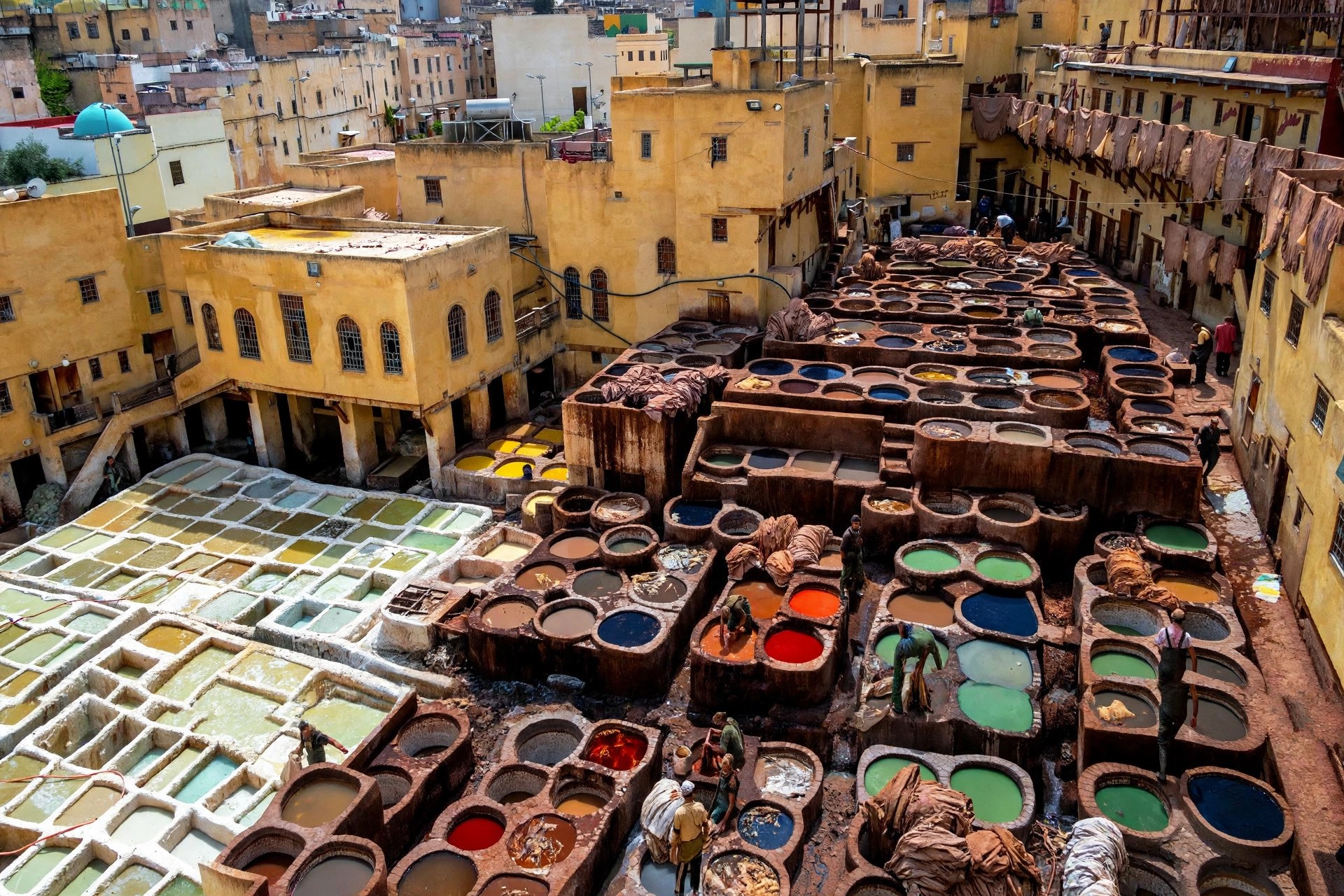
Stand on a terrace above the Chouara tannery in Fez and the whole of Moroccan craft opens up below you: round stone vats of saffron yellow, poppy red and indigo blue, workers waist-deep in dye, and hides drying on the rooftops like laundry. It is one of the oldest working industrial sites on earth. The history of Moroccan leather stretches back roughly a thousand years, from the tanning pits of medieval Fez to the souk stalls of today.
This guide follows that long road, from the disputed beginnings of the craft to the Amazigh artisans of the south and the souks where the leather is sold, flagging the dates historians still argue about, because the history of Moroccan leather has its share of open questions, and honest history says so.
In this guide
- Where the History of Moroccan Leather Began
- Chouara Tannery: A Thousand Years in the Dye Pits
- Tanning in the History of Moroccan Leather: Lime, Pigeon Droppings and Mimosa Bark
- Colour from Nature: The Dye Palette in the History of Moroccan Leather
- Beyond Fez: Marrakech, Safi and the Other Tanneries
- Amazigh Leather Craft: Bags, Babouches and the Southern Tradition
- From the Souk to the World: Trade and the Name "Morocco Leather"
- The History of Moroccan Leather Today: Survival and Change
- Where to See and Buy Moroccan Leather
- Frequently Asked Questions
- Conclusion
Where the History of Moroccan Leather Began
The history of Moroccan leather begins not with a single inventor but with a city that needed it. Fez was founded in stages between 789 and 808 under the Idrisid dynasty, and leather was part of its economy almost from the start. A medieval city needed leather for everything: shoes and saddles, water skins, book bindings, belts and bags. The river supplied the water for soaking hides, and the livestock markets supplied the raw material.
By the 11th century, Fez had grown into a major Almoravid capital, and the trans-Saharan caravan trade was carrying gold, salt and slaves north to the Mediterranean. Leather travelled with those caravans, both as a trade good and as the material of the saddles and water bags that made the trade possible. The history of Moroccan leather is best read as a craft history and a trade history at the same time, because the two were never separate. For the broader story of the country behind the craft, see our guide to the history of Morocco.
| Period | What happened | Why it matters |
|---|---|---|
| 789–808 | Fez founded under the Idrisids | Leatherwork is part of the new city's economy from the start |
| 11th century (date disputed) | Chouara tannery established in Fez el Bali | The famous dye pits begin operating; no founding document survives |
| 12th–13th centuries | Almohad and Marinid expansion; caravan trade grows | Leather becomes a major export and court luxury |
| 14th century | Historian Ali Ibn Abi Zar records 86 tanneries in the Fez medina | The scale of the industry is documented for the first time |
| 16th–17th centuries | Saadian court demand; Safi serves as the port for Marrakech | Leather goods flow to Europe through Atlantic ports |
| 19th century | "Morocco leather" becomes a prized bookbinding material in Europe | The craft's name enters English and French as a quality mark |
| 1981 | Medina of Fez inscribed as a UNESCO World Heritage Site | The tannery's setting gains world protection |
| 2024 | Academic project documents the Marrakech tanneries | The craft is studied as living heritage, not just a tourist sight |
Chouara Tannery: A Thousand Years in the Dye Pits
Chouara is the largest and most famous of the tanneries of Fez, and the one most visitors mean when they say "the Fez tannery". It sits in the north-eastern corner of Fes el Bali, near the Saffarin Madrasa. The site covers roughly 2,000 square metres of stone vats, described by the Wikipedia overview of the Chouara Tannery as one of the oldest continuously operating tanneries in the world.
How old, exactly, is the question everyone asks, and the answer is less tidy than the guidebooks suggest. Most written sources place the tannery's origins in the 11th century, under the Almoravids, roughly a thousand years ago, though local tradition traces it to the founding of Fez in the 9th century. No single document fixes the founding date, and the history of Moroccan leather is honest about that gap: treat the 11th century as the most commonly cited estimate, not a proven fact.
What the record confirms is scale: by the 14th century, the historian Ali Ibn Abi Zar counted 86 tanneries inside the Fez medina — proof that leather was one of the city's great industries, not a cottage sideline. Chouara survived where the others shrank or vanished — Sidi Moussa in the south and Ain Azliten in the north still work on a smaller scale — and the history of Moroccan leather is inseparable from that survival: the same pits, the same river water, and methods a medieval tanner would still recognise. The medina around the pits was inscribed on the UNESCO World Heritage List in 1981, as recorded in the Wikipedia entry on the Medina of Fez.
Tanning in the History of Moroccan Leather: Lime, Pigeon Droppings and Mimosa Bark
The process at the centre of the history of Moroccan leather is vegetable tanning: turning a perishable animal hide into stable, supple leather using tannins from plants, without chromium or synthetic chemicals. The hides are goat, sheep, cow and occasionally camel, and a batch takes several weeks. The work is done by hand, in the open air, and it has changed remarkably little.
First comes soaking and de-hairing. Fresh hides are plunged into white vats of quicklime, water and salt, mixed with fermented pigeon droppings. The ammonia attacks the hair and softens the skin, and the hides sit for around three days in summer and up to six in winter, turned by workers standing waist-deep in the solution. This step produces the famous smell, and the reason every terrace shop hands visitors a sprig of fresh mint.
Next the hides are scraped, rinsed, and soaked again in a round vat called the qasriya, a bath of water and more pigeon dung that thins and relaxes them. Then comes the tanning itself: the hides go into vats of powdered mimosa bark, sometimes with oak galls, pomegranate rind or sumac, where the tannins bind to the collagen fibres and stabilise them. Finally the dyed hides dry in the sun on the rooftops for about three days before going to the workshops that cut and sew them.
The slowness is the point, and the craft's economic problem: industrial chrome tanning finishes a hide in a day or two; the traditional method takes weeks. The result smells earthy rather than chemical, ages into a rich patina, and softens with use instead of cracking — and that difference is what buyers pay for.
Colour from Nature: The Dye Palette in the History of Moroccan Leather
Walk the terraces above Chouara and the dye vats look like a painter's palette poured into stone. In the history of Moroccan leather, colour was never decoration alone: each dye came from a plant, spice or mineral that the tanners knew by name, and the colours themselves became a kind of signature for the city. The best workshops still dye with natural pigments, though cheaper synthetic dyes are now common for lower-priced goods.
| Dye source | Colour | Traditionally used for |
|---|---|---|
| Poppy flower | Deep red | Bags, babouches, book covers |
| Indigo | Blue | Bags, poufs, slippers |
| Henna | Orange | Babouches, belts, decorative pieces |
| Mint | Green | Poufs, bags, slippers |
| Saffron | Yellow | The famous yellow babouche, the ziwani |
| Cedar bark | Brown | Jackets, bags, hard-wearing goods |
| Pomegranate rind | Warm brown and tan | Tanning aid as well as dye |
Beyond Fez: Marrakech, Safi and the Other Tanneries
The history of Moroccan leather is not a Fez-only story, even if Fez wrote most of it. Marrakech has tanned hides almost as long as it has existed. Founded by the Almoravids in the 11th century, the city grew a tanners' quarter in the eastern medina. The oldest and most important of the two tanning quarters is Bab Debbagh, in the north-east of the medina, with a smaller quarter at Riad Laarous to the north. A 2024 project in the journal Hespéris-Tamuda is now documenting the Bab Debbagh quarter as heritage worth recording before it fades.
Marrakech's tanneries work on a smaller scale than Chouara: around thirteen small family workshops were still operating in the Bab Debbagh area in recent years, using the same process — lime, pigeon droppings, mimosa bark — and selling finished skins directly to the artisans around the Ben Youssef Mosque. Visit in the morning for a tour, usually for a tip of 20 to 50 dirhams.
Safi's role is different: no historic tannery complex is documented there, and the city is better known for its pottery — but it was for centuries the main Atlantic port for Marrakech, and the German word Saffian is said to take its name from it. See our guide to the history of Moroccan pottery. Meknes, 60 kilometres from Fez, has its own tanning houses, and Tetouan has long supplied leather to the Rif and the Spanish coast.
Amazigh Leather Craft: Bags, Babouches and the Southern Tradition
The Amazigh thread in the history of Moroccan leather runs through the south, where leather was never just a city trade. In the Atlas mountains and the Anti-Atlas, in Tafraout and Tiznit and the oases of the Draa, families tanned their own hides and made what they needed: water skins, saddles, knife sheaths, shoulder bags and the thick-soled slippers built for mountain paths. The work was rougher than the fine goatskin of Fez, decorated with chased motifs, silk embroidery and symbols such as the dagger and the tazarzit.
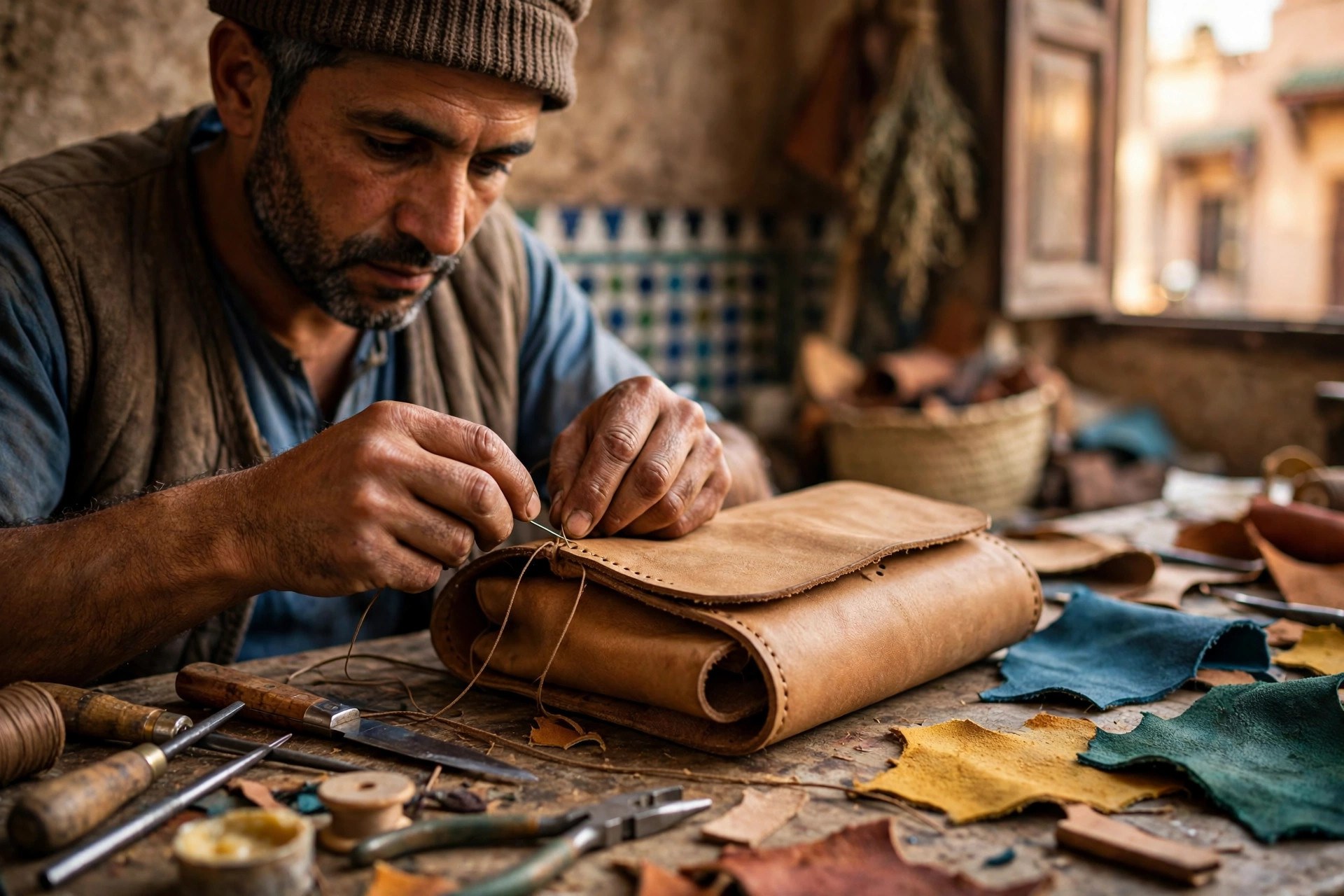
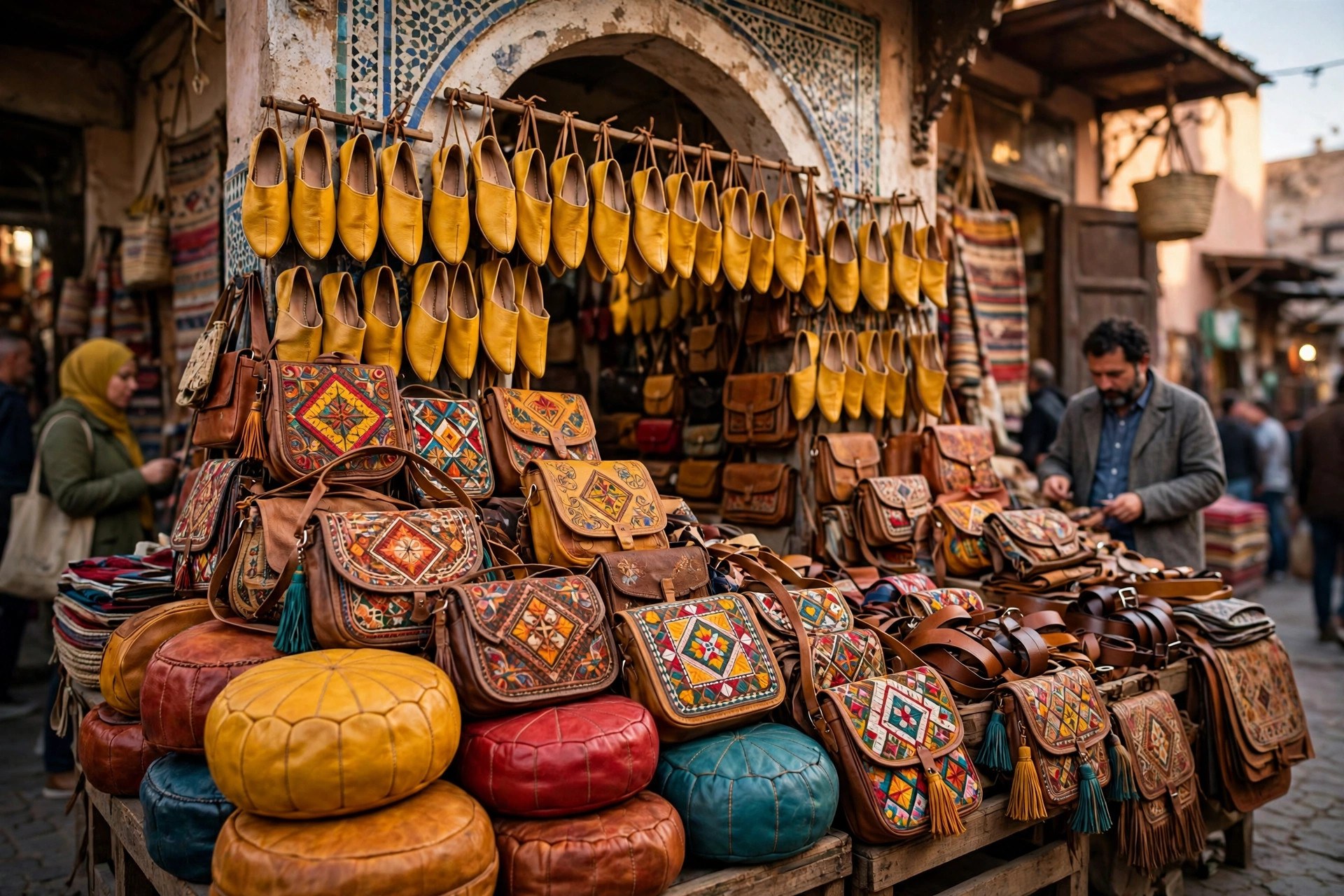
The objects tell the story best. The zaaboula is a shoulder bag worn by men in rural Morocco, carried on the left side with a dagger on the right, made from leather and decorated with tribal embroidery in cactus silk. It carried money, prayer beads, a razor and a Quran. The cherbil is a women's shoe embroidered with gold or silk thread, and the stormia, the round leather pouf, began as a practical seat for low rooms.
Tiznit, the silver town of the Souss, is also a leather town. Its craftsmen work goat leather from the tanneries of Taroudant, Marrakech and Fez, and their women's babouches are more richly decorated than the men's, with chased motifs and sometimes fine beads or velvet. The babouche there is as old as the town itself, say the craftsmen, and it is worn at festivals and weddings with the djellaba. The same southern tradition runs through the carpets of the Atlas, as our guide to the history of Moroccan carpets explores.
From the Souk to the World: Trade and the Name "Morocco Leather"
By the 19th century, the history of Moroccan leather became a global brand, quite literally. In English, "morocco leather" came to mean a soft, vegetable-tanned goatskin, prized above all for bookbinding, and in French the same material was called maroquin. The word maroquinerie, the French term for fine leather goods, is derived directly from Morocco.
There is a twist to the story that honest history should record. Despite the name, much of the finest "morocco leather" used in European bookbinding was not tanned in Morocco at all: the best goatskins often came from the Hausa city-states of northern Nigeria and from Anatolia, finished in the Moroccan manner. The name described a method, not a place of origin.
Caravans brought hides and dyes from the Atlas and the Sahara, and ships carried finished goods from Safi, Essaouira and Tangier to Europe. The history of Moroccan leather entered a new phase in the 20th century, when tourism replaced the caravan as the main market, and the souks of Fez and Marrakech became retail theatres for visitors.
The History of Moroccan Leather Today: Survival and Change
The history of Moroccan leather is still being written, and the current chapter is not a comfortable one. The tanners of Fez work in conditions that would shock a modern factory inspector: open vats, bare feet and no protective equipment. Younger workers are leaving for steadier jobs, and cheaper chrome-tanned leather undercuts the traditional product on price.
Yet the craft has advantages industry cannot copy: vegetable-tanned leather ages into a patina chrome leather never achieves, and a bag cut from a hide tanned in Chouara carries a thousand years of history. The workshops that survive sell that story honestly.
Modern export figures are hard to pin down from public sources, and we do not quote a number we cannot verify — but leather remains one of the most important craft exports of the Fez medina. Like zellige, it must stay useful, beautiful and honestly made to survive, as our guide to the history of Moroccan zellige describes. So far, it is passing.
Where to See and Buy Moroccan Leather
The history of Moroccan leather is something you can walk through, and the best way to understand it is to stand above the vats and then buy something from the hands that made it. Start in Fez at the Chouara terraces, reached through the leather shops on Rue Chouara, and go in the morning when the tanners are working. Our Fez travel guide will help you plan the route.
In Marrakech, head for Bab Debbagh in the morning, then look for stalls where the maker sits at the bench. A good shop can tell you where the leather was tanned, what it is made from, and how it was dyed. If it cannot, keep walking. For the wider trip, the Morocco travel guide covers the routes that link the tanning cities.
| Item | Typical price (November 2026) | What to check |
|---|---|---|
| Babouches (plain, goatskin) | 150–400 MAD (about $15–$40) | Soft leather, neat stitching, no chemical smell |
| Leather pouf (unstuffed) | 250–600 MAD (about $25–$60) | Even dye, strong seams, real leather lining |
| Shoulder bag (handmade) | 300–900 MAD (about $30–$90) | Vegetable-tanned smell, hand stitching, solid fittings |
| Leather jacket | 800–2,000 MAD (about $80–$200) | Supple hide, lined interior, finished edges |
| Tannery terrace visit (tip) | 20–50 MAD (about $2–$5) | Agree the tip before the tour, not after |
| Half-day guided craft tour | 200–400 MAD (about $20–$40) | Licensed guide, includes workshops, not just shops |
Prices are typical ranges as of November 2026, gathered from souk stalls and local guides; always check on arrival, and expect to haggle.
Frequently Asked Questions
How old is the history of Moroccan leather?
Most sources trace the tanneries of Fez to the 11th century, though local tradition claims it began with the founding of Fez in the 9th century. No founding document survives, so the exact date is disputed — but the history of Moroccan leather has run continuously in the same place, using essentially the same methods, for centuries.
Why do the Fez tanneries smell so bad?
Quicklime and fermented pigeon droppings, rich in ammonia, loosen hair and soften the hides, and the open-air vats make the smell part of the place. Terrace shops hand out sprigs of fresh mint to hold under your nose, and the smell fades quickly once you leave the quarter.
What is vegetable tanning, and why does it matter?
Vegetable tanning uses tannins from plants, such as mimosa bark, oak galls and pomegranate rind, to turn a hide into leather. It takes weeks rather than the day or two of industrial chrome tanning, but the result smells earthy, ages into a patina and softens with use.
How can I tell real Moroccan leather from fake?
Real vegetable-tanned leather smells earthy; chrome-tanned or synthetic leather smells sharp and chemical. Then look at the edges and stitching: handmade pieces vary slightly in tone and thickness, and the dye has depth rather than a flat printed surface. In the history of Moroccan leather, the test has always been the maker's hand, so buy where you can see the workshop.
Can I visit the Chouara tannery, and does it cost anything?
Yes. The terraces are reached through the leather shops on Rue Chouara, with no official entry fee, though the shop expects a tip of 20 to 50 dirhams. Go in the morning when the tanners are working, bring mint for the smell, and be firm but polite with anyone who tries to charge more.
How should I care for Moroccan leather at home?
Keep it dry and out of direct sun, and condition it occasionally with a neutral leather balm or a little argan oil. If it gets wet, let it dry naturally, away from heat. Vegetable-tanned leather darkens and softens with age: the patina is the point, not a flaw.
Conclusion
From the lime pits of 11th-century Fez to the souk stalls of Marrakech and the Amazigh workshops of the south, the history of Moroccan leather is the story of a craft that refused to become a museum piece. It survived because it was useful and beautiful, and because generation after generation chose to teach it rather than let it go.
Stand above the dye pits at nine in the morning and you understand why. The history of Moroccan leather is not finished; it is still being tanned, dyed, cut and stitched, one hide at a time, by hands that learned the work from hands before them.