
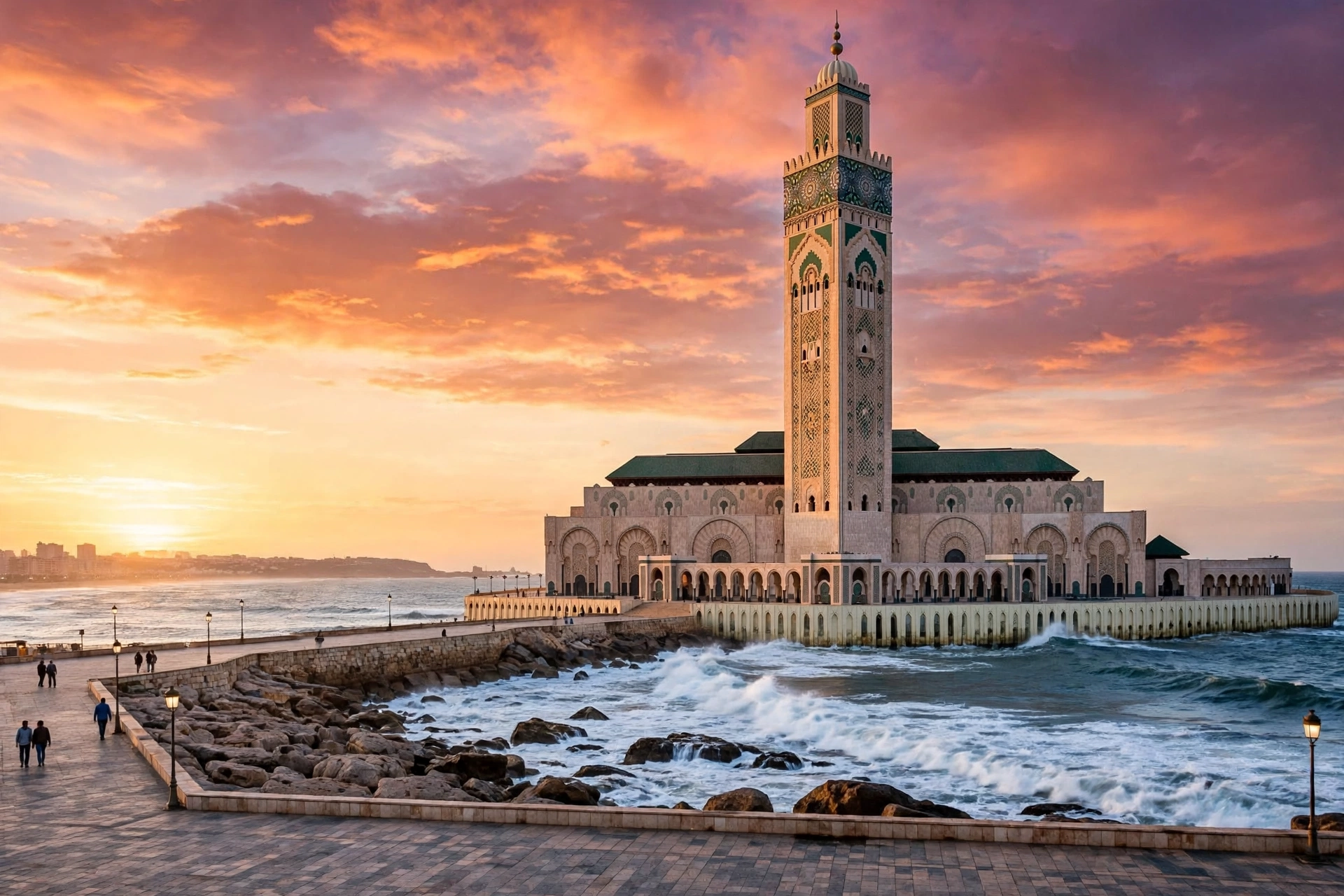
Living in Casablanca is Morocco at full speed: a port city of nearly four million people where the country's banks, factories and shipping lines do their business. If Marrakech is Morocco's postcard and Fes its memory, living in Casablanca is Morocco's working present — noisy, ambitious, and the only Moroccan city where a foreigner can build a real career.
Living in Casablanca rewards people who come to work more than people who come to wander. It has no medina to rival Fes, no blue streets like Chefchaouen and no desert at its door. What it has instead is the deepest job market in Morocco, the best international schools and the most reliable infrastructure in the country. It sits in our Living in Morocco section, alongside our wider Living in Morocco: The Complete Guide for Expats.
In this guide
- Why Expats Choose Living in Casablanca
- Casablanca at a Glance
- Best Neighbourhoods for Living in Casablanca
- Rents and Housing: What You Pay in 2026
- Monthly Cost of Living in Casablanca
- Weather: Mild Winters, Humid Summers and the Atlantic Wind
- Working in Casablanca: Jobs, Business and Remote Work
- Daily Life: Food, Cafés and Getting Around
- Healthcare and Schools
- The Downsides: Who Should Not Move Here
- Practical Steps to Move to Casablanca
- Frequently Asked Questions
- Conclusion: Is Living in Casablanca Right for You?
Why Expats Choose Living in Casablanca
Casablanca is Morocco's economic capital in the most literal sense: it generates roughly a third of the country's GDP, hosts the stock exchange and the port, and the headquarters of nearly every major bank and multinational operating in Morocco. Living in Casablanca puts you where the decisions are made, which is why the foreign community here is the largest and most professional in the country — bankers, engineers, teachers, diplomats, aid workers and entrepreneurs, many of them on corporate packages.
The city is also the most international place in Morocco. French is the working language of business, English is widely spoken in corporate circles, and the expat infrastructure is deep: international schools, private hospitals, coworking spaces and a social scene that does not depend on the tourist season. For a family relocating with children, living in Casablanca is the practical choice.
The trade is honest: living in Casablanca gives you opportunity, services and a genuinely cosmopolitan life, and asks you to accept traffic, noise, grey winter skies and the highest rents in Morocco. Many expats arrive planning to stay two years and leave after ten. That tension is the whole story of the city.
Casablanca at a Glance
| Fact | Detail |
|---|---|
| Population | ~3.7 million in the city, ~4.3 million in the metro area — Morocco's largest city |
| Location | Atlantic coast, 80 km south of Rabat, 240 km north of Marrakech |
| Climate | Mild oceanic: winters 8–18°C, summers 20–27°C, humid with sea fog |
| Airport | Mohammed V International (CMN), 30 km south; train to Casa Voyageurs ~50 MAD |
| Rail | Al Boraq high-speed to Tangier in 2h17; Al Atlas to Marrakech in ~3h |
| Tram | Four tram lines (T1–T4) plus two busway lines; single ticket 8 MAD, 6 MAD with a rechargeable card |
| Language | French dominates business and daily life; Darija everywhere; English in corporate circles |
| Best for | Careers, business, families needing international schools, remote workers who want infrastructure |
| Watch out for | Rush-hour traffic, the highest rents in Morocco, winter damp and sea fog |
Best Neighbourhoods for Living in Casablanca
Choosing where to live is the single most important decision when living in Casablanca, because the city is vast and its districts feel like different towns. Almost every foreign resident lives in one of five or six central and coastal districts — choose wrong and you spend an hour in traffic every morning.
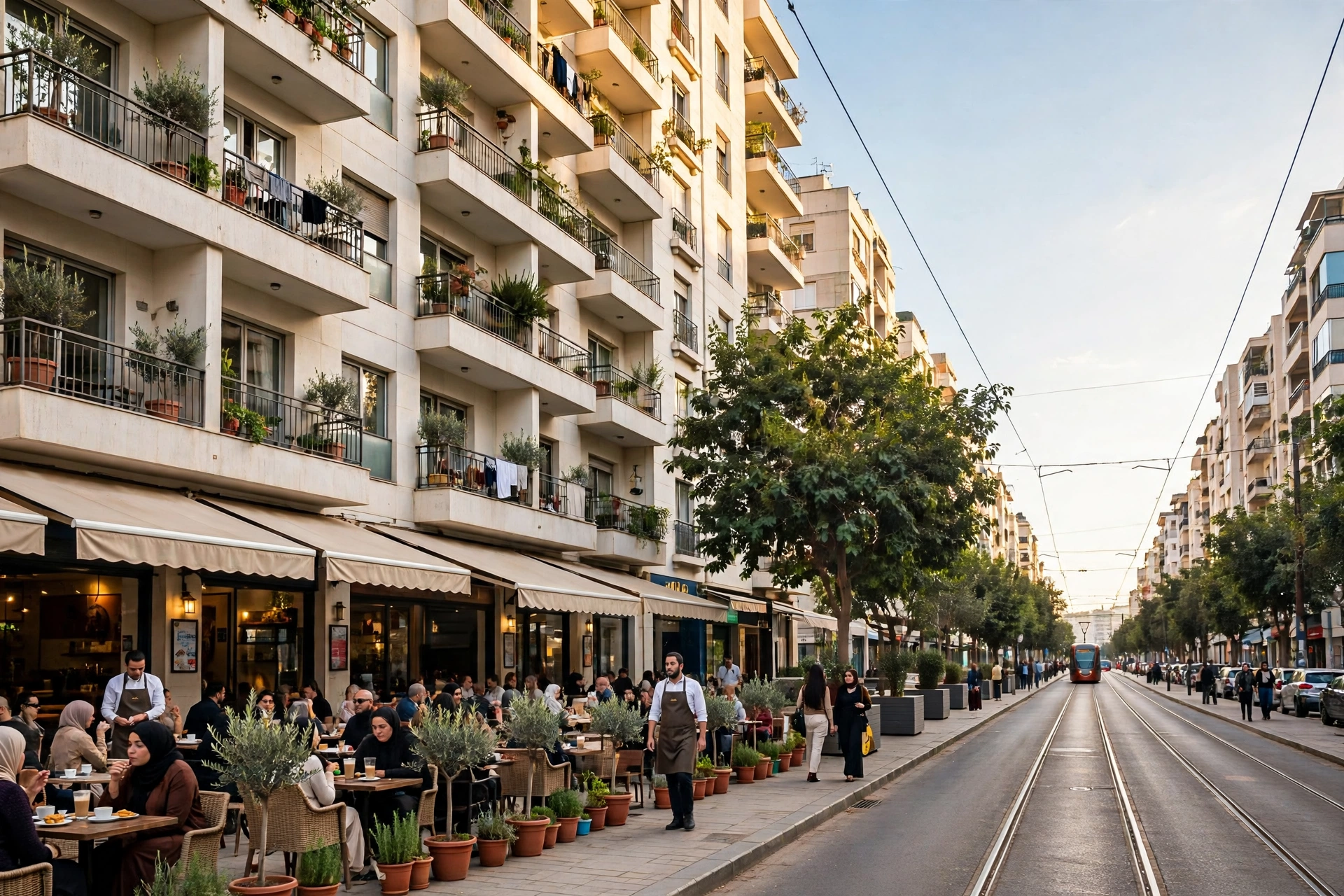
Maarif is the first choice for most newcomers, and the most popular neighbourhood for living in Casablanca. It is dense and walkable, full of cafés, restaurants, gyms and shops, with the city's best coworking spaces and the tram running through it. One-bedrooms here typically rent from around 4,000–5,000 MAD a month unfurnished, with furnished ones asking 5,500–8,000 MAD. The trade-off is noise and scarce parking.
Gauthier and Racine, together with Anfa, form the so-called golden triangle — the elegant, tree-lined heart of the city, with art-deco buildings and quiet streets. A furnished one-bedroom in Gauthier asks around 5,000–7,500 MAD a month, and good modern apartments in the triangle often rent for 11,000–16,000 MAD. Senior corporate expats and diplomats tend to settle here.
Anfa and Ain Diab are the seafront end of the city: villas, gated residences, the Corniche's restaurants and beach clubs, and the highest rent per square metre in Casablanca, around 100–140 MAD. A furnished one-bedroom in Ain Diab asks 6,000–9,000 MAD, and a sea-view flat with a pool can reach 13,000 MAD. It is quieter and greener than Maarif but less walkable.
Bourgogne, Palmier and CIL offer a middle path: residential streets between Maarif and Anfa, gated blocks, good schools nearby and rents a step below the golden triangle. A furnished one-bedroom in Palmier asks around 7,500 MAD. Further out, Sidi Maarouf and the Casablanca Finance City district suit professionals in the finance hub, while the old centre and the Habous quarter attract expats who want character and much lower rents. Our Best Neighbourhoods to Live in Casablanca guide compares each district in detail.
Rents and Housing: What You Pay in 2026
Casablanca has the most expensive rental market in Morocco: a comfortable one-bedroom here costs roughly what a two-bedroom costs in Fes. Good flats move fast, and the best ones rarely reach the listing sites — they move through neighbourhood brokers known as semsars. Start your search at least a month ahead, and budget for a deposit of one to two months' rent plus the first month upfront.
| Home type | Typical monthly rent (2026) | Where |
|---|---|---|
| Studio, unfurnished | 3,500–9,500 MAD ($350–$950) | Cheapest in Ain Sebaa and Roches Noires; priciest in Palmier and Gauthier |
| Studio, average | ~5,200 MAD ($520) | Citywide average |
| One-bedroom, unfurnished | 5,000–11,000 MAD ($500–$1,100) | Maarif and Gauthier at the lower end; Anfa and CFC at the top |
| One-bedroom, average | ~6,800 MAD ($680) | Citywide average |
| Two-bedroom, unfurnished | 6,500–15,500 MAD ($650–$1,550) | Sidi Maarouf and Bourgogne cheaper; CFC, Racine and Ain Diab priciest |
| Two-bedroom, average | ~9,200 MAD ($920) | Citywide average |
| Furnished premium, 2–3 bedrooms | 11,000–16,000 MAD ($1,100–$1,600) | Anfa, Racine, Casablanca Finance City |
| Building charges (copropriété) | 500–1,500 MAD ($50–$150) | Managed modern buildings, on top of rent |
Three things catch newcomers out. First, furnished flats command a 15–25% premium, and "furnished" usually means a bed, a table and a fridge. Second, an unfurnished flat often has no kitchen appliances at all, so budget 10,000–20,000 MAD to equip a kitchen from scratch. Third, rents rose about 5% in 2026 and should keep rising 4–6% a year, fastest in Casablanca Finance City, Sidi Maarouf, Gauthier and tram-connected Maarif. For the full process, read our Renting an Apartment in Morocco guide.
Monthly Cost of Living in Casablanca
Living in Casablanca costs more than anywhere else in Morocco, but it is still far below a Western European city. A comfortable single person should budget around 10,500–14,000 MAD a month (about $1,050–$1,400), and a couple around 16,000–22,000 MAD. Rent decides everything — it takes 40–55% of a typical expat budget — so the neighbourhood you choose matters more than any other decision.
| Expense | Single person (monthly) | Notes |
|---|---|---|
| Rent, furnished 1-bed in Maarif/Gauthier | 5,500–8,000 MAD ($550–$800) | 4,000–5,000 MAD unfurnished in cheaper districts |
| Building charges | 500–1,500 MAD ($50–$150) | Only in managed modern buildings |
| Groceries and markets | 1,800–2,500 MAD ($180–$250) | Souks and Marjane/Carrefour; imported goods cost more |
| Eating out and cafés | 1,200–2,000 MAD ($120–$200) | Lunch 60–120 MAD; a good dinner 150–300 MAD |
| Transport (tram + taxis) | 400–800 MAD ($40–$80) | Tram pass ~230 MAD; petit taxis 10–30 MAD a ride |
| Internet and mobile | 300–500 MAD ($30–$50) | Fibre 200–400 MAD; mobile 100–200 MAD |
| Gym | 300–600 MAD ($30–$60) | Basic gyms from 300 MAD; premium clubs 500+ |
| Private health insurance | 800–1,500 MAD ($80–$150) | International cover costs more; see the healthcare section |
| Utilities (electricity, water) | 400–700 MAD ($40–$70) | Higher in summer with air conditioning |
| Total, comfortable single | ~10,500–14,000 MAD ($1,050–$1,400) | Before travel and international school fees |
A family budget changes the picture sharply: an international school place costs roughly 60,000–120,000 MAD a year per child, a car adds 2,000–3,500 MAD a month, and a three-bedroom home in a good district runs 12,000–20,000 MAD.
Weather: Mild Winters, Humid Summers and the Atlantic Wind
The weather is the gentlest in Morocco and also the greyest. The Atlantic keeps temperatures mild all year: winter days run 15–18°C and summer days 23–27°C, and the city almost never sees the 40°C heat that bakes Marrakech. Rain falls mainly from November to March, and sea fog softens the skyline on winter mornings.
The catch is humidity and damp. Winter flats feel cold even when the thermometer says 16°C, because most buildings have no central heating and the damp seeps through the walls. Expats learn to buy a dehumidifier and a good heater in their first winter. Summer brings a different problem: the humidity makes 26°C feel sticky, and the ocean wind is constant enough that locals say you always need a light jacket. Compared with the rest of Morocco, though, the climate is the easiest part of living in Casablanca — no extremes.
Working in Casablanca: Jobs, Business and Remote Work
Casablanca is the only Moroccan city where a foreigner can realistically find a salaried job. The finance district hosts banks, insurers and offshore service centres; the port and the industrial zones employ engineers and logistics managers; and the international schools and universities hire teachers year-round. Salaries for expat professionals typically run 15,000–40,000 MAD a month.
Remote workers have a different calculation. Living in Casablanca as a remote worker means trading the postcard for infrastructure: the deepest fibre coverage in Morocco, coworking spaces on every boulevard in Maarif and Anfa, and an airport with direct flights to Europe in two to four hours. Hot desks run 900–1,500 MAD a month at independent spaces, while Regus and Spaces charge 2,190–2,390 MAD. The catch is that Casablanca has almost no nomad community — the remote workers here are mostly Moroccans and long-term residents — and rents in their districts have crept up towards Lisbon levels.
Two practical notes matter for anyone living in Casablanca and working here. First, Morocco has no dedicated digital nomad visa: most remote workers enter visa-free for 90 days and renew by leaving and re-entering, or apply for a carte de séjour. Second, French is the language of the office — even in international companies, meetings run in French — so a working knowledge of the language is worth more than any other skill. Our Digital Nomad Guide to Morocco and our Morocco Coworking Spaces guide cover both paths in detail.
Daily Life: Food, Cafés and Getting Around
Daily life when living in Casablanca runs on cafés. The city has the best café culture in Morocco — hundreds of terraces where business meetings and long afternoons all happen over a 10–15 MAD coffee — and the most varied food scene, from 15 MAD bowls of harira at a market stall to French restaurants in Gauthier where dinner runs 300–500 MAD a person. The seafood along the Corniche is the city's signature: grilled sardines, calamari and sea bass at restaurants where the fish was landed that morning.
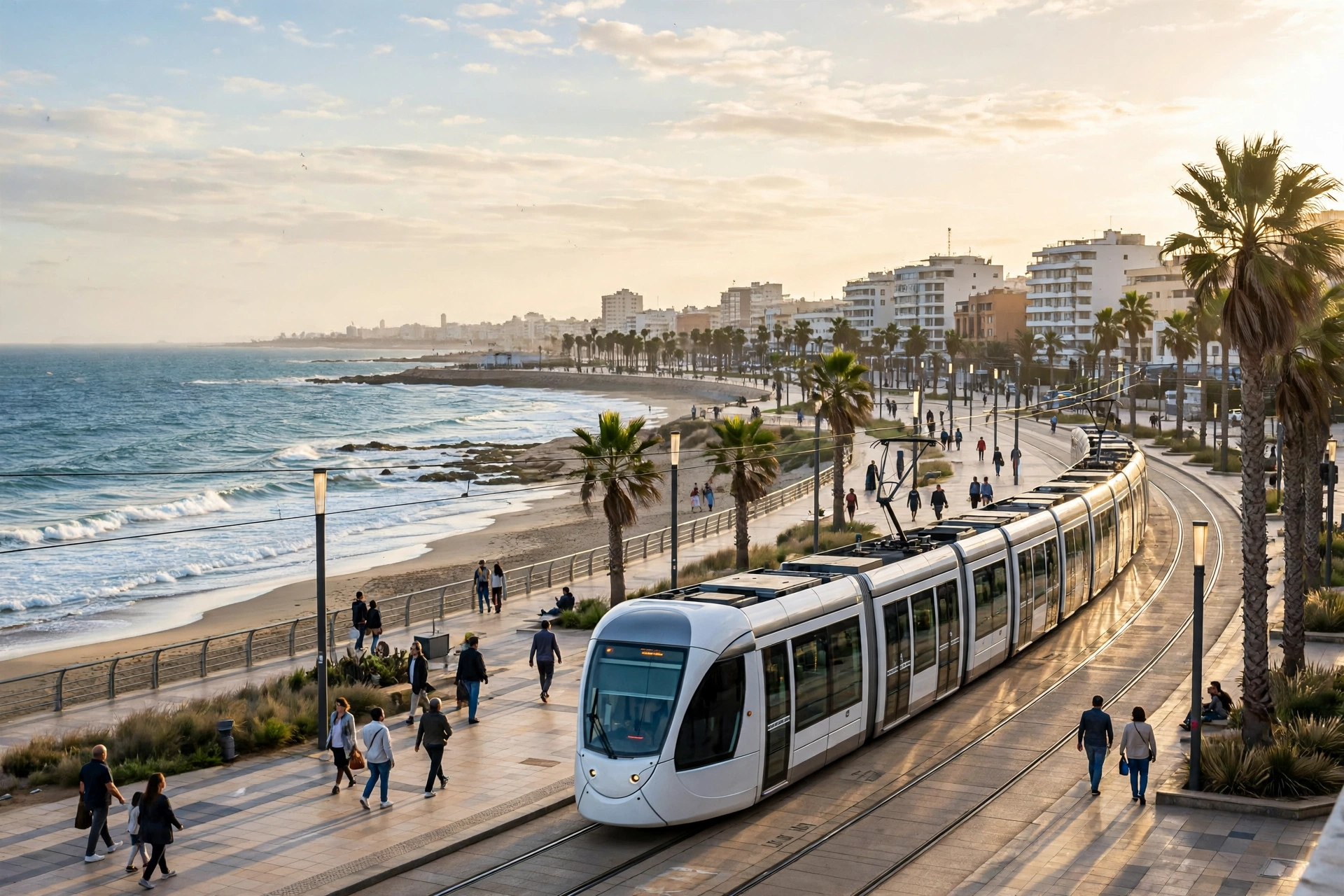
Getting around is the daily test of living in Casablanca. The tram is clean and reliable, with four lines covering the centre, Casa Voyageurs station and Ain Diab; a single ticket costs 8 MAD, or 6 MAD a ride on a rechargeable card. Petit taxis are everywhere — 10–30 MAD for most central rides — but insist on the meter, because unmetered rides are the city's oldest scam. Uber works reliably here, and the airport train costs 50 MAD in second class and 70 MAD in first.
Weekends belong to the Corniche. On Friday evenings and Saturdays the seafront fills with families, joggers and football games on the sand. The Hassan II Mosque — the third-largest mosque in the world, completed in 1993, with a 210-metre minaret — anchors the waterfront, and non-Muslims can visit its interior on guided tours for 140 MAD.
Healthcare and Schools
Healthcare is one of the strongest reasons to choose living in Casablanca over any other Moroccan city. The private clinics and hospitals here are the best in the country, with English-speaking doctors and emergency care that meets European standards. A consultation runs 300–600 MAD, and private health insurance for a single expat costs roughly 800–1,500 MAD a month. Public hospitals are crowded and French- or Arabic-only, so almost every expat uses private care. Our Healthcare in Morocco for Expats guide compares the options.
Schools are the other reason families choose Casablanca. The city hosts the widest range of international schools in Morocco: the French lycées, the American School of Casablanca and the British International School. Fees run roughly 60,000–120,000 MAD a year per child, and waiting lists at the most popular schools can stretch to a year, so apply before you move.
The Downsides: Who Should Not Move Here
Living in Casablanca is not for everyone, and honesty demands saying so plainly. The traffic is the worst in Morocco: a cross-town drive that takes twenty minutes on a Sunday takes an hour on a weekday morning, and the noise never really stops. The air is the dirtiest in the country, and the winter skies are grey for weeks.
The social texture is different too. Casablanca is a working city, not a pretty one, and newcomers who arrive expecting the Morocco of the travel posters — blue streets, desert sunsets, artisan medinas — are often disappointed in the first month. The city rewards people who come with a purpose, and it can feel lonely for those who come only to look around. If you want beauty and a slow life, choose Essaouira or Chefchaouen; if you want a career, Casablanca is the only choice. Living in Casablanca is a trade, and the city is honest about what it asks in return.
Practical Steps to Move to Casablanca
Moving here is a sequence, not a single decision, and the order matters. First, visit for at least a week and stay in the neighbourhood you think you want — Maarif for most people — so you learn the commute and the noise before you commit. Second, sort the visa question: most nationalities enter visa-free for 90 days, and a longer stay means a carte de séjour application at the Préfecture, so bring double the copies requested. Our Moving to Morocco: Visas and Residency guide walks through the process.
Third, open a bank account — possible as a foreigner with a passport and proof of address, though some banks ask for a residence card first — and set up the practical side: a local SIM from an official Maroc Telecom, Orange or Inwi shop, fibre internet checked at the exact address before signing a lease, and health insurance in place before you arrive.
Fourth, find housing through a semsar in your chosen neighbourhood and inspect the flat in person — never pay a deposit for a flat you have not seen. Finally, learn some French and a little Darija before living in Casablanca: even a few dozen words change how the city treats you, and our Learning Moroccan Arabic guide is the place to start.
Frequently Asked Questions
Is Casablanca a good city for expats?
Yes, for the right expat. Living in Casablanca suits careers, business, international schools and private healthcare, and the city has the largest foreign community in the country. It is the wrong choice if you want a slow, pretty or cheap life — Rabat is calmer, Essaouira is slower and Fes is cheaper.
How much does it cost to live in Casablanca?
A comfortable single person living in Casablanca needs around 10,500–14,000 MAD a month (about $1,050–$1,400), and a couple needs 16,000–22,000 MAD. Rent is the biggest line — 5,500–8,000 MAD for a furnished one-bedroom in Maarif or Gauthier — followed by food and transport. A family with a child in international school should budget 29,000–52,000 MAD a month.
What is the best neighbourhood for expats in Casablanca?
Maarif is the best first choice: walkable, central, full of cafés and coworking spaces, with the tram running through it. Gauthier and Racine suit senior professionals who want quiet streets, while Anfa and Ain Diab suit families who want the seafront.
Is Casablanca safe for foreigners?
Yes. Violent crime against foreigners living in Casablanca is rare, and the main risks are the same small scams found across Morocco — unmetered taxis and overcharging in the medina. The real daily hazard is traffic: cross roads carefully and expect scooters on pavements.
Can I work remotely from Casablanca?
Yes, and the infrastructure is the best in Morocco: fibre internet, coworking spaces from 900 MAD a month and an airport with direct flights across Europe. There is no dedicated digital nomad visa, so most remote workers enter visa-free for 90 days and renew by leaving and re-entering. French is the language of the office when living in Casablanca, so learn it before you arrive.
How do I get around Casablanca without a car?
Easily. The tram covers the centre, Casa Voyageurs and Ain Diab for 8 MAD a ride (6 MAD with a rechargeable card), petit taxis cost 10–30 MAD for most central trips, and Uber works reliably. The Al Boraq high-speed train reaches Tangier in 2h17 — see our Tangier to Marrakech by Train guide — and the airport train costs 50 MAD.
Conclusion: Is Living in Casablanca Right for You?
Living in Casablanca is the most practical expat choice in Morocco and the least romantic one, and that is exactly the point. It is the city for people who come to build something — a career, a business, a family life with good schools and hospitals — rather than people who come to look at Morocco. Rents are the highest in the country, traffic is the worst and skies are the greyest, but no other Moroccan city offers the same depth of work and services.
If that trade sounds right, come for a week, stay in Maarif, ride the tram and drink coffee on a terrace at dusk. Casablanca does not seduce you on arrival; it earns you slowly. For the expats who stay, living in Casablanca becomes not a compromise but a choice: the economic capital, with all its noise, is where Morocco actually happens.
Last checked: November 2026. Prices are ranges from 2026 listings and guides; confirm them before signing a lease.