
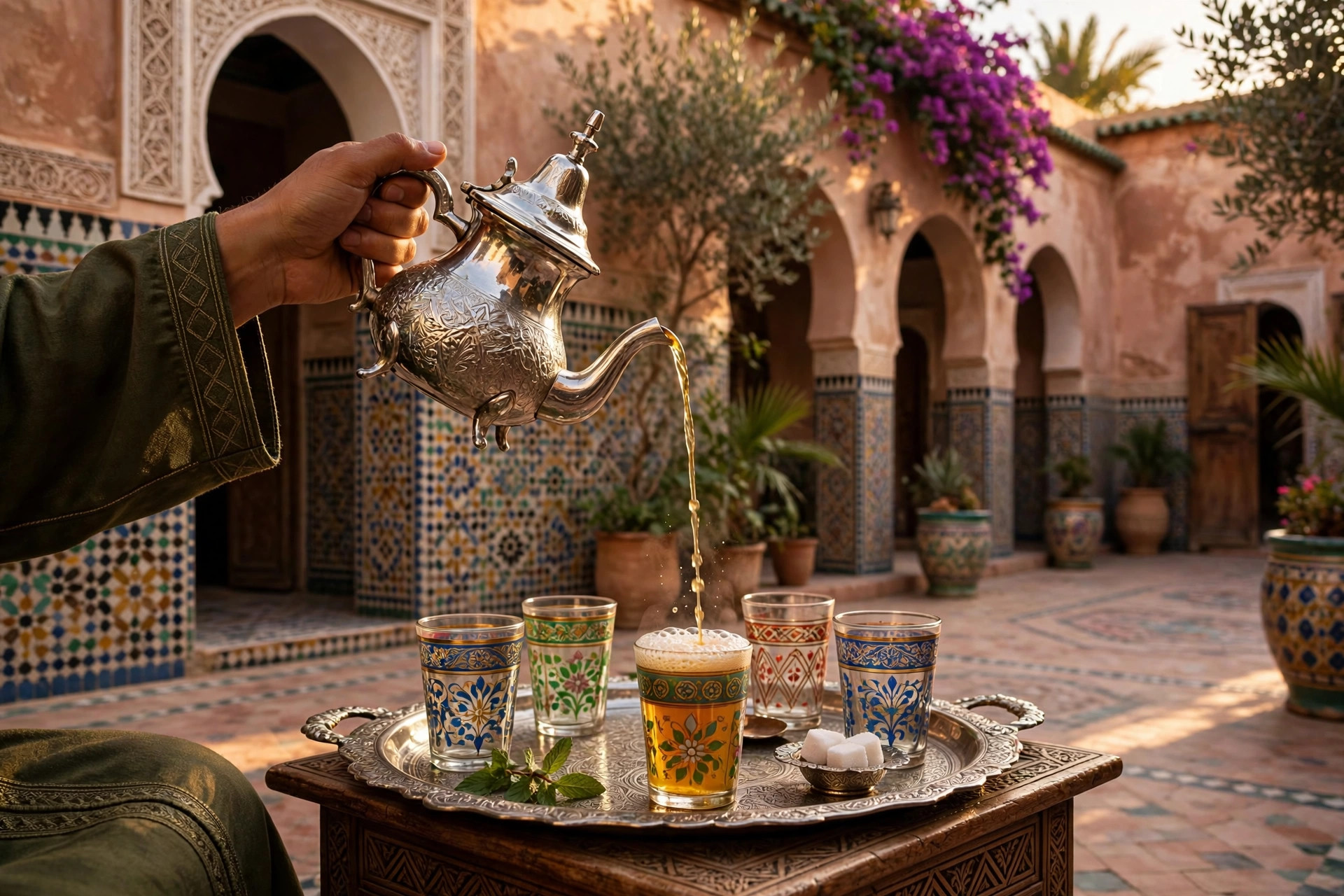
Sit down in any Moroccan home, shop or desert camp, and before any real conversation begins, someone will put a small glass of steaming tea in your hand. The history of Moroccan mint tea is the story of how a foreign leaf became the national drink, and how a simple brew grew into a ritual of welcome that still shapes daily life. It is sweet, strong and fragrant with spearmint, poured from a height and crowned with foam. Yet it has only been part of Morocco for about three centuries, short beside the thousand-year stories of Fes and Marrakech.
This guide tells the history of Moroccan mint tea honestly, including the dates historians still argue about: when tea reached Morocco, how it travelled from palace to every home, and how to drink it like a guest who understands. It sits in our History & Heritage section, beside our history of Morocco, and our Moroccan food guide covers the food that goes with the tea.
In this guide
- What Is Moroccan Mint Tea?
- The History of Moroccan Mint Tea: From Palace to Every Home
- The Disputed Arrival Date: What We Know and What We Don’t
- Timeline: How the History of Moroccan Mint Tea Unfolded
- Gunpowder Green Tea: Why This Leaf?
- Mint, Sugar and Water: The Three Partners
- The Ritual Step by Step: The History of Moroccan Mint Tea in a Teapot
- The High Pour and the Foam
- Three Glasses: Life, Love and Death
- Tea and Hospitality: The Rules of Welcome
- Regional Variations: North, South and Sahara
- The Craft: Teapots, Trays and Glasses
- Tea Houses, Cafés and the Price of a Glass
- The History of Moroccan Mint Tea Today
- Frequently Asked Questions
- Conclusion: A Glass That Never Empties
What Is Moroccan Mint Tea?
Moroccan mint tea, called atay in Darija, is Chinese gunpowder green tea brewed with fresh spearmint and sugar, then poured from a height into small decorated glasses. The leaves are rolled into tight pellets that unfurl in boiling water, giving a strong, slightly smoky brew. A generous bunch of spearmint, known as na'na', goes into the pot, and sugar is added in a quantity that surprises most first-time visitors — the first surprise the history of Moroccan mint tea holds for newcomers.
The history of Moroccan mint tea begins with a foreign product, yet the drink itself is unmistakably Moroccan. Moroccans did not invent tea, and they did not invent mint, but they invented the combination and the ceremony around it. The high pour, the foam, the three glasses and the rules of serving all grew up in Morocco, and today atay is served at weddings and funerals, in meetings and family kitchens alike.
The History of Moroccan Mint Tea: From Palace to Every Home
For its first century and a half in Morocco, tea was a luxury for the few. The history of Moroccan mint tea starts at court, where the drink arrived as a rare and expensive curiosity, heavily taxed and reserved for the sultan and his circle. Ordinary Moroccans drank water, milk and herbal infusions, while tea remained a palace pleasure, served in silver as a mark of power.
That changed in the second half of the nineteenth century, when trade reforms cut the duty on tea and the price collapsed. Imports through Tangier and Essaouira multiplied, and tea moved from the palace into merchants' homes, then ordinary households, villages and the Sahara. The history of Moroccan mint tea is a story of democratisation: a court drink became a people's drink within two generations, and by the early twentieth century it was in most Moroccan homes.
The Disputed Arrival Date: What We Know and What We Don’t
Here is the honest part: the exact date tea arrived in Morocco is not settled, and you should be suspicious of any guide that gives you a single confident year. The most widely cited account says tea reached the court of Sultan Moulay Ismail around 1700, possibly as a gift from Queen Anne of England, sent while she negotiated over English captives. Moroccan historians Abdelahad Sebti and Abderrahmane Lakhssassi place the first palace tea in the early 1700s, first used as a medicine.
A second, popular story says British merchants diverted shiploads of Chinese green tea to Morocco during the Crimean War in the 1850s, after Baltic ports were blockaded. But the historian Graham Cornwell, author of Sweetening the Pot: A History of Tea and Sugar in Morocco, 1850–1960, found no evidence for it. The records show a collapse in price after the Anglo-Moroccan trade treaty of 1856 cut duties to 10 percent. The history of Moroccan mint tea was changed less by a war than by a tax cut, and by the famines of the 1880s, when tea became a cheap source of calories for rural families moving to the cities.
Timeline: How the History of Moroccan Mint Tea Unfolded
The table below sets out the dates most sources agree on for the history of Moroccan mint tea, and marks clearly where they disagree. Treat the early dates as the best available account, not as settled fact, and read the full range in the Wikipedia account of Maghrebi mint tea.
| Date | What happened |
|---|---|
| Around 1700 | Tea reaches the court of Sultan Moulay Ismail, possibly as a gift from Queen Anne; used first as a medicine |
| Late 1700s | Tea spreads from the palace to wealthy notables; Ahmed bin al-Mubarak becomes the first mul atay, master of tea, under Sultan Suleiman (r. 1792–1822) |
| 1840s | British traveller James Richardson records a Moroccan tea ceremony and notes tea drunk widely, all day long |
| 1856 | Anglo-Moroccan trade treaty cuts duties to 10 percent; tea imports begin to multiply |
| 1857–1900 | Tea landing at Essaouira multiplies about twenty-five times while its value rises only eightfold: the price collapses |
| 1873–1894 | Sultan Moulay Hassan I sends tea, sugar and silver tea sets to tribal leaders to secure their loyalty |
| 1880s | Famines drive rural families into cities; tea spreads as a cheap source of calories and a way of belonging |
| 1904 | Sufi leader Muhammad al-Kattani tells followers to stop drinking tea, protesting French sugar and European imports |
| Early 1900s | Mint tea is established in most Moroccan homes |
Gunpowder Green Tea: Why This Leaf?
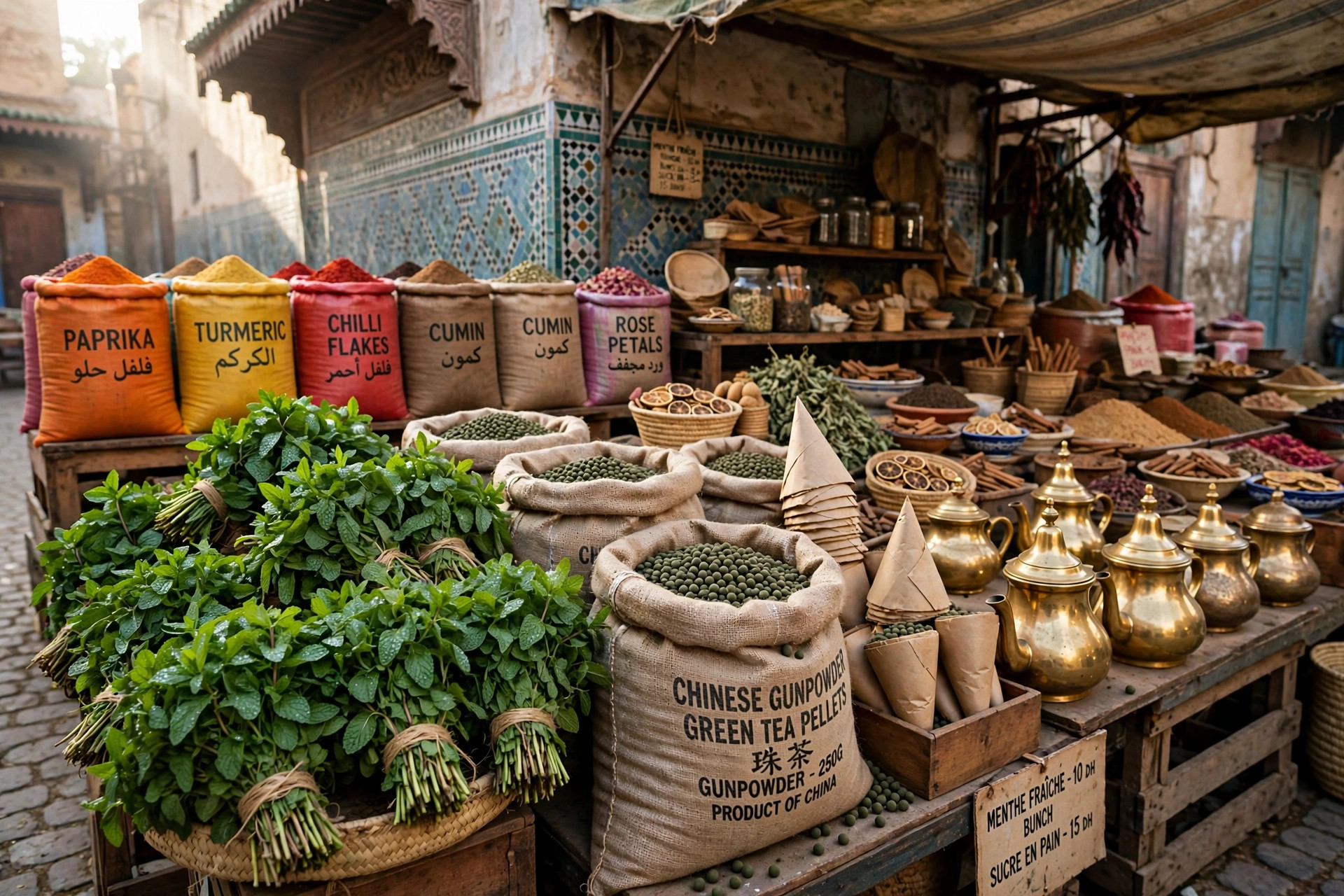
The base of atay is gunpowder green tea, a Chinese green tea whose leaves are rolled into small pellets that look like grains of black powder. In Morocco it is called barud, the Arabic word for gunpowder, so the name survived the journey intact. Most of it comes from Zhejiang province on China's east coast, and the history of Moroccan mint tea is tied to this leaf because it travels: rolled leaves survive long sea voyages and desert journeys, and the strong, bitter brew holds its edge under handfuls of mint and spoonfuls of sugar.
Mint, Sugar and Water: The Three Partners
The mint is spearmint, na'na' in Darija, a curly-leaved variety with a clear, pungent aroma. It is not peppermint, and the difference matters: spearmint is cooling and gentle, while peppermint is sharp and medicinal. Fresh mint grows abundantly in Morocco, in Atlas foothills and river valleys, and the region around Meknes is famous for it — a green heart at the centre of the history of Moroccan mint tea.
Sugar is the third partner, and the traditional amount startles visitors: roughly four or five teaspoons per small pot, sometimes as a sugar cone. The history of Moroccan mint tea cannot be told without sugar, because sugar was the expensive imported luxury that made tea a drink of prestige before it became a drink of everyone. Boiling water is the fourth ingredient, and it should be boiling, since the leaves need heat to unfurl and the mint needs heat to give up its scent.
The Ritual Step by Step: The History of Moroccan Mint Tea in a Teapot
Making atay is a performance, and the host performs it in front of the guests, unhurried. First the pot, the berrad, is warmed with a little hot water, which is then poured away. A spoonful or two of gunpowder tea goes in, boiling water is swirled over the leaves and discarded, and this rinse removes dust and the first harsh bitterness. Fresh boiling water follows, the mint is packed in, and sugar is added before the pot returns to the flame for a short simmer.
Then comes the mixing, and here beginners go wrong: the host does not stir with a spoon. Instead a glassful is poured out of the pot and back in, three times, which blends the sugar, wakes the mint and aerates the tea. The history of Moroccan mint tea lives in this small gesture, repeated millions of times a day across the country. A glass is poured, tasted and adjusted as needed, and only when the host is satisfied does the serving begin.
The High Pour and the Foam
The most theatrical moment of the ritual is the pour itself. The host lifts the teapot high above the glass, sometimes thirty to fifty centimetres, and lets the tea fall in a thin golden ribbon. The height does three things at once: it aerates the tea, it cools it to a drinkable temperature, and it shows the host's skill and confidence — a flourish the history of Moroccan mint tea has kept for generations.
Three Glasses: Life, Love and Death
Guests are always offered three glasses, never one, and the history of Moroccan mint tea is bound up in this rule. The proverb says the first glass is gentle as life, the second is strong as love, and the third is bitter as death. Each glass comes from the same pot, and the flavour shifts as it steeps: first strong and slightly bitter, then gentler, then lighter and sweeter. The three rounds give the conversation time to warm up, and tell the guest that nobody is in a hurry.
Tea and Hospitality: The Rules of Welcome
In Morocco, tea is not merely a drink. It is the first and most important gesture of welcome, offered to guests, strangers, shop customers and negotiators before any business is discussed. Refusing a glass is a serious social misstep, while offering it says you are welcome here and time is not short. The history of Moroccan mint tea is therefore also a history of Moroccan manners, built on generosity, patience and respect.
The role of tea-maker carries prestige: traditionally the head of the household prepares the tea in front of guests. In a shop in the souk, accepting tea does not oblige you to buy anything — it is a genuine gesture, and you can leave gracefully after the glass. The nickname "Moroccan whisky" captures the social weight of the drink in a country where traditional households do not serve alcohol: atay is the toast, the handshake and the welcome mat in one glass.
Regional Variations: North, South and Sahara
Moroccan tea is not one recipe. It changes as you move around the country, and knowing the differences turns a glass of tea into a way of reading where you are. The history of Moroccan mint tea is a single story told in many local accents, from the breezy cafés of Tangier to the desert camps of the deep south.
| Region | How the tea differs |
|---|---|
| Tangier and the north | Lighter and more fragrant; served on café terraces overlooking the Strait; Café Hafa, open since 1921, is the famous terrace for it |
| Fes and the centre | Classic and balanced; mint from the Meknes region; served with pastries in old medina houses |
| Marrakech and the south | Sweeter and stronger; often perfumed with orange blossom water or herbs |
| Sahara and the desert | Strongest and most bitter; brewed over a camp brazier; the ceremony is longest and most formal |
| Winter, everywhere | Some families add wormwood (chiba), sage or verbena for a bitter, warming version |
The Craft: Teapots, Trays and Glasses
Buying a set is a pleasure for visitors, and the souks of Fes are among the best places to look, with brass and silver teapots in every size. A small plain teapot can cost 100 to 200 dirhams (about $10 to $20), while a large engraved silver-plated set with tray and glasses can run to 500 to 1,500 dirhams (about $50 to $150). The history of Moroccan mint tea is written in these objects too: the teapot, the tray and the glass are the tools of a ritual barely changed in a century.
Tea Houses, Cafés and the Price of a Glass
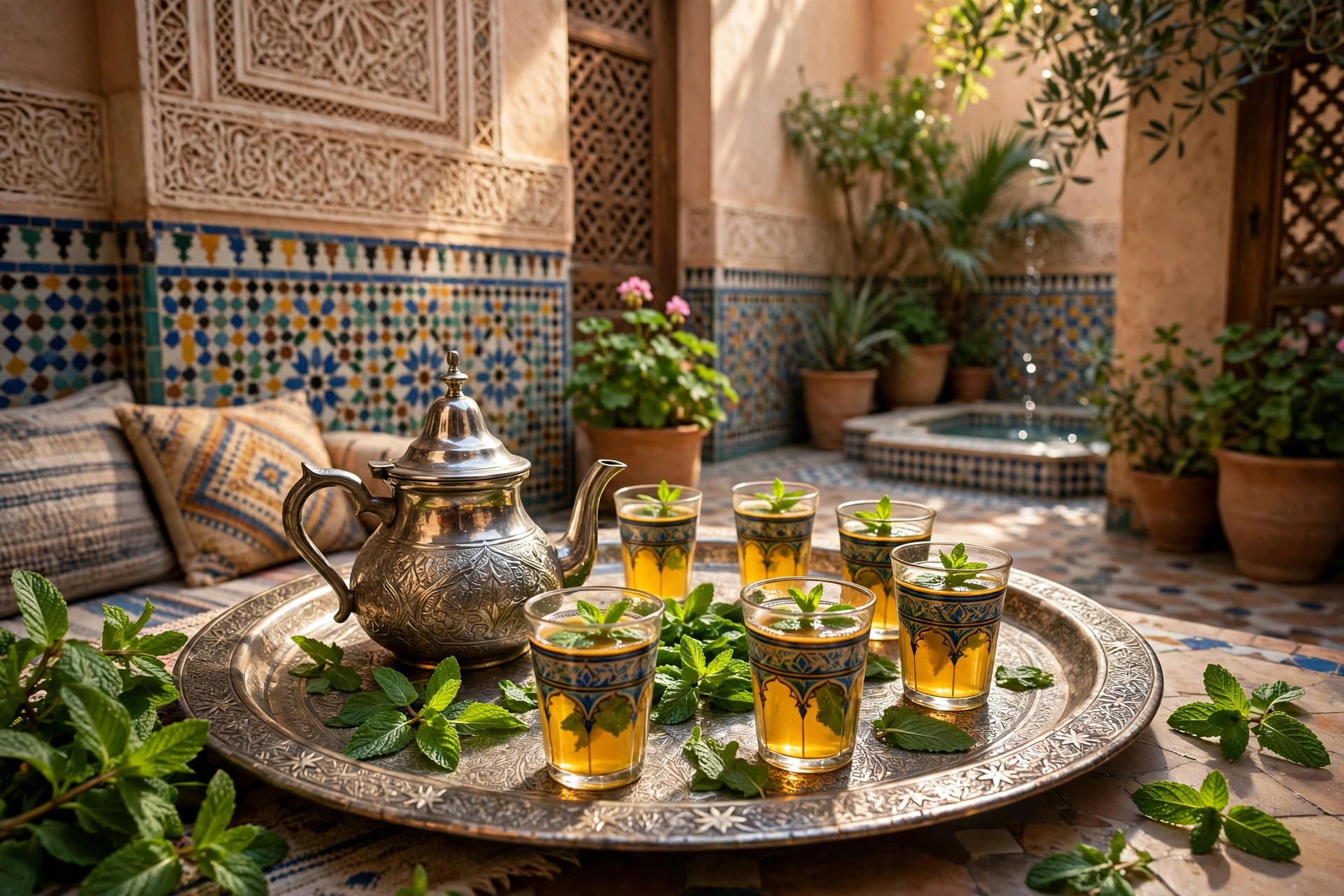
Tea is everywhere in Morocco, and a glass is never far away. In a neighbourhood café, a glass of mint tea costs about 5 to 10 dirhams (about $0.50 to $1), while in a tourist riad or café in Marrakech it can be 12 to 15 dirhams (about $1.20 to $1.50). A bunch of fresh mint in the market costs 2 to 5 dirhams (about $0.20 to $0.50), and a 250-gram packet of gunpowder green tea costs 15 to 25 dirhams (about $1.50 to $2.50). Prices checked November 2026; one US dollar is about 10 dirhams.
The cheapest tea is often the best, because it is made by someone who has poured it ten thousand times — one more small chapter in the history of Moroccan mint tea. Look for the café where old men sit for hours over one pot, or the stall where the vendor pours for his neighbours. Our guide to tipping in Morocco covers what to leave when the tea is served at your table. For the wider story behind this ritual, the Treaty of Fes of 1912 and the Agadir earthquake of 1960 are good places to continue.
| Item | Typical price, November 2026 |
|---|---|
| Glass of mint tea, neighbourhood café | 5–10 MAD (about $0.50–$1) |
| Glass of mint tea, tourist café or riad | 12–15 MAD (about $1.20–$1.50) |
| Bunch of fresh mint, market | 2–5 MAD (about $0.20–$0.50) |
| Gunpowder green tea, 250 g packet | 15–25 MAD (about $1.50–$2.50) |
| Small plain teapot | 100–200 MAD (about $10–$20) |
| Engraved silver-plated tea set with tray | 500–1,500 MAD (about $50–$150) |
The History of Moroccan Mint Tea Today
Today atay is both a daily habit and a national symbol, and the history of Moroccan mint tea is still being written. Morocco imports vast quantities of Chinese green tea every year, and trade reporting in 2025 described the country as the largest buyer of Chinese tea. Young Moroccans drink it in modern cafés with laptops open, while their grandparents drink it the same way their own grandparents did, and the diaspora serves it in Moroccan restaurants from Paris to Montreal.
Frequently Asked Questions
When did mint tea arrive in Morocco?
Tea reached the Moroccan court around 1700, but the exact arrival date is not settled. The best-known account places it at the court of Sultan Moulay Ismail in the early 1700s, possibly as a gift from Queen Anne. It stayed a palace luxury for about a century and a half, reaching ordinary households only after the 1856 trade treaty cut duties. The history of Moroccan mint tea therefore begins with a date historians still debate, not a single certain year.
What is Moroccan mint tea made of?
Three things, plus boiling water: Chinese gunpowder green tea, fresh spearmint (na'na') and sugar. The leaves are rolled into tight pellets, the mint is added in a generous bunch, and the sugar is measured generously, roughly four or five teaspoons per small pot. Some families add orange blossom water, and in winter some add wormwood, sage or verbena.
Why is Moroccan mint tea poured from a height?
The high pour aerates the tea, cools it to a drinkable temperature and raises the prized collar of foam on each glass. It also shows the host's skill: a steady hand pouring from thirty to fifty centimetres without spilling is a point of pride. The history of Moroccan mint tea made the pour a performance, and the foam is how Moroccans judge whether a glass was made well.
Why are guests served three glasses?
Three is the traditional number, in the proverb that the first glass is gentle as life, the second strong as love, and the third bitter as death. Each glass comes from the same pot, so the flavour changes as the tea steeps. Take each glass with your right hand, holding it by the rim and the base, since the middle is scalding. Staying for three glasses honours the host and lets the conversation warm up. After the third, a warm "baraka" signals that you are satisfied.
Is Moroccan mint tea the same as Maghrebi mint tea?
They are closely related. Maghrebi mint tea is the wider North African preparation of gunpowder green tea with spearmint and sugar, shared across Morocco, Algeria, Tunisia, Libya and Mauritania. The Moroccan version, atay, is the best known, with its high pour, its three glasses and its particular ritual — the most famous chapter of the history of Moroccan mint tea.
Can I make Moroccan mint tea at home?
Yes, and you need only a small pot, gunpowder green tea, fresh spearmint and sugar. Rinse a spoonful of tea with boiling water, then pour it off, add fresh boiling water and a big bunch of mint, sweeten to taste, and simmer for three to five minutes. Pour a glassful out and back into the pot three times rather than stirring, then serve from a height. Drink it with msemen, layered flatbreads, or with amlou, almond and honey spread.
Conclusion: A Glass That Never Empties
Three centuries ago, tea was a medicine in a sultan's palace, a rare luxury that almost nobody in Morocco had tasted. Today it is the first thing a guest is offered and the last thing a host wants to run out of. The history of Moroccan mint tea is the story of that transformation, from a taxed foreign leaf to the drink that defines Moroccan hospitality.
So when a glass is put in your hand, take it with your right hand, hold it by the rim, and stay for all three. The history of Moroccan mint tea lives in that small act: a country that took something foreign, made it its own, and now offers it to every stranger as a welcome. The glass never really empties, because there is always another pot on the fire.
Last checked: November 2026. The exact arrival date of tea in Morocco is disputed, not settled; the Crimean War diversion story is reported without evidence. Prices are typical ranges, with one US dollar at about 10 dirhams.