
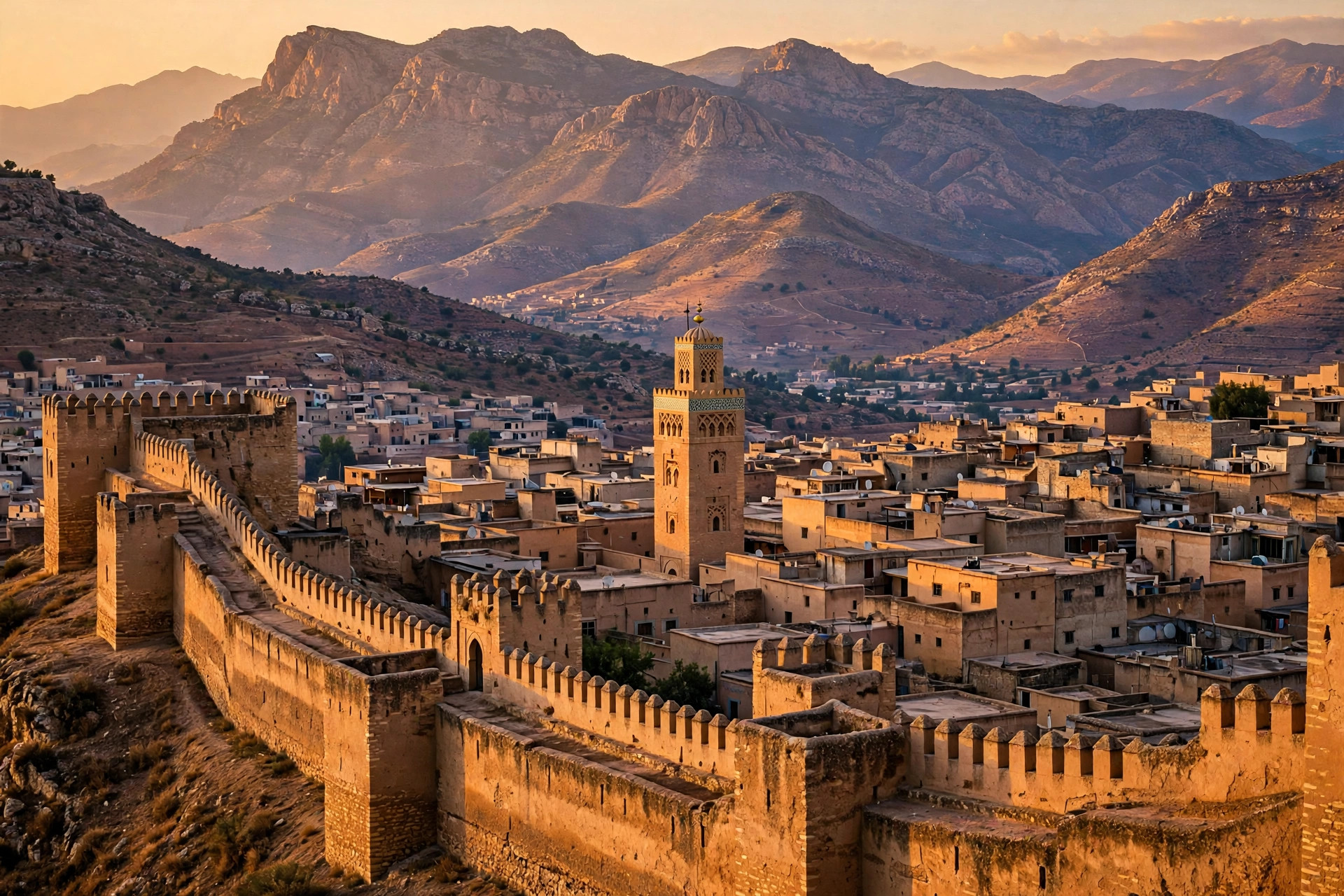
This Taza travel guide is for travellers who want a real Moroccan town without the crowds. Taza sits in the narrow pass between the Rif mountains to the north and the Middle Atlas to the south, about 120 kilometres east of Fez on the road and rail line to Oujda. It is a working market city of about 150,000 people, with a walled medina, a mosque older than anything standing in Marrakech, and two mountain ranges on the horizon.
The city is really two towns. The old medina, Taza-Haut, stands on a ridge at about 585 metres, ringed by medieval walls and gates. The new town, Taza-Bas, spreads across the plain about 140 metres below, built by the French after 1914. This Taza travel guide covers both, plus the two great day trips south into the mountains: Friouato Cave and Tazekka National Park.
All prices are in Moroccan dirhams (MAD), checked in November 2026, at roughly 10 MAD to $1 — planning ranges, not promises; confirm on arrival.
In this guide
- Taza at a Glance
- A Short History of Taza
- The Medina and Bab el-Rih
- The Great Mosque of Taza
- Friouato Cave: One of Africa's Deepest Caves
- Taza National Park and Jebel Tazekka
- The Taza Gap: Morocco's Historic Corridor
- Taza Travel Guide: A One-Day Walking Route
- Where to Eat in Taza
- Where to Stay in Taza
- Getting to Taza
- When to Visit Taza
- Practical Tips for Visiting Taza
- Frequently Asked Questions
- Conclusion
Taza at a Glance
Taza has 150,763 people (2024 census) and is the capital of Taza Province in the Fes-Meknes region. It guards the Taza Gap, the only comfortable pass between the Atlantic plains and eastern Morocco. Most travellers pass through on the train without stopping — and miss one of the quietest old towns in the country.
| Fact | Detail |
|---|---|
| Location | In the Taza Gap between the Rif and the Middle Atlas, about 120 km east of Fez, 150 km south of Al Hoceima |
| Population | 150,763 (2024 census) |
| Best for | Walled medina and 12th-century Great Mosque, Friouato Cave, cedar forests of Tazekka National Park |
| Time needed | One full day for the medina; two days with the cave and the national park |
| Getting there | Train from Fez on the Fez–Oujda line, about 2 hours; car about 1.5 hours via the N6 road |
| Budget | 200–400 MAD ($20–40) per person for a day trip without a hotel |
The plan in this Taza travel guide is simple: the medina in the morning, the walls at sunset, and the mountains on day two.
A Short History of Taza
Taza exists because of a gap in the mountains. Here the Rif and the Middle Atlas almost meet, leaving a corridor a few kilometres wide — the only easy way between eastern Morocco and the Atlantic plains. Prehistoric finds near the medina suggest people lived here tens of thousands of years ago, although the exact early chronology is not settled.
The recorded history begins with a fortified camp, Ribat Taza, founded by Musa ibn Abi'l-Afiya, leader of the Miknasa. The Almoravids took the town in 1074, the Almohads in the early 1130s, and the Marinids in 1248 — each dynasty pausing here before advancing on Fez. The Almohad caliph Abd al-Mu'min used Taza as a base and founded its Great Mosque around 1142. The walls were completed in 1172, according to the medieval source Kitab al-Istibsar, although that dating is reported rather than proven.
Taza was a capital more than once. The first Alaouite ruler, Moulay Rachid, made it his main base in 1665 before conquering the rest of Morocco. The French took the town in 1914 and laid out the new quarter below, which is why Taza today is two towns on two levels. This Taza travel guide treats that split as part of the visit: the medina above, the modern town below, and the mountains beyond.
The Medina and Bab el-Rih
The medina of Taza is small, lived-in and almost free of souvenir shops. You can cross it in twenty minutes along one ridge-top spine, past bakeries, spice shops and cafés, with the four old mosques — the Great Mosque, the Sidi Azouz mosque, the Mosque of the Market and the Andalous Mosque — marking the way.
The walls are the real pleasure of this Taza travel guide. A promenade follows the circuit of the old ramparts, most of it first raised in the 12th century under the Almohads and later reinforced by the Marinids and Saadians. Parts have crumbled, but the walk still offers views over olive groves and valleys in every direction.
Bab el-Rih: the Gate of the Wind
At the northern end of the walls stands Bab el-Rih, the Gate of the Wind, the medina's main entry and its best viewpoint. On a clear day you can see the Rif on one side and the Middle Atlas on the other. The gate takes its name from the wind that funnels through the gap, and it is at its best in the late afternoon, when the light turns the stone gold.
Bab Jemaa and the Saadian Borj
Bab Jemaa is the gate on the southern side, where the wall drops away towards the new town. Nearby, the Saadian sultan Ahmad al-Mansur added a fortified tower in the 16th century, a massive structure some 26 metres wide at its base. On the western stretch, look for the Tour Es-Sarragine, square at the base and round at the top. This Taza travel guide rates the wall walk as the single best free thing in the city.
The Great Mosque of Taza
The Great Mosque of Taza, the Jamaa el-Kbir, stands near Bab el-Rih at the heart of the medina. Founded by the Almohad caliph Abd al-Mu'min in the period after 1142, it is the oldest surviving example of Almohad architecture in Morocco — older than the famous Almohad monuments of Marrakech. The Marinids enlarged it in 1292–1293, and the Alaouite sultan Moulay Rachid renovated it in the 17th century.
The mosque is best known for its enormous bronze chandelier, given by the Marinid sultan Abu Yaqub Yusuf in 1294. About 2.5 metres across and some three tonnes, it once held more than five hundred oil lamps — the largest of its kind left in North Africa.
As with all mosques in Morocco, entry is restricted to Muslims, so non-Muslim visitors admire the mosque from outside. The minaret, the carved doorway and the square in front of it are still the calm centre of the old town. This Taza travel guide suggests visiting in the morning, when the square is busy with the market and the light is kind to the stone.
Friouato Cave: One of Africa's Deepest Caves
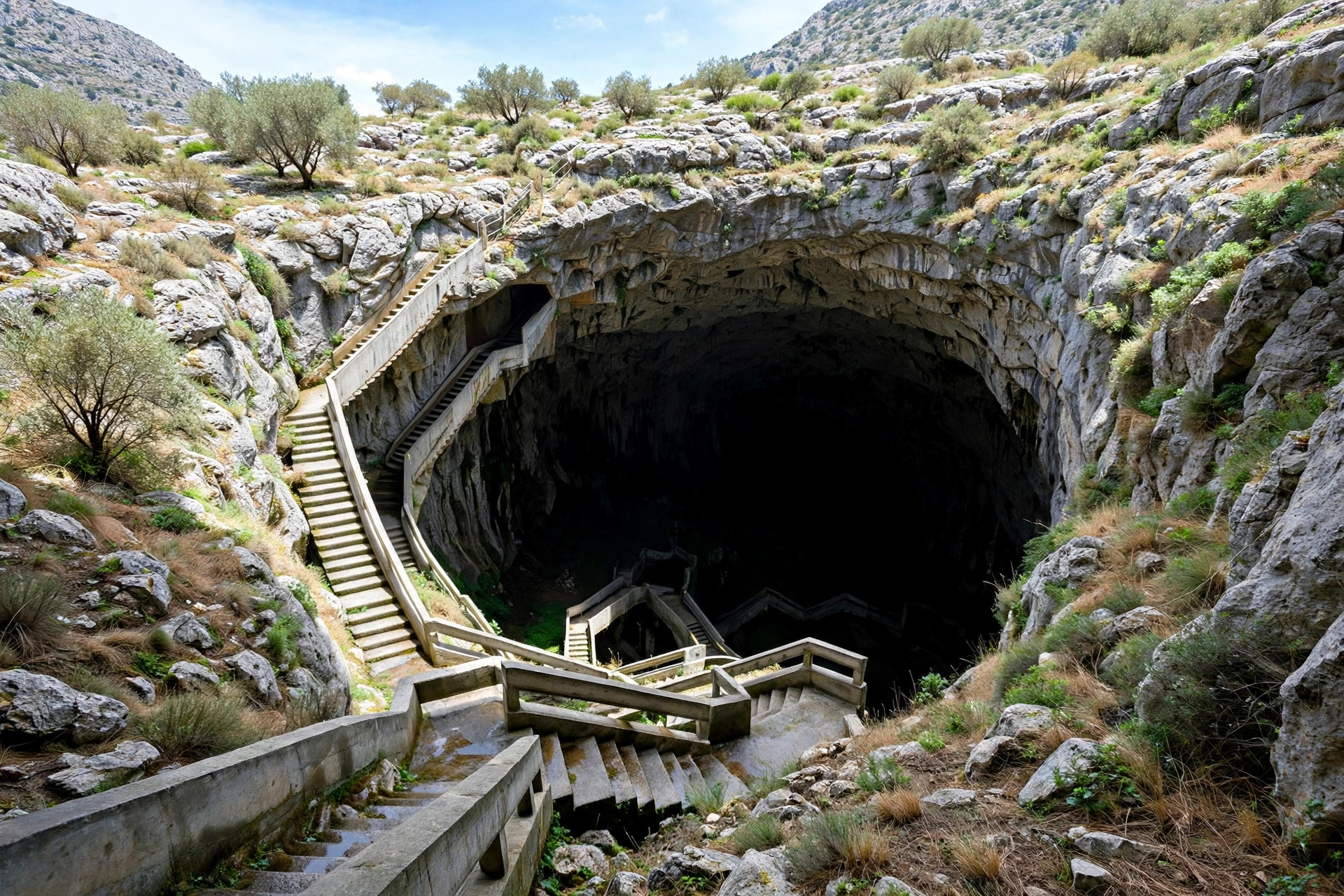
About 30 kilometres south of Taza, inside Tazekka National Park near the village of Bab Boudir, lies the Gouffre de Friouato — one of the deepest known cave systems in Africa. Its explored passages run 2,178 metres and drop about 271 metres, through chambers lined with stalactites and stalagmites. Its most spectacular chambers, the Salle de Lixus and the Salle de Draperies, are named for their curtain-like formations.
The cave has had a troubled recent history. In April 2016 a rockfall inside killed a schoolteacher on a class trip, and the site was closed the same week. It stayed shut for a decade. That changed on 27 July 2026, when Friouato reopened after a rehabilitation project of more than 12 million dirhams: the entrance restored, weak sections reinforced, new lighting installed and guided visits introduced.
Be realistic about the visit. The entrance is a huge open shaft, and reaching the cave floor means descending around 500 steep steps and climbing all of them back up — allow at least three hours there and back from Taza. The temperature inside is about 13°C, so bring a warm layer, sturdy shoes and water. This Taza travel guide recommends asking your guide about conditions on the day before starting down, and confirming the current entry fee on arrival.
Taza National Park and Jebel Tazekka
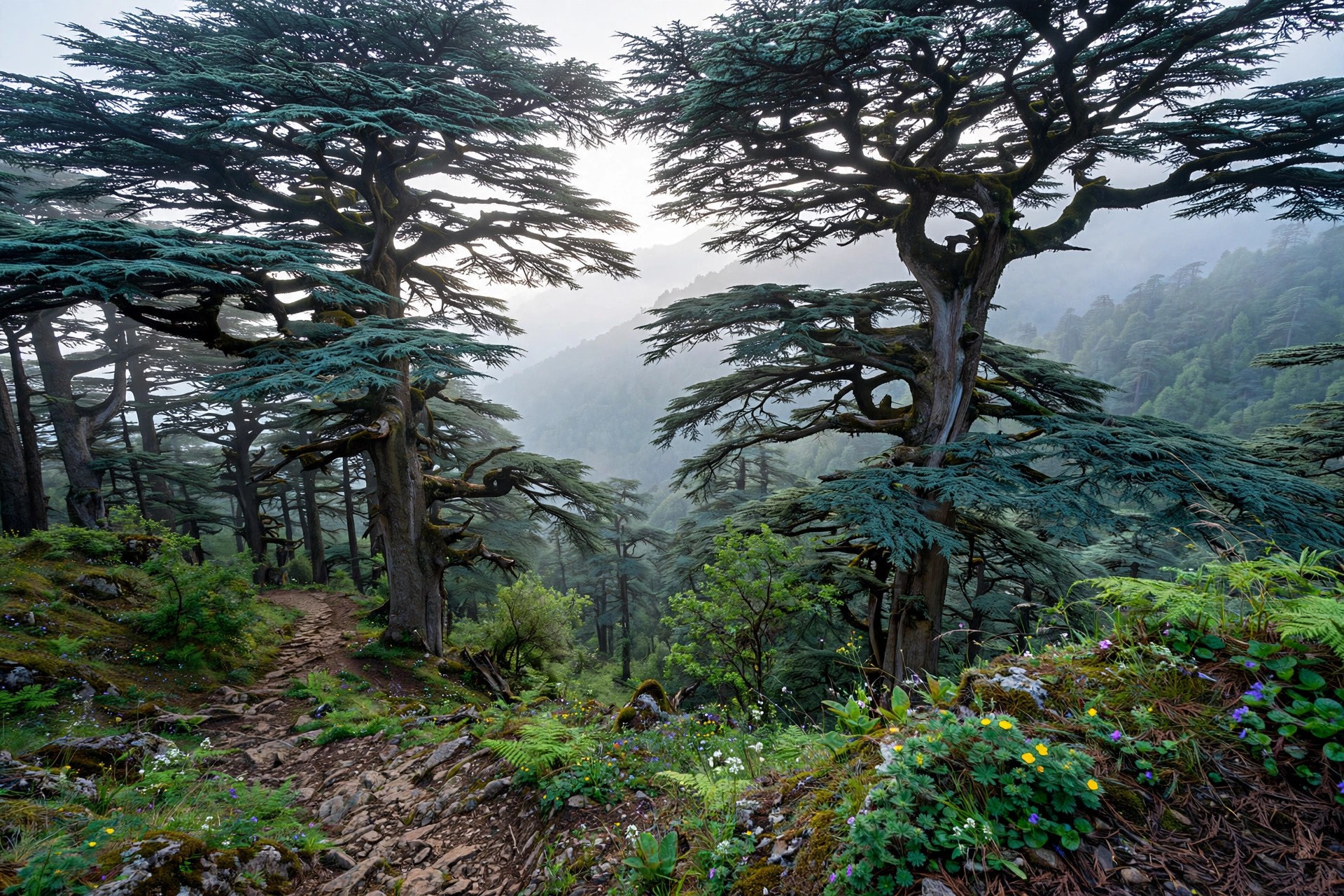
Tazekka National Park lies about 20 kilometres southwest of Taza, in the northern Middle Atlas, and it is the green surprise of this Taza travel guide. The park was created in 1950 as a small reserve of under 7 square kilometres to protect the cedar grove on Jebel Tazekka, then extended in 1989 and 2004 to about 13,700 hectares of forest, canyons, cascades and caves. Its high point, Jebel Tazekka, rises to 1,980 metres.
The forest is the park's heart. Atlas cedars, some several centuries old, crown the summit ridge, while cork oak and holm oak cover the lower slopes. Wild boar, foxes, birds of prey and Barbary macaques live here, and the limestone gorges hide waterfalls and a seasonal lake.
The summit of Jebel Tazekka is a straightforward but strenuous hike, rewarded with a panorama that takes in three mountain ranges on a clear day. A grand taxi from Taza costs roughly 150–250 MAD ($15–25) return — agree the price before you set off. Bring water, a hat and a layer: as this Taza travel guide warns, the park sits high enough to catch clouds and rain that never reach the plains, and the weather can change fast.
The Taza Gap: Morocco's Historic Corridor
The Taza Gap is not a single sight but the reason Taza exists, and this Taza travel guide would be incomplete without it. The gap is the low pass where the Rif and the Middle Atlas come together, the natural corridor through which armies, traders and migrants have moved between east and west for centuries. Armies and traders moved westward through it for centuries, and every dynasty fortified Taza to control it.
You can read the gap in the landscape from the medina walls: the Rif rising to the north, the Middle Atlas to the south, and the narrow plain running east towards Oujda and the Algerian frontier. The modern N6 road and the Fez–Oujda railway follow the same corridor today.
Taza is a frontier market town, where the food, the accents and the crafts mix the Rif and the Middle Atlas. Our Fez travel guide covers the imperial city at the western end of the corridor, and our Tetouan travel guide explores the Rif side of the story.
Taza Travel Guide: A One-Day Walking Route
The medina is small and the new town spread out below, so a plan helps. This route takes a full day at a slow pace, and this Taza travel guide follows it in order.
- Start at Bab el-Rih (9:00): enter the medina through the Gate of the Wind, walk the walls for the views over the valley, and look for the Tour Es-Sarragine on the western stretch.
- The Great Mosque square (10:00): admire the mosque's minaret and carved doorway from the square, then wander the lanes past the four old mosques.
- Coffee in the medina (11:00): sit in the square with a coffee for 8–12 MAD ($0.80–1.20) and watch the old town wake up.
- The souks (11:30): walk the market streets for spices, olives and bread, and look for the old mellah quarter.
- Lunch in the medina (13:00): a tajine with bread, salad and mint tea, 40–70 MAD ($4–7).
- Bab Jemaa and the Saadian borj (14:30): walk to the southern gate and the great 16th-century tower for the view down to the new town.
- Down to the new town (16:00): take a petit taxi for 8–15 MAD ($0.80–1.50) to Place de l'Indépendance and stroll Avenue Mohammed V.
- Sunset from the walls (18:00): climb back to the medina walls for the best light of the day, then dinner in the new town.
Wear good shoes: the lanes are cobbled and the climb between the towns is steep. With a second day, visit Friouato Cave in the morning and the national park in the afternoon.
Where to Eat in Taza
Taza serves honest mountain cooking rather than fine dining. This Taza travel guide starts with the medina: small restaurants and grill stalls serve tajines for 40–70 MAD ($4–7), harira with bread for under 20 MAD ($2), and grilled meats with salad and mint tea for 50–90 MAD ($5–9).
In the new town, the cafés along Avenue Mohammed V serve the usual standards — pastilla for 60–90 MAD ($6–9), couscous on Fridays, and fresh orange juice for 10–15 MAD ($1–1.50). At the weekly souk, taste the region's olives, mountain honey and Rif herbs. Ask locally which day the souk runs — the schedule was not confirmed at the time of writing.
Where to Stay in Taza
Most visitors sleep in the new town, where the hotels and the station are. This Taza travel guide finds simple hotels in Taza-Bas for 250–450 MAD ($25–45) a night, and mid-range hotels for 500–900 MAD ($50–90), usually with breakfast and parking.
Book ahead in summer, when the town fills with returning families, and ask for a room facing the medina ridge. If you are planning a longer stay, our guide to living in Taza — the companion piece to this Taza travel guide — covers rents, neighbourhoods and everyday life in detail. For a longer mountain trip, browse our Morocco Travel guides.
Getting to Taza
Taza sits on the main line between Fez and Oujda, and on the N6 road that follows the same corridor. The train is the best option from Fez, and the drive is short and scenic.
| From | How | Time | Cost |
|---|---|---|---|
| Fez | Train from Fez station on the Fez–Oujda line | About 2 hours | 50–80 MAD ($5–8) |
| Fez | Car via the N6 road | About 1.5 hours | 80–120 MAD fuel ($8–12) |
| Oujda | Train from Oujda station | About 3 hours | 80–120 MAD ($8–12) |
| Al Hoceima | Car or bus via the Rif road | About 2.5–3 hours | 100–150 MAD ($10–15) |
| Meknes | Train via Fez | About 3 hours | 80–120 MAD ($8–12) |
| Friouato Cave | Grand taxi return from Taza | About 30 minutes each way | 300–400 MAD ($30–40) |
The station is in the new town, a 10-minute petit taxi ride below the medina. ONCF trains run several times a day in both directions, roughly every two hours — check the current timetable before you travel, as times change. Our Morocco road trip guide and our guide to driving in Morocco cover the route. The train is the most relaxing way to arrive.
When to Visit Taza
Taza has a seasonal mountain climate, shifting from cool winters to hot summer days, and this Taza travel guide rates spring and autumn highest: warm days, cool evenings, and the best light on the walls. Summer is hot and busy; winter brings cold nights and sometimes snow on the high peaks.
| Season | Weather | What to expect |
|---|---|---|
| Spring (March–May) | 18–26°C, sunny | Best walking weather, green mountains, wildflowers in the park |
| Summer (June–August) | 28–38°C, dry | Hot in the new town; the medina ridge and the park are cooler |
| Autumn (September–November) | 20–28°C, sunny | Warm days, quiet lanes, the best light for photos |
| Winter (December–February) | 8–18°C, some rain | Cold nights, snow on Jebel Tazekka, very quiet town |
The best light comes in the last two hours before sunset. Avoid midday in summer on the walls: there is little shade. For the wider picture, our guide to the best time to visit Morocco compares the seasons across the country.
Practical Tips for Visiting Taza
The practical advice in this Taza travel guide comes down to five points:
- Cash is king. The medina's small shops rarely take cards, and the ATMs are in the new town.
- French and Darija open doors. English is understood in the larger hotels, but less so in the medina and the souk — a few words of French go a long way.
- Climb in stages. The medina stands about 140 metres above the new town, and the climb is steep. Take a petit taxi up and walk down, not the other way round.
- Check the cave before you go. Friouato reopened in July 2026 after a decade closed, but conditions and prices can change. Ask at your hotel on the morning of the visit.
- Stay for sunset if you can: the light over the valley from the medina walls in the last hour is the best thing in the city, and it costs nothing.
Frequently Asked Questions
Is Taza worth visiting?
Yes, and this Taza travel guide says so plainly: a walled medina with the oldest surviving Almohad mosque in Morocco, ramparts with views over two mountain ranges, and two great day trips — Friouato Cave and the cedar forests of Tazekka National Park — all in one quiet, affordable city.
How do I get to Taza from Fez?
ONCF trains from Fez take about 2 hours and cost roughly 50–80 MAD ($5–8). By car, the N6 takes about 1.5 hours.
Is Friouato Cave open?
Yes — Friouato Cave reopened on 27 July 2026 after being closed for a decade following a fatal rockfall in 2016. Visits are now run with trained guides for an entry fee, after a major safety project. Confirm the current fee and conditions on the day, as the new pricing was not published at the time of writing.
How much time do I need in Taza?
One full day is enough, as this Taza travel guide shows, for the medina, the Great Mosque, the walls and the new town. Two days add Friouato Cave and Tazekka National Park, both south of the city.
Can I visit Taza as a day trip from Fez?
Yes: about 120 kilometres east of Fez, 2 hours by train or 1.5 hours by car. But this Taza travel guide recommends staying overnight if you can, for the sunset from the walls and the cave the next morning.
Is Taza safe for tourists?
It is one of the calmest cities in northern Morocco, and this Taza travel guide rates it among the safest: the medina and the new town are safe to walk day and night. The main risks are the steep climb, the uneven rampart stones, and the long staircase inside Friouato Cave.
Conclusion
This Taza travel guide ends where the city begins: on the medina walls above the valley, with the Rif on one side and the Middle Atlas on the other. Taza will not overwhelm you — and that is precisely why it stays with you. In one day you walk through nine centuries, from an Almohad mosque to a French new town, and in two days you descend into one of Africa's deepest caves and walk among ancient cedars.
Come for the walls and the mosque, stay for the cave and the forest, and pair the city with Fez. Now you know the way — and, as this Taza travel guide showed, the train from Fez takes barely two hours.