
The history of Moroccan doors begins with a knock. Stand before a great cedar door in Fez and you are looking at five centuries of craft: carved geometry, brass studs, and a knocker that once told the household who was waiting outside. A Moroccan door is never just an entrance — it is a statement of wealth, a piece of protection, and a family signature carved in wood.
All prices are in Moroccan dirhams (MAD), checked in November 2026, with dollar equivalents at roughly 10 MAD to $1. They are planning ranges — check on arrival. This guide follows the history of Moroccan doors from the monumental gates of the imperial cities to the blue-painted doors of Chefchaouen today.
In this guide
- The History of Moroccan Doors at a Glance
- City Gates: Doors Built for Empires
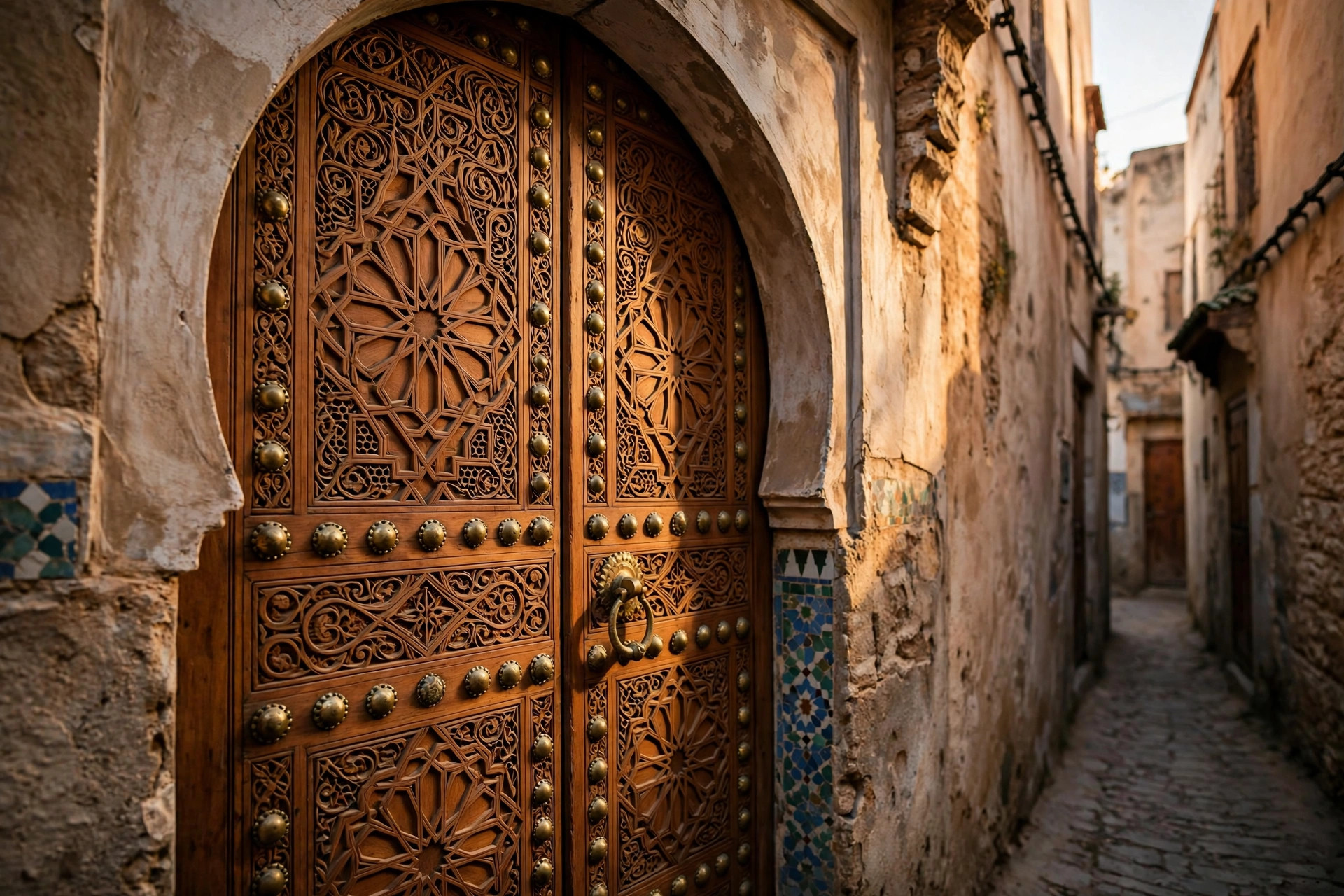
- The Carved Cedar Doors of Fez
- Brass Studs, Knockers and the Language of the Door
- Riad Doors: Privacy Behind a Plain Wall
- Kasbah Doors: Fortress Entrances of the South
- The Doors of the Mellah
- The Craft: Woodcarvers, Metalworkers and Zellige Frames
- Doors as Status, Protection and Identity
- Where to See the Best Doors Today
- Buying a Moroccan Door: What to Pay and What to Avoid
- Modern Revival and Restoration
- Frequently Asked Questions
- Conclusion
The History of Moroccan Doors at a Glance
The short version of the history of Moroccan doors: the great dynasties built monumental gates to impress and defend, the master carvers of Fez turned cedar into lace, and the brass founders armoured ordinary doors with studs and knockers that spoke a silent language.
| Period | What happened |
|---|---|
| 12th century | Almohad sultans raise monumental gates such as Bab Agnaou in Marrakech |
| 13th–15th centuries | Marinid Fez fills madrasas and mosques with carved cedar doors |
| 17th–18th centuries | Moulay Ismail builds the great gates of Meknes, including Bab Mansour |
| 18th–19th centuries | Riad doors, kasbah doors and mellah doors develop their own distinct styles |
| 1913 | Bab Bou Jeloud is built in Fez under French Resident-General Lyautey |
| 1930s | Chefchaouen's blue doors spread, though the exact origin of the colour is debated |
| Today | Restorers and revival workshops keep the old doors standing and the craft alive |
City Gates: Doors Built for Empires
The grandest chapter in the history of Moroccan doors is written at the scale of a city. Bab Mansour in Meknes is the most famous gate in Morocco: a vast triumphal arch of marble columns, zellige and carved plaster, begun under Sultan Moulay Ismail and completed around 1732, after his death. It was built to tell visitors that the sultan's capital was the centre of the world. The gate is described in detail on Wikipedia's Bab Mansour page.
Bab Agnaou in Marrakech is older and quieter. Built in the late 12th century under the Almohad caliph Abu Yusuf Yaqub al-Mansur, it was the ceremonial entrance to the royal kasbah, its horseshoe arch framed by carved stone and a band of calligraphy. It is usually dated to around 1188–1190, though the exact year is not fully settled.
Bab Bou Jeloud in Fez is the youngest of the three great gates, and the most photographed: a Moorish-style arch of three openings, built in 1913 under French Resident-General Lyautey, blue-tiled on the Fez el-Bali side and green on the Fez el-Jdid side — a reminder that the history of Moroccan doors did not stop with the medieval dynasties. Read more in our Fez travel guide.
The Carved Cedar Doors of Fez
If one wood defines the history of Moroccan doors, it is cedar. The cedar forests of the Middle Atlas supplied Fez with a timber that is fragrant, insect-resistant and soft enough to carve deeply. The cedar doors of the Bou Inania Madrasa (1350–1355) are among the finest in the country: heavy leaves worked with star patterns and calligraphy, and hung with bronze knockers.
The same craft fills the mosques and madrasas of the old city. The doors of the Qarawiyyin mosque and the Attarine Madrasa pair carved cedar with zellige and bronze. The whole medina is a UNESCO World Heritage site, listed in 1981. In the history of Moroccan doors, the cedar door of Fez is the high point of the carver's art.
The exact dating of the earliest carved cedar doors in Morocco is not fully settled. Loose panels and reused doors are hard to place, and some celebrated doors are older than the buildings that now hold them — but by the Marinid period the carved cedar door was already a mature art. The history of Moroccan zellige tells the story of the tile frames that so often surround these doors.
Brass Studs, Knockers and the Language of the Door
A Moroccan door speaks before it opens. The brass studs hammered across its face were once practical — they strengthened the wood against battering and fire — but they became decoration too. Their origins are not fully settled: some link them to Andalusian influence, others to older defensive practice.
The knockers are the most charming part of the history of Moroccan doors. Many old houses in Fez and Marrakech have two: a heavy one, said to be for male visitors, and a lighter ring, said to be for female visitors, so the household could tell from the sound who was waiting. The paired knockers are real — but whether the male-and-female rule was ever a strict custom, or simply a story guides tell, is not fully settled.
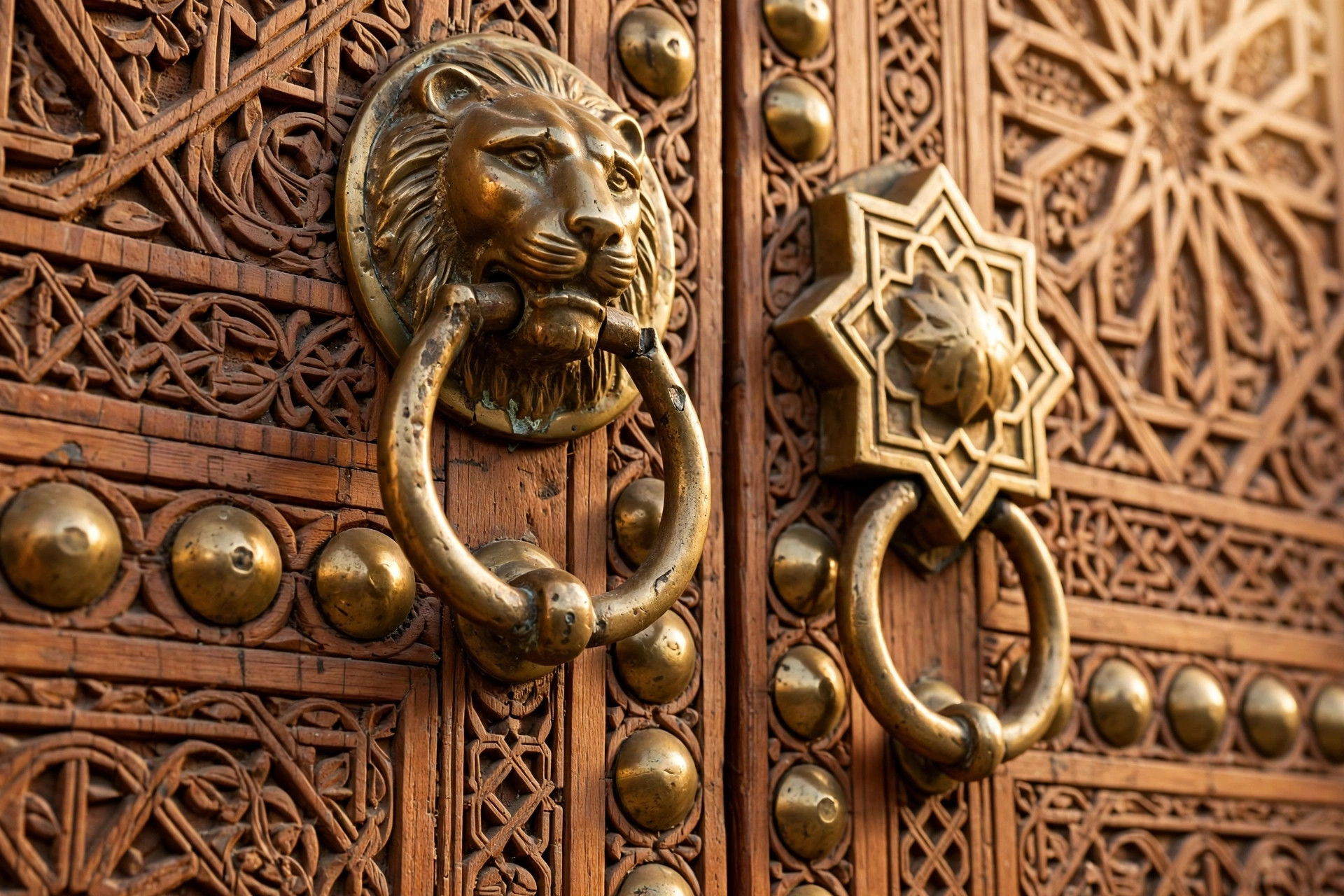
Brass work belongs to the metalworkers whose craft is told in our history of Moroccan metalwork. The founders cast the knockers, the studs and the ring handles in brass and bronze, and the carvers set them into the cedar — in the history of Moroccan doors, the metal is the jewellery of the wood.
Riad Doors: Privacy Behind a Plain Wall
The riad door is the quietest door in the history of Moroccan doors, and the most deceptive. From the street, a riad shows almost nothing: a high, plain wall and a single heavy door. Step through it and the house opens into a courtyard of orange trees, fountains and coloured tiles — the plainness is deliberate, because in the medina wealth was kept inside.
Riad doors are usually studded cedar, set in a frame of carved plaster or zellige, and painted in deep green, the colour most associated with Fez, or in the blue of Chefchaouen. Many have a small secondary door cut into one leaf, so the household could admit a single visitor without opening the great leaves. The history of Moroccan doors is, in the riad, a history of privacy.
Kasbah Doors: Fortress Entrances of the South
South of the Atlas, the history of Moroccan doors changes character. The kasbahs of the Draa Valley and the Souss were fortresses as much as homes, built of rammed earth and palm wood, and their doors had to stop raiders — massive planks of palm or cedar, bound with iron and studded with spikes, set in a towered gateway.
Ait Ben Haddou, the UNESCO-listed ksar on the road to Ouarzazate, shows the style at its grandest: a fortified village of earthen towers, its gates opening onto a hillside of houses. The Taourirt Kasbah in Ouarzazate has doors on the same scale. They are also the most fragile doors in the history of Moroccan doors: rammed earth melts in the rain, and a neglected kasbah door rots from the bottom up.
The Doors of the Mellah
Every old Moroccan city has a mellah, the Jewish quarter, and the mellah has its own doors. The doors of the mellah of Fez — the oldest in Morocco, founded in 1438 — and the mellah of Marrakech are recognisable at a glance: heavy cedar leaves with brass studs, often carved or inlaid with the Star of David, the menorah, or a Hebrew inscription above the lintel. Essaouira's mellah has doors in the same language, many painted deep blue.
The mellah door is a reminder that the history of Moroccan doors belongs to more than one community. Jewish and Muslim craftsmen worked in the same souks, sharing techniques, cedar and brass. The differences are in the symbols, not the craft.
The Craft: Woodcarvers, Metalworkers and Zellige Frames
A great Moroccan door is the work of three crafts at once, and the history of Moroccan doors is the story of how they fit together. The woodcarver planes and pegs the planks, then carves the geometry and calligraphy with chisels and a mallet. The metalworker casts the studs, knockers and hinges in brass and bronze, the zellige master cuts the tiles that frame the doorway, and the plaster carver finishes the arch above it.
The work is slow: a single carved door for a riad can take a master carver and his apprentice several weeks, and a monumental gate door months. The patterns are learned by apprenticeship, not from books. The geometry is the same language that appears in the history of Moroccan zellige and the history of Moroccan carpets: stars, polygons and interlacing bands.
Doors as Status, Protection and Identity
In the old medina, a door was a person's public face. The size, carving, studs and frame of a door told the street exactly how important the family inside was — a grandee's door was tall enough for a horseman, a poor family's door a single unadorned leaf. The history of Moroccan doors is also a social history, written in wood and brass.
Doors were also protection, and not only against thieves. The studs and the heavy bar behind the door were practical, but many doors carry symbols meant to ward off the evil eye: the hand of Fatima, the five-pointed star, and the blue paint that is still believed in the south to keep misfortune away. A family's door was also its identity: in a medina of unmarked streets, the door was the address.
Where to See the Best Doors Today
The best way to read the history of Moroccan doors is to walk and look — most of them cost nothing to see, because they are the streets themselves.
| Place | What to see | Cost |
|---|---|---|
| Bab Mansour, Meknes | The great triumphal gate of Moulay Ismail, marble columns and zellige | Free to view from the square |
| Bab Bou Jeloud, Fez | The 1913 blue-and-green tiled gate between the two old cities | Free to view |
| Bab Agnaou, Marrakech | The 12th-century Almohad gate to the royal kasbah | Free to view |
| Bou Inania Madrasa, Fez | Marinid carved cedar doors in a 14th-century madrasa | 20 MAD ($2) |
| Mellah of Fez | Jewish quarter doors with Stars of David and Hebrew inscriptions | Free to walk |
| Ait Ben Haddou | Fortress gates of the UNESCO-listed ksar | Free to enter the village |
| Chefchaouen medina | Blue-painted doors on every lane of the blue city | Free to walk |
| Bahia Palace, Marrakech | Carved cedar and painted doors in a 19th-century palace | 70 MAD ($7) |
| Dar Si Said Museum, Marrakech | Historic doors, woodwork and crafts in one museum | 30 MAD ($3) |
Prices are planning ranges checked in November 2026 — check on arrival. The medina lanes are the real museum: go early, before the crowds, when the doors are lit by the morning sun and the streets belong to the residents.
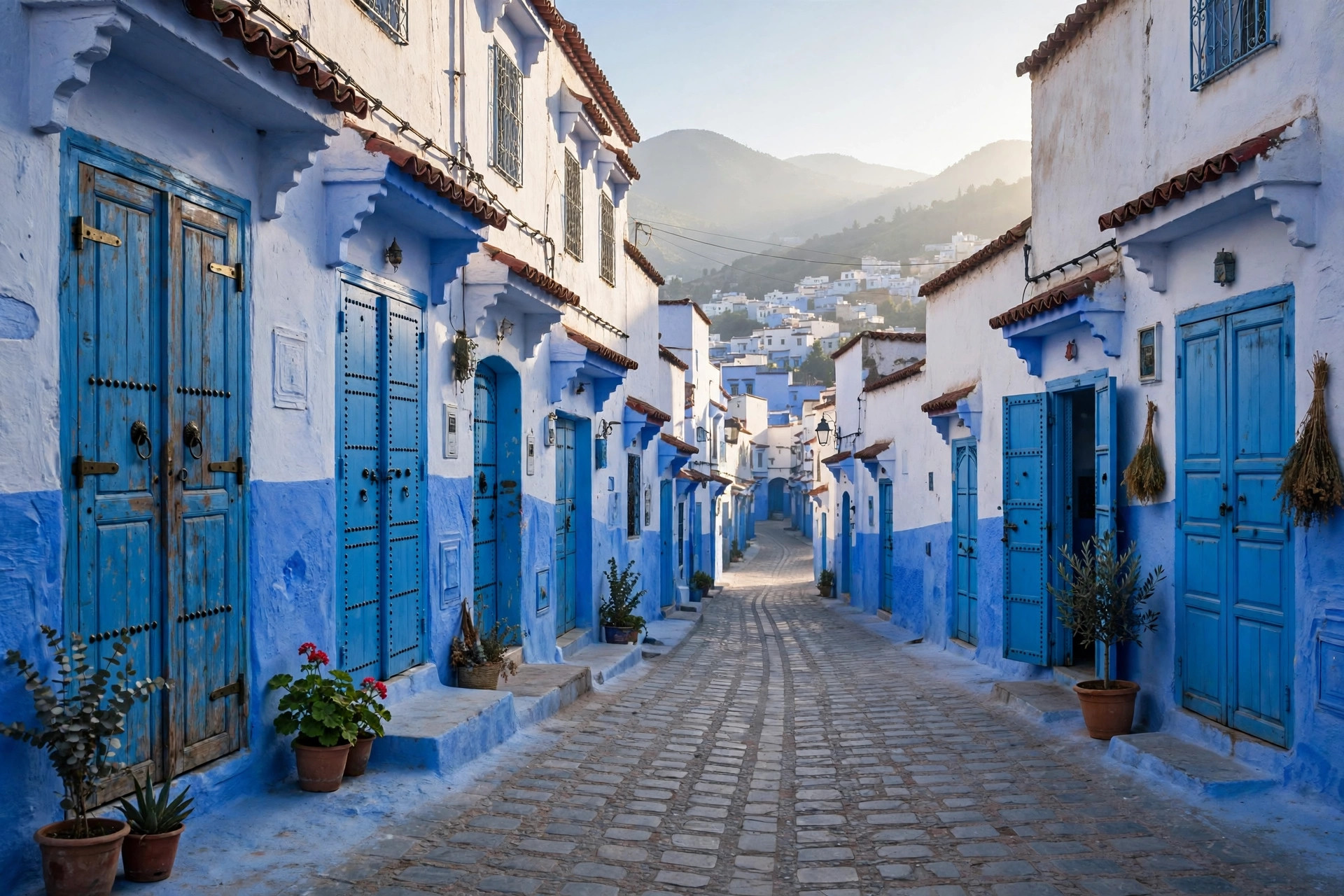
Chefchaouen deserves a slow morning of its own. The blue city is the one place in Morocco where the doors are the attraction, and every lane offers a new shade of blue against whitewashed walls. Our Chefchaouen blue city guide covers the lanes and the practical details. The origin of the blue paint is often credited to Jewish refugees who arrived in the 1930s, but the exact story is not fully settled — some accounts trace the blue further back.
Buying a Moroccan Door: What to Pay and What to Avoid
A carved door is one of the most satisfying things to buy in Morocco — and one of the hardest to take home. Small carved panels and miniature doors are the practical souvenir; a full door is a shipping project. Prices below are planning ranges checked in November 2026 — check on arrival, and expect to bargain.
| Item | What to pay |
|---|---|
| Small carved door panel (30–50 cm) | 150–400 MAD ($15–40) |
| Miniature studded door, cedar | 200–500 MAD ($20–50) |
| Carved mirror frame in door style | 300–800 MAD ($30–80) |
| Full carved cedar door, new, one leaf | 2,000–6,000 MAD ($200–600) |
| Full carved cedar door, pair of leaves | 4,000–15,000 MAD ($400–1,500) |
| Antique door (genuine, with provenance) | 10,000 MAD ($1,000) and up |
Buy the wood, not the story. A genuine cedar door is heavy, fragrant and carved on both faces; a softwood copy is light, odourless and carved on one face only. Run your hand over the carving — a hand-carved pattern has small irregularities, while a machine-routed copy is perfectly regular. The history of Moroccan glass gives the same advice for its own craft: in the history of Moroccan doors, as in glass, the imperfections are the proof.
Avoid anything sold as a palace door without papers. Real antique doors are protected heritage, and exporting one without a permit is illegal; the "antique" doors in many souk shops are new doors aged with tea and smoke. Buy new work from the workshop that made it, keep the receipt, and arrange crated shipping through the seller.
Modern Revival and Restoration
The history of Moroccan doors is still being written, and the newest chapter is restoration. In Fez, the rehabilitation programme of the old city has restored hundreds of doors, repairing cedar panels, recasting lost brasswork and repainting frames in their original colours. In Marrakech, the riad hotels have become the biggest patrons of the door carvers, commissioning new doors in the old style. Young carvers in Fez are learning the old patterns, and design shops abroad are ordering Moroccan doors for houses that have never seen a medina.
The revival has its critics, who argue that a replaced door is a copy, not a restoration. Others point out that a door is a working object: a door that cannot close is not a door, and a medina of doors that cannot close is a museum, not a city. The debate is the same one that surrounds every living craft in the history of Moroccan doors.
Frequently Asked Questions
What is the most famous door in Morocco?
Bab Mansour in Meknes is the most famous gate in the history of Moroccan doors, built under Moulay Ismail and completed around 1732. Bab Bou Jeloud in Fez is the most photographed, and Bab Agnaou in Marrakech is the oldest of the three great gates. All three are free to view from the street.
Why are Moroccan doors covered in brass studs?
The studs began as reinforcement — they strengthened the wooden leaves against battering and fire — and became decoration. The exact origins of the brass-stud tradition are not fully settled, and the history of Moroccan doors probably owes the style to a mixture of Andalusian influence and older defensive practice.
What is the difference between the two door knockers?
Many old houses have two knockers — a heavy one said to be for male visitors and a lighter ring said to be for female visitors — so the household could tell from the sound who was waiting. Whether the rule was ever strict custom or simply a story is not fully settled, but the paired knockers are real and common in Fez and Marrakech.
Why are the doors in Chefchaouen blue?
The blue paint is usually credited to Jewish refugees who settled in the city in the 1930s, but the exact origin is not fully settled — some accounts trace the blue further back. Whatever its origin, the blue has become the city's identity.
How old are the carved cedar doors of Fez?
The finest dated examples in the history of Moroccan doors are Marinid, from the 14th century — the doors of the Bou Inania Madrasa were built between 1350 and 1355. The exact dating of the earliest carved cedar doors is not fully settled, because loose panels and reused doors are hard to place, but the craft was already mature by the Marinid period.
Can I buy a real Moroccan door?
Yes. Small carved panels cost 150–400 MAD ($15–40) and miniature studded doors 200–500 MAD ($20–50) in the souks, while a full new cedar door runs 2,000–15,000 MAD ($200–1,500). Buy new work from the workshop, keep the receipt, and arrange crated shipping through the seller.
Conclusion
The history of Moroccan doors is the story of a country that put its art on its thresholds. It began with the great gates of the dynasties — Bab Agnaou, Bab Mansour, Bab Bou Jeloud — and continued in the carved cedar of Fez, the brass of the metalworkers, the fortress doors of the southern kasbahs, and the blue doors of Chefchaouen. A door in Morocco is never only a door: it is a family's standing, a craftsman's signature, and a piece of protection. Go to Meknes at sunset, then walk the lanes of Fez in the morning — the history of Moroccan doors is still there, in the wood, the brass, and the sound of the knocker. More Moroccan crafts and dynasties wait in our History & Heritage section.