
Introduction
Importing a car into Morocco is possible, but it is not a casual errand. The country runs one of the Mediterranean's strictest vehicle-import regimes: a car brought in permanently must be less than five years old, the taxes on it commonly add 40–50% to its value, and the whole process runs through Moroccan customs, the Douane, before the car can be registered. Get one rule wrong and the car is refused at the port.
There are two completely different ways of importing a car into Morocco, and confusing them is the most expensive mistake a newcomer makes. Tourists can bring a car in free of duty for up to six months a year under temporary admission — but it must leave with them. Residents, and Moroccans returning home for good, can import a car permanently and put Moroccan plates on it, after paying the full duties and taxes. This guide, one of our costs and practical life guides, covers both routes, the documents, and the real costs.
In this guide
- Importing a Car into Morocco: Temporary vs Permanent
- The Five-Year Rule: Which Cars Can Be Imported
- Who Can Import a Car into Morocco
- What Importing a Car into Morocco Costs: Taxes and Fees
- The Documents You Need
- Importing a Car into Morocco Step by Step
- Getting the Car There: Ferries and Shipping
- After Customs: Registration, Vignette and Contrôle Technique
- Insurance: What You Need Before You Drive
- Returning Moroccans (MRE): The Special Rules
- Mistakes That Cost Importers Thousands
- Is Importing a Car into Morocco Worth It?
- Frequently Asked Questions
- Conclusion
Importing a Car into Morocco: Temporary vs Permanent
Temporary admission is for visitors. You drive your own car off the ferry, customs records it against your passport, and you drive in Morocco for up to six months in a calendar year without paying any import duty. It costs nothing at the border. The catch is absolute: the car must leave Morocco with you. You cannot sell it, lend it, or leave it behind, and once you become a resident you can no longer own a foreign-plated car. Overstaying the six months can mean a fine of up to 100% of the car's value, and the vehicle can be seized.
Definitive import is for people moving to Morocco. The car is cleared through customs, duties and VAT are paid, and it is registered with Moroccan plates and a Moroccan carte grise. A car imported this way must be less than five years old, you must hold a Moroccan residence permit, and you should budget roughly 40–50% of the car's value in taxes.
Visiting only? Temporary admission is the answer. Moving to Morocco? Decide before you buy the car, not after.
The Five-Year Rule: Which Cars Can Be Imported
The most important rule for importing a car into Morocco is the age limit: a car imported permanently must be less than five years old, counted from the date of its first registration — not the year it was built. The rule has been in force since 2011, and there is no discretion at the port: a car a few months over five years is refused, however good its condition.
The details matter for importing a car into Morocco permanently. Because the clock runs from first registration, a car first registered in early 2022 can still be imported in early 2027. Check the first-registration date on the registration document, not the model year on the sales listing. Some guides report that the age is counted from the manufacture date instead, so ask customs which date they apply before you buy.
Two more conditions apply. Morocco drives on the right, and right-hand-drive cars are not accepted for registration. The car must also meet the current emissions standard — guides disagree on whether the floor is Euro 4 or Euro 6, so confirm it with the Douane before buying, because a car that fails homologation cannot be registered at any price.
Who Can Import a Car into Morocco
Permanent import is not open to everyone. For importing a car into Morocco permanently, the basic condition is residency: a foreign national needs a valid Moroccan residence permit, the carte de séjour, to register a vehicle in their own name. Without it, you cannot complete the import at all — which is why temporary admission exists for everyone else. If you are still waiting for your permit, read our guide to Morocco visa costs first.
Two groups get special treatment. Moroccans living abroad who return home for good (known as MRE) can import a car as part of their return, with reduced duties in some cases. Diplomats can import cars older than five years, the only exception to the age rule. ExpatFocus's guide to buying or importing a car in Morocco summarises the same headline figures.
You should also have owned the car for at least six months, and be able to prove it with the original registration document and insurance history. Customs watches for people buying a cheap car abroad purely to import and resell it.
What Importing a Car into Morocco Costs: Taxes and Fees
This is where most importers get their shock. Importing a car into Morocco is taxed on the value customs assigns the car — the Douane's own reference value, not the price on your invoice. If the invoice looks low, customs revalues the car.
Three charges stack up: customs duty commonly quoted at 10–17.5% of the assessed value (17.5% is the figure most guides use for passenger cars), VAT of 20% charged on the value plus the duty, and a small parafiscal tax of 0.25%. Together, the total usually lands at roughly 40–50% of the car's assessed value.
| Cost item | What to expect |
|---|---|
| Customs duty | 10–17.5% of the assessed customs value |
| VAT (TVA) | 20%, charged on value + duty |
| Parafiscal tax | 0.25% of the assessed value |
| Customs broker (transitaire) | 2,000–4,000 MAD ($200–$400) |
| Technical inspection (visite technique) | 250–400 MAD ($25–$40) |
| Registration (carte grise) and plates | ~400 MAD (~$40) |
| Ferry, car + 2 passengers, one way | €118–€250 (1,300–2,750 MAD) |
A worked example: take a car assessed at €20,000 (about 220,000 MAD). Duty at 17.5% is €3,500, VAT at 20% on €23,500 is €4,700, and the parafiscal tax adds about €50 — total taxes of roughly €8,250 (about 91,000 MAD), before the broker, inspection, registration and ferry. That is why guides quote €8,000–€10,000 in taxes on a €20,000 car, and why importing a car into Morocco only makes sense for a car you cannot buy locally at a fair price. For running costs afterwards, see our guide to the cost of owning a car in Morocco.
The Documents You Need
Importing a car into Morocco runs on paperwork, and a missing document stops the process at the port. Assemble the file before the car ships.
- Passport and carte de séjour (residence permit), valid and in your name.
- Proof of address in Morocco — a rental contract or utility bill.
- Original vehicle registration document from the country of origin, showing the first-registration date and at least six months of ownership.
- Purchase invoice for the car, even though customs may revalue it.
- Certificate of conformity from the manufacturer, proving the car meets the required standard.
- Export declaration (EX-A) from the country the car leaves — needed both for Moroccan customs and for reclaiming VAT paid in Europe.
- Insurance covering Morocco, valid from the day the car arrives.
- Bill of lading or ferry ticket proving how the car entered the country.
If someone else drives the car across, they need a notarised authorisation from you; keep originals and copies in separate bags.
Importing a Car into Morocco Step by Step
Allow two to four weeks from the car's arrival to Moroccan plates.
- Check eligibility first. Confirm the car's first-registration date, your residence permit, and the current emissions standard with the Douane or a licensed broker before you spend anything.
- Hire a customs broker (transitaire). Almost essential for a first import: 2,000–4,000 MAD ($200–$400). They file the declaration, talk to customs in French and Arabic, and know which desk your file sits on.
- Ship or drive the car to the port. Tanger Med is the main gateway from Europe; Casablanca handles most roll-on/roll-off shipping from further afield.
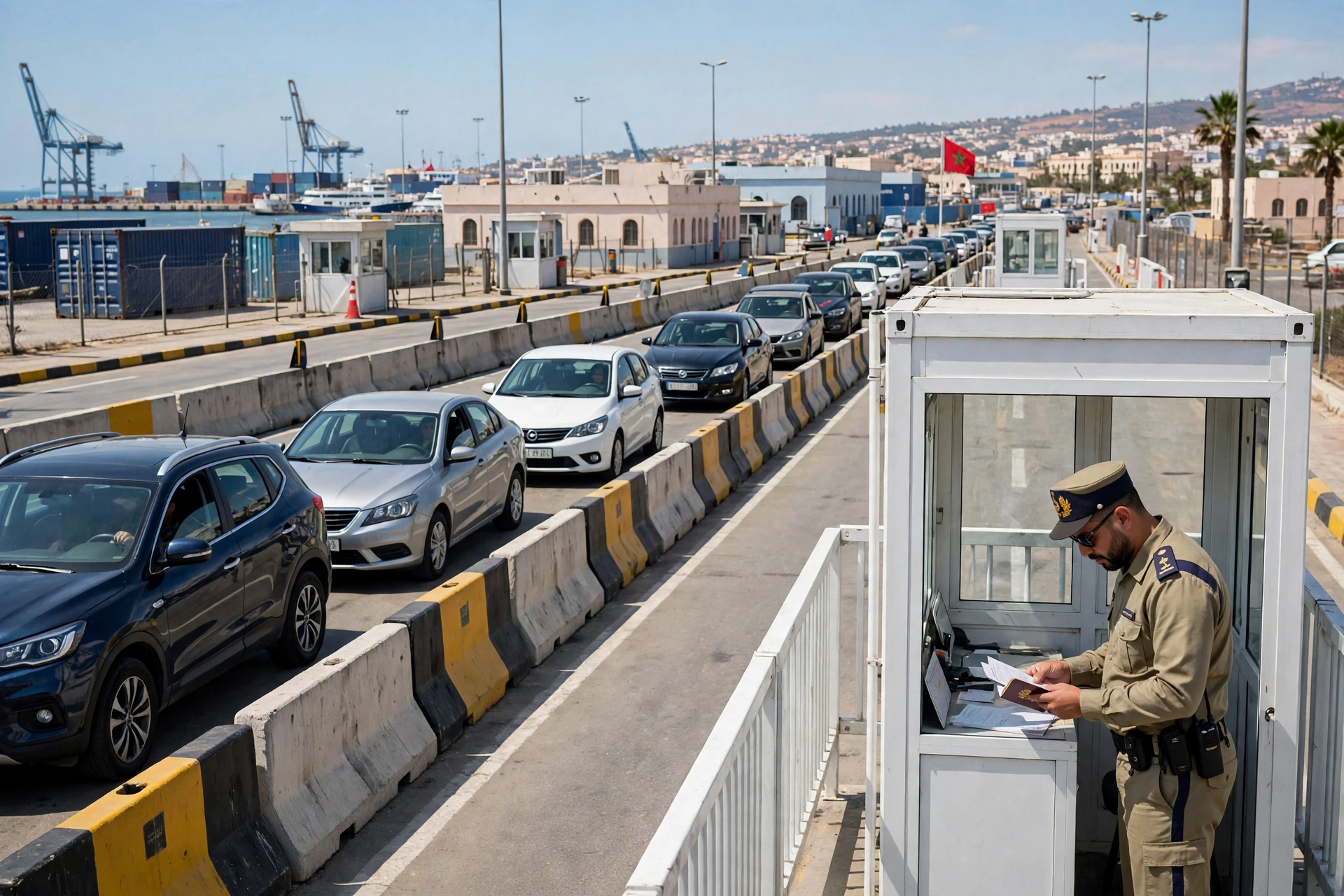
- Declare the car at customs. File form D16 for definitive import, present the full document file, and pay the duty, VAT and parafiscal tax. Customs issues a quittance (payment receipt) and a certificat de dédouanement (clearance certificate).
- Pass the visite technique. A technical inspection at an approved centre, 250–400 MAD ($25–$40), checking brakes, lights, emissions and roadworthiness.
- Register the car. Take the file to the NARSA registration centre for Moroccan plates and your first carte grise — about 400 MAD ($40) in admin and plate fees. Registration typically takes around 30 days from a complete application.
- Pay the vignette. The annual road tax, set by the car's fiscal horsepower and fuel type — a few hundred dirhams a year for an ordinary family car, rising steeply for large engines.
- Insure and drive. Arrange Moroccan insurance before the first drive; the car is not legal on the road until it is registered and insured.
Getting the Car There: Ferries and Shipping
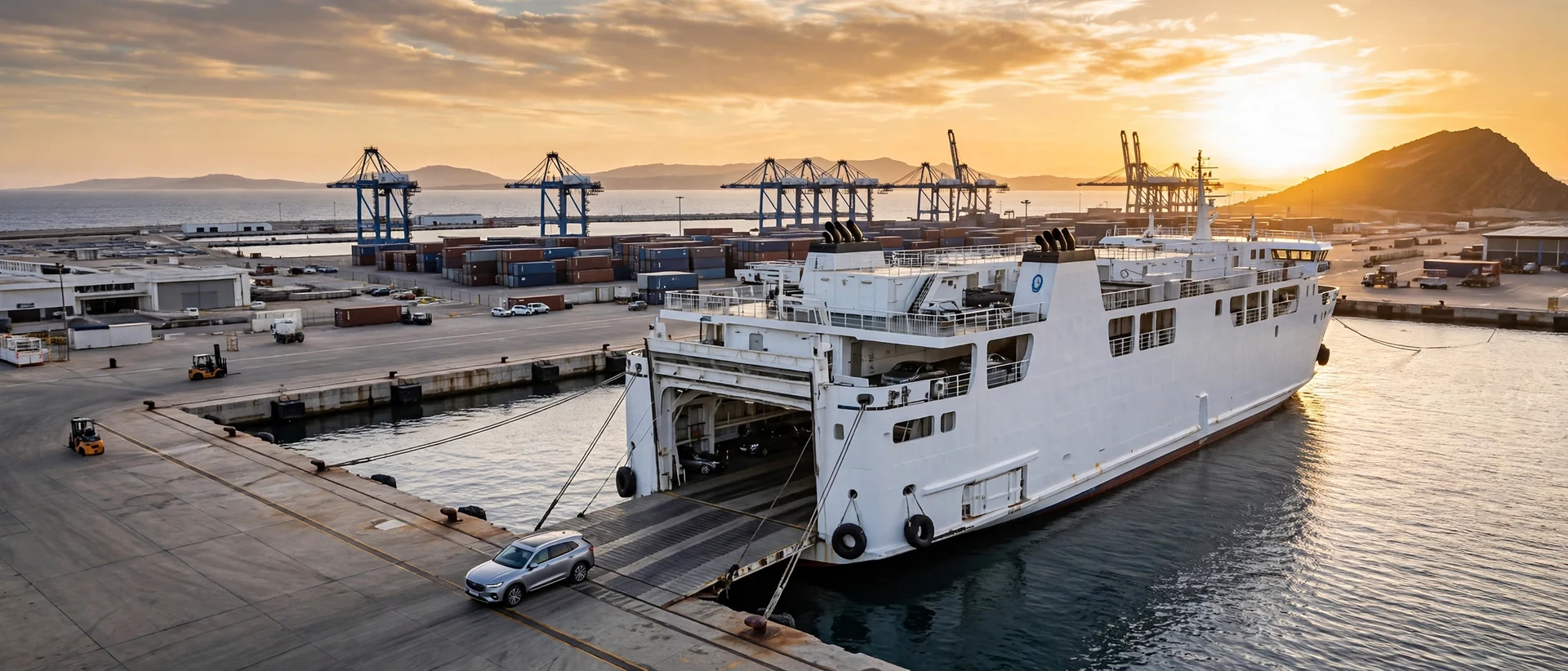
Most people importing a car into Morocco arrive by ferry from Spain, and the crossing is the easy part. Algeciras to Tanger Med takes about 1.5 hours with up to 30 crossings a day in summer; a car with two passengers costs roughly €118–€250 one way (1,300–2,750 MAD) depending on the season and operator, and a car alone starts from about €110. Tarifa to Tangier Ville is faster at about an hour, with a car costing around €165 one way. Operators include Baleària, DFDS, Africa Morocco Link and Naviera Armas. For ferry prices in detail, see our guide to Morocco ferry prices from Spain to Tangier. MyTangier's 2026 guide to buying and importing a car in Tangier walks through the same procedure port by port.
| Route | Crossing time | Car + driver, one way |
|---|---|---|
| Algeciras – Tanger Med | ~1.5 hours | From ~€110 (1,210 MAD) |
| Algeciras – Tanger Med, car + 2 passengers | ~1.5 hours | €118–€250 (1,300–2,750 MAD) |
| Tarifa – Tangier Ville | ~1 hour | ~€165 (1,815 MAD) |
| Sète (France) – Tanger Med | ~36 hours | From ~€330 (3,630 MAD) |
If the car comes from further away, it usually ships roll-on/roll-off to Casablanca or Tanger Med — get a written shipping quote before you buy the car, and clear it at the port it lands in.
After Customs: Registration, Vignette and Contrôle Technique
Clearing customs is only half the job — the car still needs Moroccan plates.
After importing a car into Morocco, registration runs through NARSA, the national road safety agency, at a Centre d'Immatriculation. Your file needs the customs clearance certificate, the inspection pass, your residence permit, proof of address, and the insurance certificate. The first carte grise costs around 400 MAD ($40) including plates, and the process typically takes about 30 days from a complete application — so keep every receipt, and do not drive on foreign plates while you wait unless the temporary admission covering the car is still valid.
Two annual obligations follow the car. The vignette is the annual road tax, based on the car's fiscal horsepower and fuel type; keep the receipt in the car, because police checks ask for it. The contrôle technique is the annual roadworthiness inspection for cars over five years old, at an approved centre, for a few hundred dirhams. Both are cheap, both are checked, and missing either one turns a routine traffic stop into a fine.
Insurance: What You Need Before You Drive
No car drives legally in Morocco without insurance, and anyone importing a car into Morocco needs a policy that names Morocco explicitly. A European Green Card that lists Morocco (MA) covers you for a visit under temporary admission — check the back of the card before you travel, because a Green Card that omits Morocco is worthless at the border. If it does not cover Morocco, frontier insurance is sold at the port. For a permanently imported car, take out a Moroccan policy as soon as the plates are issued: third-party liability is the legal minimum, and comprehensive cover is worth it after paying 40–50% in taxes. Keep the certificate with the carte grise in the car at all times.
Returning Moroccans (MRE): The Special Rules
Moroccans living abroad who return home permanently get the most generous treatment in the system. For returning Moroccans, importing a car into Morocco comes with substantial reductions on the import duty — some guides report reductions of up to 90% for returning residents over 60, who may also import a car up to ten years old instead of five. These are reported figures, not a promise: the exact franchise depends on your age, how long you lived abroad, and the current customs circular, so get the terms in writing from the Douane before you ship anything.
Document the return — proof of residence abroad and the inventory of goods — and clear the vehicle with the household shipment, usually through a broker. Start months ahead: the customs file takes longer than the move itself.
Mistakes That Cost Importers Thousands
Most failed imports fail on the same handful of errors.
Buying the car before checking the rules. A car that is five years and a month old, a right-hand-drive car, or a car below the emissions standard is refused at the port — and you must then re-export a car you cannot register. Check first, buy second.
Confusing the two regimes. Driving in on temporary admission and then deciding to stay is the classic trap: once you are a resident you cannot keep a foreign-plated car. Decide which route you are on before you cross the border.
Letting temporary admission expire. The six-month limit is a calendar-year limit, and overstaying can cost up to 100% of the car's value plus seizure. If your plans change, leave with the car and re-enter, or start the definitive import in time.
Skipping the broker. The 2,000–4,000 MAD a transitaire costs is the cheapest money in the whole process. First-time importers who file alone commonly lose more in delays and repeat trips to the port.
Is Importing a Car into Morocco Worth It?
Honestly, often not. Importing a car into Morocco only makes financial sense when the car is worth bringing: a model that is rare, overpriced or unavailable in Morocco, a car with sentimental value, or a vehicle you already own and know. For most people, buying locally is cheaper, faster and simpler.
| Option | Typical total cost | Time to drive | Main risk |
|---|---|---|---|
| Import a €20,000 car | ~€28,250 + ferry (311,000 MAD) | 2–4 weeks | Revaluation, refusal at port |
| Buy the same car in Morocco | ~€24,000–€27,000 (264,000–297,000 MAD) | 1–3 days | Higher local used prices |
| Rent a car for a 2-week trip | ~€400–€700 (4,400–7,700 MAD) | Same day | None |
Used cars in Morocco cost more than comparable cars in Europe, precisely because of the import duties — so the local price already includes the taxes you would pay yourself. Do the arithmetic on your exact car with a broker's written estimate first. If the numbers are close, buy in Morocco: our guide to buying a car in Morocco walks through the local process, and the cost of driving in Morocco is the same whichever way the car arrived.
If you are moving to Morocco for the long term, the car is only one line in the budget — read our cost of living in Morocco guide and our Morocco money and dirham guide before you transfer a deposit.
Frequently Asked Questions
Can I import a car older than five years into Morocco?
Not permanently. The five-year rule, counted from first registration, applies to every permanent import except diplomats — and, by some reports, returning Moroccans over 60, who may import up to ten years old. An older car can only enter under temporary admission for up to six months.
How much does importing a car into Morocco cost in total?
Budget roughly 40–50% of the car's assessed value in taxes: 10–17.5% customs duty, 20% VAT on value plus duty, and 0.25% parafiscal tax. On a €20,000 car that is about €8,250, plus a 2,000–4,000 MAD broker fee, a 250–400 MAD inspection, about 400 MAD for registration, and the ferry.
Can a tourist drive their own car in Morocco?
Yes. Under temporary admission your car enters free of duty for up to six months per calendar year — normally three months on entry, extendable to six. It is recorded against your passport, needs insurance naming Morocco, and must leave with you.
Can I sell a car I brought in under temporary admission?
No. A temporarily admitted car cannot be sold, lent or left in Morocco; it must be re-exported by the person who brought it in before the admission expires.
Is it cheaper to import a car or buy one in Morocco?
Usually it is cheaper to buy in Morocco. Importing a car into Morocco adds roughly 40–50% in taxes, and local used prices already reflect those duties — so the saving is normally small or negative unless the model is rare or unavailable locally. Get a broker's written estimate and compare it with local prices first.
Conclusion
Importing a car into Morocco rewards preparation and punishes improvisation. The rules are strict but clear: under five years old, left-hand drive, resident, duties paid — or, for a visit, temporary admission for up to six months. The taxes are the hard part, at roughly 40–50% of the car's value, and the cheapest way to handle them is a broker's written estimate before you buy anything.
If the numbers work, follow the steps in order and keep every document. If they do not, buy locally and spend the difference on the road. Either way, importing a car into Morocco is a decision you can now make with the figures in front of you — and the one rule above all: check the car against the rules before you buy it, not at the port. LahbabiGuide is written by a Moroccan, for people moving to and travelling in Morocco.