
This larache travel guide is for travellers who like their Morocco slow. Larache is a working Atlantic port of about 125,000 people, roughly 86 km south of Tangier at the mouth of the Loukkos river — Spanish arcades, a whitewashed medina, long empty beaches and, three kilometres north, the ruins of Lixus. Almost no foreign tourists come here.
Larache rewards a night rather than a dash: ruins in the morning, the fish market at noon, the Spanish square at sunset and the beach at dawn. This larache travel guide covers what to see, where to eat and sleep, what it costs, and how to get here.
All prices are in Moroccan dirhams (MAD), checked in November 2026, with dollar equivalents at roughly 10 MAD to $1. They are planning ranges — check on arrival. Prices here are among the lowest on the Moroccan coast, and most of what matters costs nothing.
In this guide
- Larache at a Glance
- Why Visit Larache: Morocco's Quiet Atlantic Port
- The Lixus Ruins: Rome's Garum Port on the Loukkos
- Place de la Libération and the Spanish Quarter
- The Old Medina: Bab el Medina and the Souks
- Larache's Beaches: Two Shores of the Loukkos
- The Fishing Port and the Loukkos Estuary
- Where to Eat in Larache: Seafood First
- Where to Stay in Larache
- Getting to Larache (and Around)
- Costs: What to Budget in Larache
- Day Trips from Larache
- Best Time to Visit Larache
- Frequently Asked Questions
- Conclusion
Larache at a Glance
| Fact | Detail |
|---|---|
| Location | Atlantic coast, mouth of the Loukkos river, Tanger-Tétouan-Al Hoceima region |
| Population | About 125,000 (2014 census) |
| Distance from Tangier | About 86 km south (~1.5 hours by road) |
| Distance from Asilah | About 40 km south |
| Nearest train station | Ksar el-Kebir, about 35 km inland |
| Main sights | Lixus ruins, Place de la Libération, old medina, fishing port, Atlantic beaches |
| Best time to visit | April–June and September–October |
| How long to stay | 1 night (2 if you want the beaches and a day trip) |
Why Visit Larache: Morocco's Quiet Atlantic Port
Most travellers on Morocco's northern coast stop at Tangier and Asilah and drive on. Larache is what they miss: a real port town where the fishing boats still matter more than the tourists, on a low headland where the Loukkos meets the Atlantic — tides, gulls, the smell of salt, men mending nets on the quay.
Larache's history is older than the town itself. Across the river, Lixus was a Phoenician trading post from at least the 7th century BC and a major Roman city. The modern town grew up on the south bank in the late Middle Ages, became a major Atlantic port by the 15th century, and spent 1912–1956 under Spanish administration — the source of the arcaded squares and art-deco facades you still see today.
What makes this larache travel guide different is the absence of performance. Nobody here is staging Morocco for visitors: the cafés are full of locals, the fish is priced for fishermen's families, and the beaches are long, clean and mostly empty outside July and August.
The Lixus Ruins: Rome's Garum Port on the Loukkos
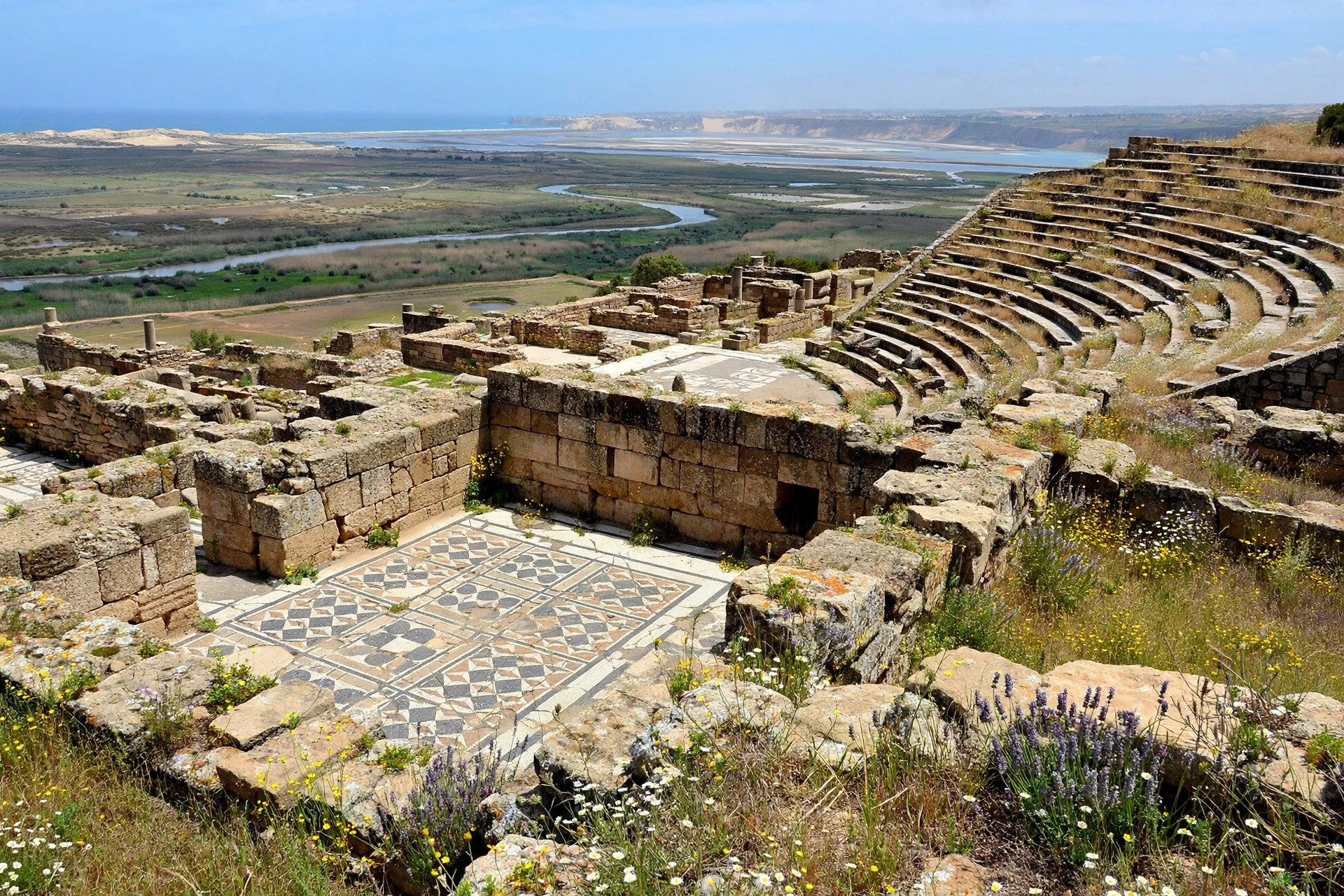
Three kilometres north of Larache, on a headland above the Loukkos estuary, stands Lixus — one of the oldest inhabited sites on the Atlantic coast of Africa, and the first stop in this larache travel guide. Phoenician traders were here from at least the 7th century BC; the Romans made it a major city from the 1st century AD. Its wealth came from the sea: garum, the fermented fish sauce the Roman world poured over everything, made in tanks that are among the best-preserved in Morocco. See Wikipedia's Lixus page for the full history.
Walk slowly and the city reassembles itself: a theatre cut into the hillside, a forum, temples and baths, and mosaic floors — including a celebrated Oceanus, god of the sea. The garum factory is the most striking part: row after row of stone vats where fish and salt fermented, then shipped in amphorae across the empire. Start at the top for the best view, then work down to the tanks. Allow two hours; the site is large, uneven and unshaded, so bring water and a hat. Local tradition ties Lixus to the Garden of the Hesperides — legend, not established fact.
For the nearest imperial city, see our Fez travel guide. Practical notes for this larache travel guide: Lixus sits on the N1, 3 km north of town — a grand taxi or a walk both work. Entrance is typically 20–30 MAD; hours are roughly 9:00–17:00, though times are not always posted.
Place de la Libération and the Spanish Quarter
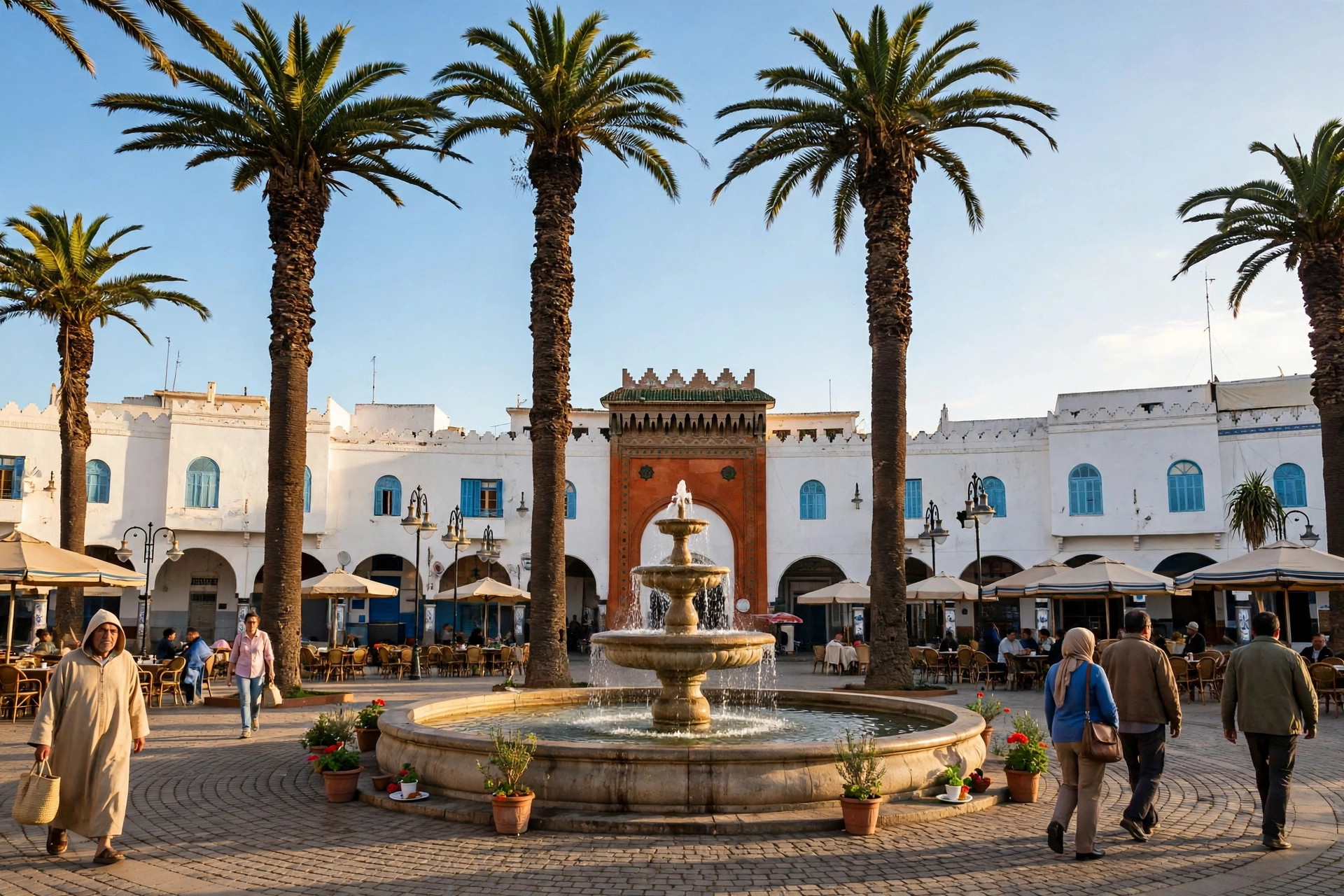
The heart of modern Larache is the Place de la Libération, the circular square the Spanish built as the Plaza de España, and the liveliest stop on this larache travel guide. Arcaded pavements ring a central fountain, and the café terraces are the town's living room: old men playing cards, families strolling at dusk, teenagers circling on scooters. The facades are Spanish colonial — art-deco and whitewashed — in gentle, sun-bleached decay.
The square anchors the ensanche, the Spanish colonial quarter of the 1912–1956 protectorate. Its streets hold houses with wrought-iron balconies that could be in Cádiz. The quarter is not a museum — pick a café on the square, order a mint tea (8–10 MAD), and watch the town go by. Above the town, the Spanish cemetery holds the grave of the French writer Jean Genet, buried here at his own wish. The Bab el Medina gate leads into the old medina: two historic centres, Moroccan and Spanish, side by side.
The Old Medina: Bab el Medina and the Souks
Larache's medina is small, whitewashed and refreshingly un-touristed — the medina chapter of this larache travel guide is a short one. Enter through the Bab el Medina gate and you are in a maze of narrow lanes where the shops sell what locals actually buy: vegetables, bread, second-hand clothes and, in the Souk Esseghir, a permanent vegetable market.
About 200 metres from the square, the covered central market — recently renovated — is worth a wander even if you buy nothing: fish stalls on one side, spices and olives on the other, and the butchers' lane that you will smell before you see. Prices here are local: a bag of oranges or a kilo of sardines costs a fraction of Tangier prices. The medina also shows Larache's Andalusian character.
Larache's Beaches: Two Shores of the Loukkos
Larache has two beaches, divided by the Loukkos river. The town beach, on the south bank below the port, is the lively one: golden sand, Atlantic surf, and families from the neighbourhoods above. The second beach lies across the river — quieter, wilder, reached on foot from the square in about 300 metres to the little passenger boat, or by car and bus on a 10 km loop.
The Atlantic here is an ocean, not a sea: the water is cool even in August, the waves are real, and the wind picks up most afternoons. Swimmers should stay close to where locals swim and respect the flags and lifeguards in summer. Surfers will find uncrowded breaks, though there are no board rentals in town — bring your own.
Beyond the beaches, the coast runs for kilometres in both directions — dunes and scrub to the south, the headland of Lixus to the north — and in the off-season you can walk for an hour and meet nobody but fishermen. Bring sun protection and water: there are few cafés on the far beach. This is the quiet side of the coast that this larache travel guide is really about.
The Fishing Port and the Loukkos Estuary
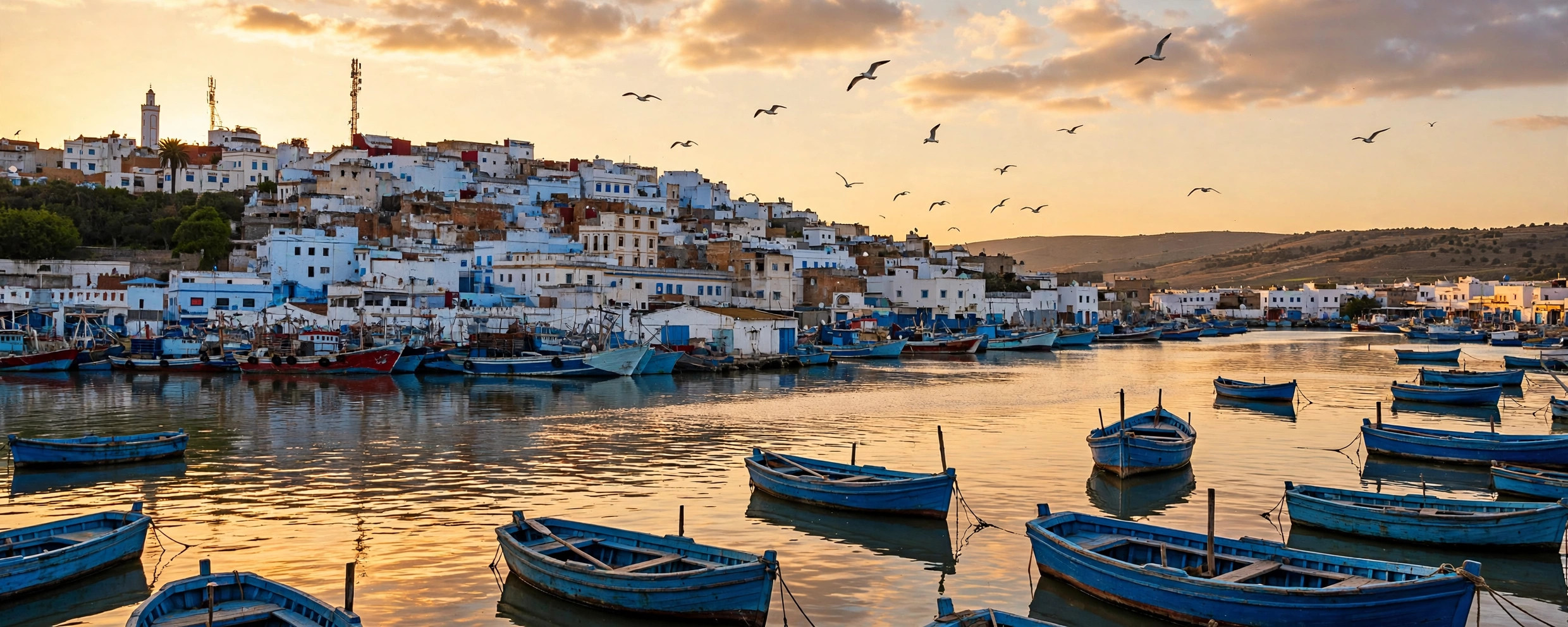
Larache's port is the town's engine room, and the most photogenic part of any larache travel guide. Arrive at dawn: trawlers unloading sardines and sole, auctioneers shouting prices, gulls wheeling over the crates, the little blue boats bobbing at their moorings. The light at sunrise is the best photograph in town.
The Loukkos is one of Morocco's great rivers, watering the fertile Gharb plain before it reaches the sea at Larache. The estuary is mudflats, herons and salt marsh, and the riverside road makes a fine evening walk. Buy fish here if you have a kitchen: sardines, sea bream and sole go for a fraction of restaurant prices. A kilo of sardines costs 15–25 MAD ($1.50–$2.50) at the port, against 60–80 MAD ($6–$8) for a grilled plate in a restaurant.
Where to Eat in Larache: Seafood First
Larache is a fish town, and eating here is simple, fresh and cheap — which is why food gets its own section in this larache travel guide. Eat what came off the boats that morning: grilled sardines, fried calamari, sea bream grilled whole with cumin and salt, and fish soup as a starter. A full seafood lunch — soup, grilled fish, salad, bread and mint tea — costs 60–100 MAD ($6–$10) per person.
The best places cluster in two areas: the port, where small restaurants serve the day's catch, and the streets around the Place de la Libération, where the cafés and grill rooms stay open late. Order the fish of the day, and ask the price before you sit down. Vegetarians will find the usual fallback — vegetable tagines, harira soup and salads — though dedicated vegetarian menus do not exist here.
Where to Stay in Larache
Larache has no resorts and no international hotels, which is good news for your wallet — a point this larache travel guide keeps coming back to. Accommodation is small, local and inexpensive: modest hotels around the Place de la Libération and the port, plus guesthouses and apartments. Expect 150–300 MAD ($15–$30) for a clean double with a private bathroom, and 300–500 MAD ($30–$50) for the best rooms in town.
Book the square, not the beach: the hotels near the Place de la Libération put you within a minute of the cafés, the medina gate and the bus stops, while the beach is a short walk away. Air conditioning matters in July and August, and hot water is not always guaranteed in the cheapest rooms — check both before you pay. There are no hostels, and few places list on the big booking sites.
Getting to Larache (and Around)
Getting to Larache is straightforward: the coastal road south from Tangier runs through Asilah and then along the Atlantic. Once here, Larache is a walking town — the square, the medina, the port and the beach are all within a fifteen-minute walk, and petit taxis cover the rest for 5–10 MAD.
By bus and grand taxi
CTM and local buses run from Tangier (about 1.5 hours, 30–50 MAD, $3–$5) and from Asilah (about 45 minutes, 15–25 MAD, $1.50–$2.50). Buses arrive at the station on the edge of town; a petit taxi to the square costs 5–10 MAD. Grand taxis run the same routes faster and leave when full.
By train — almost
Larache has no train station. The nearest ONCF station is at Ksar el-Kebir, about 35 km inland, with trains to Tangier, Fez and Casablanca; buses and grand taxis cover the last stretch in under an hour. Check times on ONCF's website before you travel. The boat across the Loukkos to the far beach runs in daylight hours when the weather allows, and the 10 km road loop is the fallback. If you are driving, the N1 runs straight through town.
Costs: What to Budget in Larache
Larache is one of the cheapest coastal towns in Morocco: a comfortable day — a hotel room, three meals, transport and a ruin visit — costs less than a single dinner in Marrakech. The table below is the budget summary of this larache travel guide, checked in November 2026.
| Item | Typical cost (MAD) | Approx. USD |
|---|---|---|
| Double room, mid-range hotel | 200–350 per night | $20–$35 |
| Grilled sardine lunch | 40–70 | $4–$7 |
| Full seafood dinner | 80–120 | $8–$12 |
| Mint tea in a café | 8–12 | Under $1.50 |
| Lixus entrance | 20–30 | $2–$3 |
| Petit taxi in town | 5–10 | Under $1 |
| Bus Tangier–Larache | 30–50 | $3–$5 |
| Grand taxi Asilah–Larache | 20–30 | $2–$3 |
| Kilo of sardines at the port | 15–25 | $1.50–$2.50 |
| Comfortable daily budget | 300–500 | $30–$50 |
Cash is king in Larache: the port restaurants, the market stalls and the petit taxis all take dirhams, and cards work only in the larger hotels and a few cafés. There are ATMs around the Place de la Libération, but carry cash for the market and the beach. Tipping is modest — round up the bill.
Day Trips from Larache
Larache makes a good base for the northern coast. Asilah, 40 km north, is the coast's whitewashed art town — painted murals, a fortified medina and a much livelier restaurant scene — and it pairs naturally with Larache on a two-night coastal run. Read our Tangier travel guide for the big city at the top of the coast, and our Tetouan travel guide for the Rif behind it.
South of Larache, the Moulay Bousselham lagoon, about 45 km away, is one of Morocco's great birdwatching sites: a vast tidal lagoon where flamingos, herons and waders gather, with small boats that will take you out among the sandbanks. If you have a car, the coastal road south towards Moulay Bousselham and on to Rabat is one of the quietest drives in Morocco. It is a fitting last stop for this larache travel guide.
Best Time to Visit Larache
The best time for this larache travel guide is April to June and September to October, when the Atlantic is warm enough to swim and the town is quiet. Summer brings Moroccan families and higher prices, but August dilutes the town's calm. Winter is mild and wet, and the sea is rough, so the beach boat may not run. See our best time to visit Morocco guide, and pack a windproof layer.
Frequently Asked Questions
Is Larache worth visiting?
Yes — if you like quiet, authentic coastal towns. Larache is not a resort: no big hotels, no nightlife, no crowds. It has Roman ruins, a Spanish square, great seafood and long empty beaches, and it is one of the cheapest places on the Moroccan coast.
How do I get from Tangier to Larache?
By bus or grand taxi from Tangier, about 1.5 hours and 30–50 MAD ($3–$5). There is no train to Larache; the nearest station is Ksar el-Kebir, 35 km inland.
Can I visit Lixus without a car?
Yes — and it is the highlight of this larache travel guide. Lixus is 3 km north of Larache on the N1: a grand taxi, a 40-minute walk, or a taxi to the site and a walk back. Allow two hours at the ruins, and bring water: there is almost no shade.
Is Larache safe for solo travellers?
Larache is a small, relaxed town and generally very safe, including for solo travellers and women travelling alone. Normal precautions apply: keep valuables out of sight in the market, avoid the port late at night, and dress modestly in the medina.
Can you swim at Larache's beaches?
Yes, in summer and early autumn, when the water is at its warmest. The Atlantic is cool and the surf is real, so swim where locals swim and respect the flags. The far beach is quieter; the town beach has lifeguards.
How many days do I need in Larache?
One full day covers Lixus, the square, the medina and the port, with an evening on the beach. Two days adds a beach morning and a day trip to Asilah or the Moulay Bousselham lagoon — the unhurried pace this larache travel guide recommends.
Conclusion
Larache is Morocco's quiet Atlantic port — a town that never learned to perform for tourists, and is better for it. The Lixus ruins alone would justify the trip: a Phoenician and Roman city above the river, where the fish sauce that fed an empire was made. Add the Spanish square, the medina, the fishing port at dawn and the empty beaches, and you have the most unhurried stop on the northern coast — the promise of this larache travel guide.
Come for a night on your way between Tangier and Rabat, eat the fish, walk the estuary at sunset, and leave feeling you have seen a Morocco most travellers miss. That is what this larache travel guide promises — and Larache, quietly, delivers.