
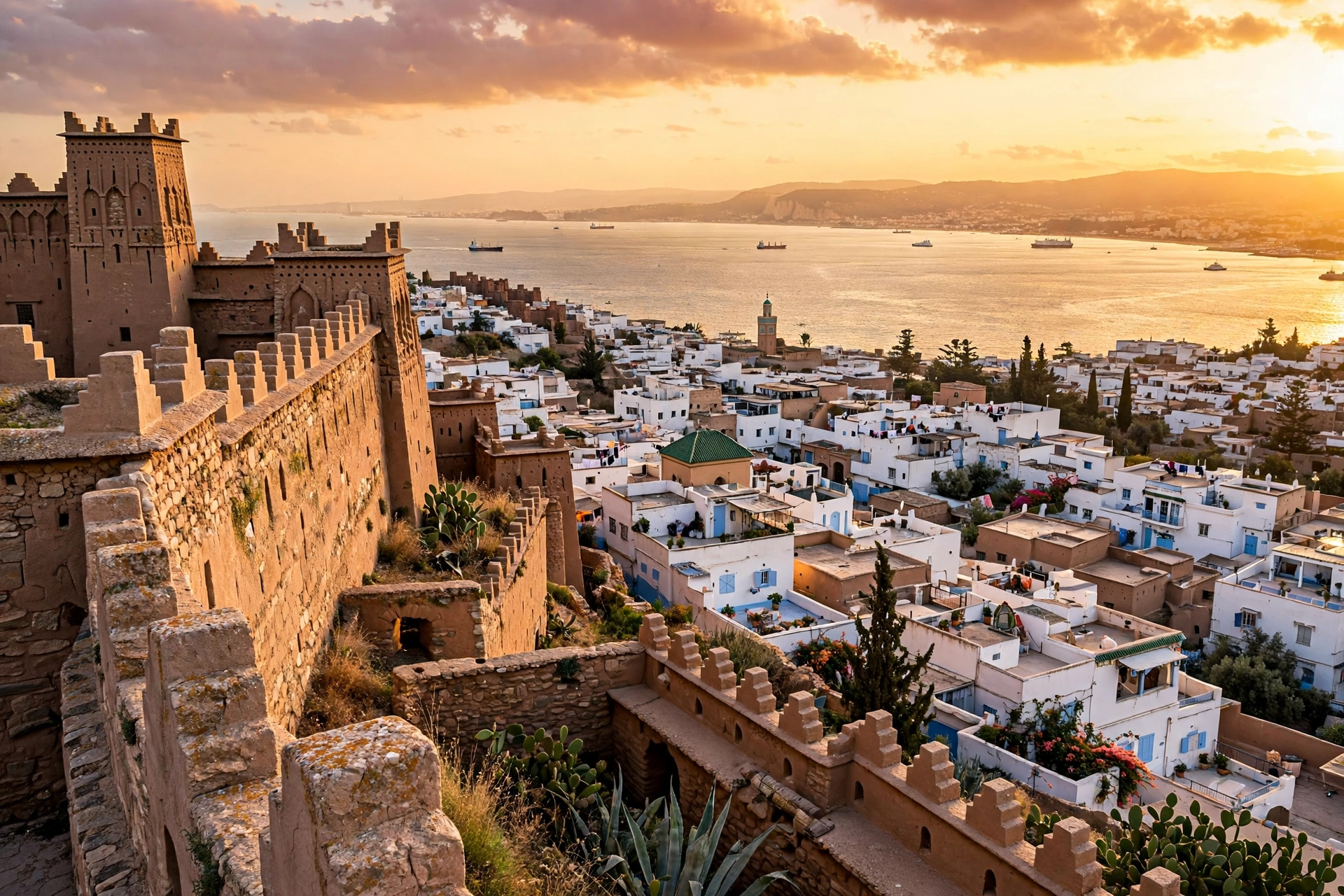
A Morocco in 16 days itinerary is the first length where the whole country fits with no rushed day and no skipped capital. Sixteen days crosses Morocco in one direction, gives every imperial city a day, gives the desert two nights, gives the Atlas its own day, gives Essaouira two slow nights and adds a full day in Rabat. Shorter routes always sacrifice something.
This Morocco in 16 days itinerary starts in Tangier, runs south through Chefchaouen, Volubilis and Meknes, spends two nights in Fes, crosses the Middle Atlas to the Merzouga dunes, returns through the Dades Valley and Ait Ben Haddou, spends four nights in Marrakech with an Atlas day, rests two nights in Essaouira, spends a day in Rabat and finishes in Casablanca.
In this guide
- Why Sixteen Days Is the Sweet Spot
- Morocco in 16 Days Itinerary at a Glance
- Day 1: Arrive in Tangier, the Strait City
- Day 2: Tangier to Chefchaouen, the Blue City
- Day 3: Chefchaouen to Meknes via Volubilis
- Day 4: Meknes to Fes, the Medieval Medina
- Day 5: A Full Day in Fes
- Day 6: Fes to Merzouga and a Night in the Sahara
- Day 7: A Full Day in the Merzouga Desert
- Day 8: Merzouga to the Dades Valley via the Todra Gorge
- Day 9: Dades to Marrakech via Ait Ben Haddou
- Day 10: A Full Day in Marrakech, the Red City
- Day 11: A Second Day in Marrakech
- Day 12: A Day in the Atlas Mountains at Imlil
- Day 13: Marrakech to Essaouira, the Atlantic Wind City
- Day 14: A Full Day in Essaouira
- Day 15: Essaouira to Rabat, the Quiet Capital
- Day 16: Rabat to Casablanca, Then Home
- How to Get Around on This Morocco in 16 Days Itinerary
- What a Morocco in 16 Days Itinerary Costs in 2026
- Where to Stay Each Night
- Mistakes That Ruin a Morocco in 16 Days Itinerary
- Frequently Asked Questions
- Conclusion: Is Sixteen Days Enough for Morocco?
Why Sixteen Days Is the Sweet Spot
Fifteen days in Morocco is already a great trip, but it skips the capital. A Morocco in 16 days itinerary adds a full day in Rabat — the Oudaya Kasbah, the Hassan Tower and the Chellah — and still keeps the slow Essaouira days and desert nights that make the route work.
The other reason this Morocco in 16 days itinerary works is the pace: Fes gets two nights, the desert two, Marrakech four, Essaouira two, Rabat one, and no day asks for more than seven hours behind the wheel. With fifteen days, our Morocco in 15 Days route ends in Casablanca straight from Essaouira; with sixteen, the capital gets its due.
Morocco in 16 Days Itinerary at a Glance
The table below is the whole Morocco in 16 days itinerary in one view. Drive times assume a private car; buses add about an hour per leg.
| Day | Route | Drive | Sleep |
|---|---|---|---|
| 1 | Arrive Tangier | — | Tangier |
| 2 | Tangier to Chefchaouen | 2.5 hours, 115 km | Chefchaouen |
| 3 | Chefchaouen to Meknes via Volubilis | 4 hours, 230 km | Meknes |
| 4 | Meknes to Fes | 1 hour, 65 km | Fes |
| 5 | Fes, full day | On foot | Fes |
| 6 | Fes to Merzouga | 7 hours, 460 km | Desert camp, Erg Chebbi |
| 7 | Merzouga desert, full day | Camels and on foot | Desert camp, Erg Chebbi |
| 8 | Merzouga to Dades Valley | 4 hours, 270 km | Dades Valley |
| 9 | Dades to Marrakech via Ait Ben Haddou | 5.5 hours, 330 km | Marrakech |
| 10 | Marrakech, full day | On foot | Marrakech |
| 11 | Marrakech, second full day | On foot | Marrakech |
| 12 | Marrakech to Imlil and back | 1.5 hours each way | Marrakech |
| 13 | Marrakech to Essaouira | 2.5 hours, 175 km | Essaouira |
| 14 | Essaouira, full day | On foot | Essaouira |
| 15 | Essaouira to Rabat | 4 hours, 300 km | Rabat |
| 16 | Rabat to Casablanca, fly home | 1.5 hours, 90 km | Fly home |
No day on this Morocco in 16 days itinerary asks for more than seven hours behind the wheel, and the two longest legs have the best scenery — the Ziz Valley and the High Atlas.
Day 1: Arrive in Tangier, the Strait City
Start your Morocco in 16 days itinerary in Tangier, not Casablanca. Tangier sits on the Strait of Gibraltar, a short ferry from Spain, with direct flights from London, Paris and Madrid. Landing here puts you straight onto the north-to-south line, and the kasbah above the strait is the perfect first view.
Spend the afternoon in the kasbah and the medina, then walk the Corniche at sunset — our Tangier Travel Guide covers both. Dinner: seafood pastilla or grilled sardines costs 80–150 MAD ($8–15).
Day 2: Tangier to Chefchaouen, the Blue City
Leave Tangier after breakfast for the Rif. The road takes about two and a half hours, and the last hour is the prettiest driving on a Morocco in 16 days itinerary: green hills and small Amazigh villages, the blue town appearing suddenly below. Chefchaouen's medina is small enough to cross on foot in twenty minutes. Climb to the upper medina, then walk to the Spanish Mosque at sunset for the view over the blue town — our Chefchaouen Blue City Guide explains when the light is best.
Day 3: Chefchaouen to Meknes via Volubilis
Leave Chefchaouen early and drive south through the Rif foothills to Volubilis, Morocco's great Roman ruin. Give the site two hours: the mosaics are still in place where the Romans laid them, and the triumphal arch frames the hills. Our Volubilis guide explains the city before Rome.
Continue to Meknes in the afternoon and walk straight to Bab Mansour, the grandest gate in Morocco, then cross Place el-Hedim at dusk, when families gather and the light turns the tiles gold. Our Meknes Travel Guide covers the granaries, the royal stables and the medina.
Day 4: Meknes to Fes, the Medieval Medina
The drive from Meknes to Fes takes barely an hour. Arrive before noon and spend the afternoon getting lost on purpose in Fes el-Bali, the oldest living medieval medina in the world, where nine thousand alleys have no cars. Start at Bab Bou Jeloud, the blue gate, and follow Talaa Kebira downhill past brass workers and spice stalls. Our Fes Travel Guide maps the neighbourhoods and the two main arteries, so you can find your way back on this Morocco in 16 days itinerary without hiring an unofficial guide at the gates.
Day 5: A Full Day in Fes
Give Fes a full day: one afternoon only scratches it. Start at the tanneries in the morning, when the dye pits are brightest — take the sprig of mint the leather workers hand you. Then visit the Al-Attarine Madrasa, a fourteenth-century school of carved cedar and zellige tilework. In the afternoon, climb to the Marinid Tombs for the view over the old city at golden hour — on a Morocco in 16 days itinerary, the alleys stop feeling like a maze and start feeling like home. Dinner in the medina costs 100–200 MAD ($10–20) with mint tea.
Day 6: Fes to Merzouga and a Night in the Sahara
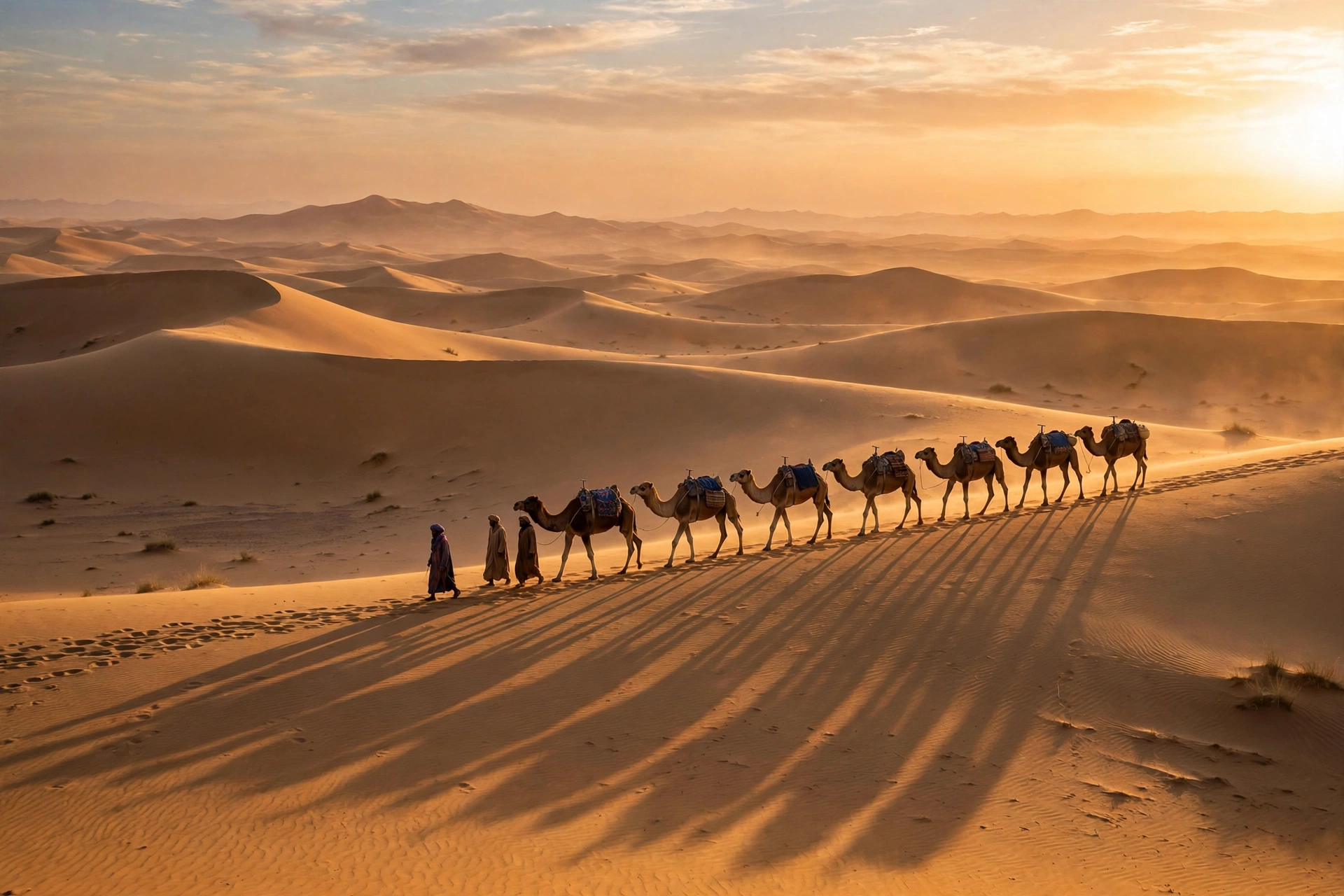
Day six is the longest drive of the trip, and the most rewarding. Leave Fes early and cross the Middle Atlas through Ifrane, the cedar forests around Azrou and the Ziz Valley, where the road drops between palm groves and cliffs. The drive takes about seven hours with stops, so start by eight. Arrive in Merzouga in the late afternoon and ride camels into the Erg Chebbi dunes at sunset, where your camp waits: a traditional tent, a tagine dinner and a sky full of stars. Our Sahara Desert guide explains why Erg Chebbi's tall dunes are worth the longer drive.
Day 7: A Full Day in the Merzouga Desert
Wake before dawn and climb the nearest dune for sunrise. Then spend the day the slow way: a morning walk to a nomad family, lunch in Khamlia village, and afternoon sandboarding down the big dune. The second desert night is what makes this Morocco in 16 days itinerary different from a rushed desert tour. Most visitors see the dunes for one sunset and leave; you get a full day to understand them.
Day 8: Merzouga to the Dades Valley via the Todra Gorge
Leave the dunes after breakfast and drive west to the Todra Gorge, a canyon with cliffs three hundred metres high. Stop at the narrowest point and walk in, where the rock walls block the sun. Continue to the Dades Valley for the night on this Morocco in 16 days itinerary, where the road winds between rock formations called the monkey fingers. Stay in a small guesthouse in the valley, where dinner is a home-cooked tagine.
Day 9: Dades to Marrakech via Ait Ben Haddou
On this Morocco in 16 days itinerary, drive south from the Dades Valley to Ouarzazate, the film-studio town at the edge of the Sahara, then on to Ait Ben Haddou, the fortified ksar from a dozen films. Climb to the top of the ksar for the view over the river valley, then cross the High Atlas over the Tizi n'Tichka pass at 2,260 metres.
Allow five and a half hours for the slow, winding pass road. Arrive in Marrakech by late afternoon and take your first walk through Jemaa el-Fna at dusk, when the food stalls light up — our Marrakech Travel Guide explains what to see first.
Day 10: A Full Day in Marrakech, the Red City
Spend the day in Marrakech on foot: the Koutoubia Mosque, the Saadian Tombs and the Bahia Palace, whose painted ceilings and gardens are the finest in the city. The three cost about 300 MAD ($30) and fill one morning. In the afternoon, cross into the souks for leather, lanterns and spices, with a fair price in mind. End the day back in Jemaa el-Fna for dinner at the stalls on this Morocco in 16 days itinerary — a full meal costs 60–120 MAD ($6–12).
Day 11: A Second Day in Marrakech
Marrakech deserves a second full day. Start in the Majorelle Garden, the cobalt-blue garden restored by Yves Saint Laurent, then visit the Yves Saint Laurent Museum next door and the Amazigh Museum inside. Spend the afternoon in Guéliz, the modern district, for cafés and galleries, then return to the medina for a rooftop dinner above the souks. Our Ouarzazate guide covers the road you drove here — and a slower second day is when Marrakech stops feeling frantic.
Day 12: A Day in the Atlas Mountains at Imlil
Take a day out of the city into the High Atlas. The drive to Imlil takes about ninety minutes, climbing through walnut groves and Amazigh villages to the trailhead below Mount Toubkal, North Africa's highest peak at 4,167 metres. The walk to Aroumd village takes two hours and rewards you with a waterfall and a valley view. Lunch in a mountain guesthouse — a mountain omelette and mint tea on a terrace above the valley — costs 60–100 MAD ($6–10). Our day trips guide covers Imlil and the other escapes from the Red City.
Day 13: Marrakech to Essaouira, the Atlantic Wind City
Leave Marrakech after breakfast for the Atlantic coast. The drive to Essaouira takes about two and a half hours across the argan plain — look for the goats in the trees. Stop on the way at an argan cooperative run by local women. Arrive by midday and walk the ramparts first: the cannons, the seagulls and the wind off the Atlantic. Our Essaouira Travel Guide covers the medina, the harbour and the beach — and grilled sardines at the harbour cost 40–70 MAD ($4–7) on any Morocco in 16 days itinerary.
Day 14: A Full Day in Essaouira
This is the extra day that justifies the whole Morocco in 16 days itinerary. Spend the morning on the beach — Essaouira's wide sand is made for walking, and the wind that makes Marrakech unbearable in July makes this coast perfect. In the afternoon, wander the medina slowly: art galleries, wood workshops and spice shops. Climb the ramparts again at sunset, when the light turns the white walls gold and the fishing boats come in. Dinner at the harbour is the same grilled fish as yesterday — Essaouira is a town to settle into.
Day 15: Essaouira to Rabat, the Quiet Capital
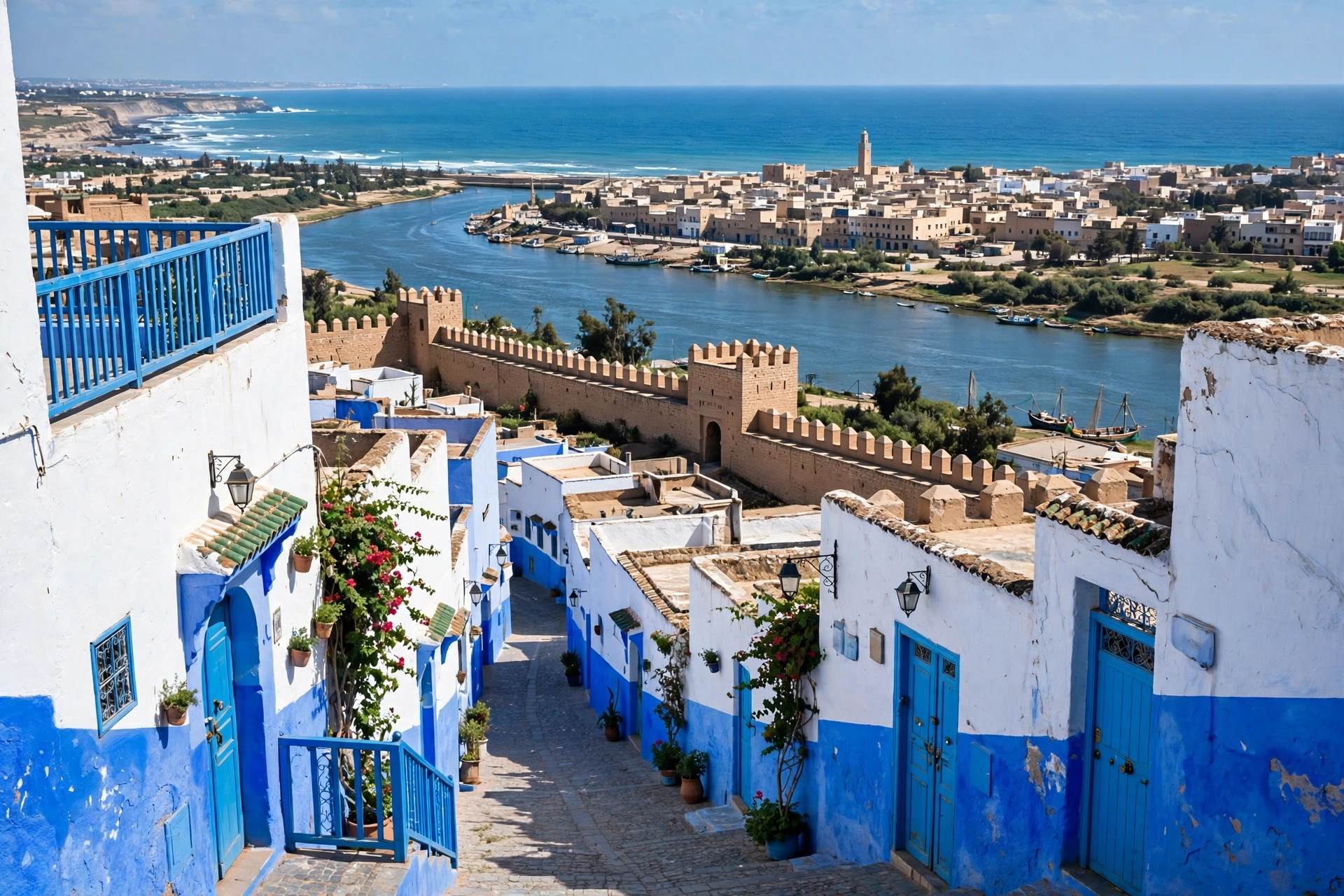
Drive north along the coast to Rabat, the capital, stopping in El Jadida to see the Portuguese fortress and its Manueline cistern, twenty-five columns reflected in shallow water. The coastal road takes about four hours with the stop, so leave Essaouira by nine. Arrive in Rabat in the afternoon and walk straight to the Oudaya Kasbah, the blue-and-white citadel above the Bou Regreg — our Rabat Travel Guide covers the kasbah, the medina and the Andalusian gardens. Dinner in Agdal costs 100–200 MAD ($10–20) on a Morocco in 16 days itinerary.
Day 16: Rabat to Casablanca, Then Home
Spend your last morning in Rabat at the Hassan Tower, the unfinished twelfth-century minaret, and the Chellah, where storks nest on Roman and medieval ruins. Entry to the Chellah costs 70 MAD ($7), checked in November 2026.
Then drive or take the train south to Casablanca — about ninety minutes — and visit the Hassan II Mosque, the largest mosque in Morocco and one of the few non-Muslims can enter on a guided tour. Entry costs 130 MAD ($13) for foreign adults, checked in November 2026. After the mosque, take a taxi to Mohammed V Airport — forty-five minutes from the centre, longer in rush hour — to end your Morocco in 16 days itinerary and fly home.
How to Get Around on This Morocco in 16 Days Itinerary
The simplest way to run this Morocco in 16 days itinerary is with a private driver, which costs roughly 600–900 MAD ($60–90) a day including fuel. A driver removes the stress of mountain roads and parking in the medinas. Book through your riad or a reputable agency, not through a tout at the airport.
The alternative is a mix of trains and rental cars. ONCF runs the Al Boraq high-speed train from Tangier to Casablanca, and Al Atlas trains link Fes, Meknes, Marrakech and Casablanca; the desert and mountain legs need a car. Renting a car costs 250–450 MAD ($25–45) a day, and our driving guide explains the road rules and mountain passes. Our Tangier to Marrakech train guide covers the full rail journey, and Visit Morocco lists official transport information. Check our best time guide before you pick your season.
What a Morocco in 16 Days Itinerary Costs in 2026
The table below is a realistic mid-range budget for one person on this Morocco in 16 days itinerary, checked in November 2026. Budget travellers can spend half as much.
| Item | Daily cost (MAD) | 16-day total (MAD) | In USD |
|---|---|---|---|
| Mid-range riad or hotel | 500–800 | 8,000–12,800 | $800–1,280 |
| Food and drink | 200–350 | 3,200–5,600 | $320–560 |
| Private driver or car rental | 400–700 | 6,400–11,200 | $640–1,120 |
| Entry fees and activities | 100–200 | 1,600–3,200 | $160–320 |
| Desert camp (2 nights) | — | 1,200–2,400 | $120–240 |
| Local transport and tips | 50–100 | 800–1,600 | $80–160 |
| Total | 1,250–2,050 | 21,200–36,800 | $2,120–$3,680 |
The biggest saving on a Morocco in 16 days itinerary is travelling as a couple: the driver, the car and the room split in two, while food and entry fees stay per person. The biggest budget leak, as our trip cost guide explains, is unmetered taxis and guide commissions — agree the price first.
Where to Stay Each Night
Stay in riads inside the medinas wherever you can — they are the experience, not just a bed. Book the first three nights before you fly, and the rest as you go. Book the desert camp and the Fes riad in advance — both sell out in spring and autumn — and the rest two or three days ahead.
| Nights | City | Where to stay |
|---|---|---|
| 1 | Tangier | Riad in the kasbah or medina |
| 2 | Chefchaouen | Guesthouse in the upper medina |
| 3 | Meknes | Riad near Place el-Hedim |
| 4–5 | Fes | Riad in Fes el-Bali |
| 6–7 | Merzouga | Desert camp in Erg Chebbi |
| 8 | Dades Valley | Guesthouse in the valley |
| 9–12 | Marrakech | Riad in the medina or Guéliz |
| 13–14 | Essaouira | Riad in the medina or near the beach |
| 15 | Rabat | Riad in the medina or Agdal |
| 16 | Fly home | — |
Mistakes That Ruin a Morocco in 16 Days Itinerary
The first mistake is trying to add more. Sixteen days already covers ten cities; adding the Rif coast, Agadir or Zagora turns a holiday into a driving test. The country rewards depth, not distance. The second is booking the desert from Marrakech as a tour. Those tours rush the dunes and skip the second night, the best part — book the camp directly in Merzouga and arrive on your own schedule.
The third mistake is underestimating the heat: in July and August, Marrakech reaches 38°C and the desert more, so drive at eight and sightsee in the mornings and evenings. The fourth is skipping travel insurance and a first-aid kit. Moroccan pharmacies are excellent and cheap, but a twisted ankle on a dune or a stomach bug is far easier with insurance and rehydration salts in your bag. The fifth is carrying only cards: the desert camps, the mountain guesthouses and the medina stalls all run on cash, so withdraw dirhams in the cities first.
Frequently Asked Questions
Is 16 days enough for Morocco?
Yes. A Morocco in 16 days itinerary covers the imperial cities, the Sahara, the Atlas Mountains and the Atlantic coast at a relaxed pace, including the capital. — the shortest length that does all five properly.
How much does a Morocco in 16 days itinerary cost?
A mid-range Morocco in 16 days itinerary costs roughly 21,000–37,000 MAD ($2,100–$3,700) per person, including a private driver, riads, food and a two-night camp. Couples split the driver and the room, so each person pays less.
What is the best time of year for a Morocco in 16 days itinerary?
Spring (March to May) and autumn (September to November) are best: warm days, cool nights and green mountains. Summer is too hot in Marrakech and the desert, and winter brings cold nights in the Atlas and camps.
Do I need a car for a Morocco in 16 days itinerary?
Not for the whole trip. Trains cover Tangier, Fes, Meknes, Marrakech, Rabat and Casablanca, but the desert, the Dades Valley and the Atlas villages need a car.
Can I do a Morocco in 16 days itinerary by public transport only?
Almost, but not quite. Buses reach every city on this route, including Merzouga, but the desert camp, the Todra Gorge and the Atlas villages need a car.
Is Morocco safe for a 16-day trip?
Yes. Morocco is safe for tourists, and the real risks are small scams rather than crime: unmetered taxis, unofficial guides and inflated souk prices. Agree prices in advance, keep valuables out of sight and drink bottled water.
Conclusion: Is Sixteen Days Enough for Morocco?
Sixteen days is the length where Morocco stops being a highlights tour and starts being a journey. A Morocco in 16 days itinerary gives you the Strait and the Atlantic, the blue city and the medieval medina, two nights among the dunes and a day in the High Atlas, and it still leaves you an evening in Essaouira, a day in Rabat and a morning at the Hassan II Mosque.
Start planning with our Morocco Travel Guide for First-Time Visitors for visas, money and packing — and if you have sixteen days, take them.
Last checked: November 2026.
3 thoughts on “Morocco in 16 Days: The Complete North-to-South Route”