
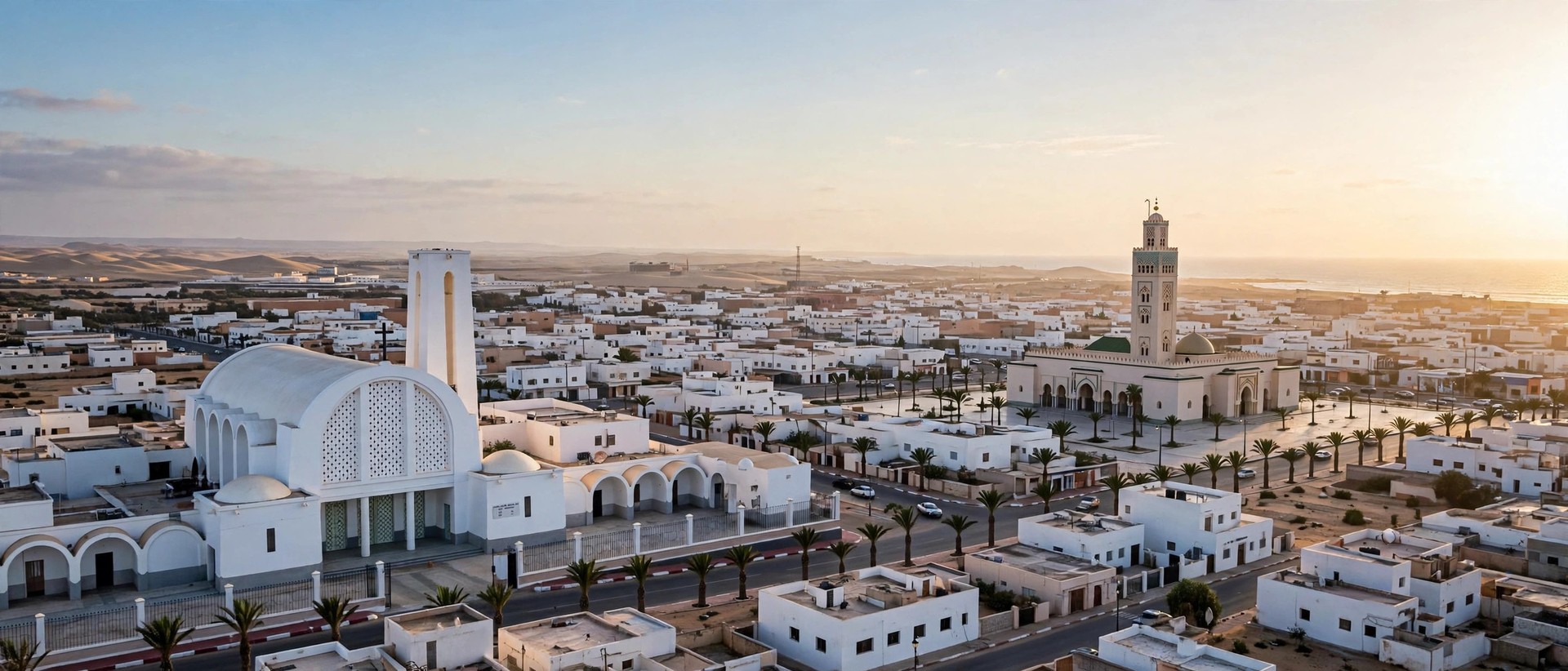
This Laayoune travel guide introduces a city most travellers only pass through — and that is why it rewards a stop. Laayoune, Arabic for "the springs", is the largest city of the south, home to about 263,000 people (2024 census) on the south bank of the Saguia el-Hamra, the river that gives the region its name. It sits about 13 km inland from the Atlantic: a low, bright city of wide boulevards and Sahrawi tea houses, where the desert meets the ocean breeze.
Laayoune lies in Western Sahara, a territory whose final status is disputed internationally; it is administered by Morocco and reached on Moroccan domestic flights. What follows, part of our Morocco Travel series, covers how to get there, what to see, where to stay, what it costs and when to go. All prices are planning ranges in Moroccan dirhams (MAD), checked in November 2026, at roughly 10 MAD to $1 — check on arrival.
In this guide
- Laayoune at a Glance
- A Short History of Laayoune
- Getting to Laayoune
- Getting Around Laayoune
- Where to Stay in Laayoune
- The Cathedral, Mosques and the Old Town
- Markets and the Camel Market
- Food and Drink in Laayoune
- Foum el Oued: Where the Sahara Meets the Atlantic
- Bou Craa and the Desert Around Laayoune
- Climate and the Best Time to Visit Laayoune
- Laayoune Travel Guide Costs and Daily Budget
- Practical Tips for Visiting Laayoune
- Frequently Asked Questions
- Conclusion
Laayoune at a Glance
| Fact | Detail |
|---|---|
| Location | Southern Morocco, on the Saguia el-Hamra, about 13 km from the Atlantic |
| Population | About 263,000 (2024 census) |
| Region | Capital of the Laâyoune-Sakia El Hamra region |
| Elevation | About 72 metres |
| Nearest airport | Hassan I Airport (EUN), about 2.5 km from the centre |
| Best months | October to May |
| Daily budget | 350–700 MAD ($35–$70) for a mid-range traveller |
Any Laayoune travel guide has to start with a correction: this is not a ruined desert outpost. Laayoune is a working administrative capital with universities, a stadium, hospitals and a large fishing and phosphate economy. Most visitors come for one or two nights on the road between Agadir and Dakhla.
A Short History of Laayoune
Laayoune is a young city by Moroccan standards, and any Laayoune travel guide should say so first. Spanish captain Antonio de Oro founded it in 1938 as a small military outpost beside the springs and the Saguia el-Hamra riverbed, and it grew quickly into the administrative capital of the Spanish Sahara. The old Spanish quarter still shows that origin in its grid streets, its cathedral and its colonial villas.
After Spain withdrew in early 1976, following the Green March of November 1975 and the Madrid Accords, the city grew fast under Moroccan administration. The population rose from about 94,000 in 1982 to about 263,000 in 2024, driven by the phosphate mine at Bou Craa, the fishing port at El Marsa and public-sector jobs. The United Nations mission MINURSO keeps its headquarters here. Read more on Wikipedia.
Getting to Laayoune
Flying is the easy way in. Hassan I Airport (EUN) sits about 2.5 km from the centre. Royal Air Maroc flies direct to Casablanca in about 1 hour 35 minutes, to Agadir in about 1 hour 10 minutes, plus Marrakech, Rabat and Dakhla. Binter Canarias flies to Las Palmas in Gran Canaria in about 50 minutes. Expect roughly 800–1,500 MAD ($80–$150) return from Casablanca; check the airline directly.
By road, this Laayoune travel guide follows the N1 coastal highway. The drive from Agadir is about 630 km and takes roughly 7.5 to 8 hours. From Dakhla it is about 620 km by road, a drive of 6 to 8 hours depending on stops and checkpoints. CTM and Supratours coaches run the long routes: Agadir to Laayoune takes about 12 hours and costs roughly 266 MAD ($27); Marrakech takes about 16 hours and roughly 387 MAD ($39). See our Morocco driving costs guide for petrol and tolls.
| Route to Laayoune | Distance | Time |
|---|---|---|
| Casablanca (flight) | About 880 km | 1 h 35 min |
| Agadir (flight) | About 500 km | 1 h 10 min |
| Agadir (road, N1) | About 630 km | 7.5–8 h |
| Dakhla (road, N1) | About 620 km | 6–8 h |
| Tarfaya (road) | About 100 km | 1 h 15 min |
| Las Palmas (flight) | About 400 km | 50 min |
Getting Around Laayoune
Laayoune is spread out, so this Laayoune travel guide starts with taxis: petit taxis run everywhere in town for about 5–15 MAD ($0.50–$1.50) a ride. Grand taxis and coaches leave from the bus station for Tarfaya, Boujdour, Smara and Dakhla. For Foum el Oued, the beach 25 km west, a taxi return costs roughly 80–120 MAD ($8–$12); agree the waiting time before you leave.
Driving yourself is straightforward: the roads in town are wide and quiet, and the N1 south is good tarmac. Keep your passport handy, as there are routine police checkpoints on the long desert roads. Fill the tank whenever you see a station south of Tan-Tan, and do not leave the paved roads — the area east of the berm is off limits.
Where to Stay in Laayoune
This Laayoune travel guide is honest about hotels: the choice is small and business-like, not boutique. The best-known is the four-star Al Massira on Avenue de la Meque, with about 103 rooms, a pool, restaurants and an airport shuttle. Hotel Parador, a classic in the style of an Arab palace with garden courtyards, is the other established choice, and smaller hotels such as the Sahara Line and San Mao Sahara cover the mid-range.
As planning ranges for November 2026, check on arrival: budget rooms 250–450 MAD ($25–$45), mid-range hotels 400–700 MAD ($40–$70), and the top hotels 600–1,000 MAD ($60–$100) a night. Stay in the centre, around Place Mechouar or Avenue Mohammed V, within walking distance of the cathedral, the souks and the cafes. Our Dakhla travel guide covers the next stop south.
The Cathedral, Mosques and the Old Town
The Cathedral of Saint Francis of Assisi is the city's best-known landmark. Built in the 1950s, when Laayoune was the capital of the Spanish Sahara, it is a striking piece of modernist Spanish architecture: a white tower topped by a distinctive cone, and a low hall whose lines echo a Saharan tent. It is no longer used for regular worship, and the interior is often locked, so admire it from outside in the late afternoon, when the white walls soften in the light. Allow 20 to 30 minutes.
Around the cathedral, the old Spanish quarter keeps its grid of low white houses, shaded streets, colonial villas and faded CORREOS letter boxes. The Grand Mosque, also known as the Moulay Abdelaziz Mosque, is the main mosque on any Laayoune travel guide walk, with Saharan-style architecture and a tall minaret visible across the skyline. Non-Muslims can admire it from the plaza, especially around prayer times. Place Mechouar, the main civic square, fills with families in the evening, and the souks around Avenue Mohammed V sell spices, dates, textiles and the bright melhfa wraps worn by Sahrawi women.
Markets and the Camel Market
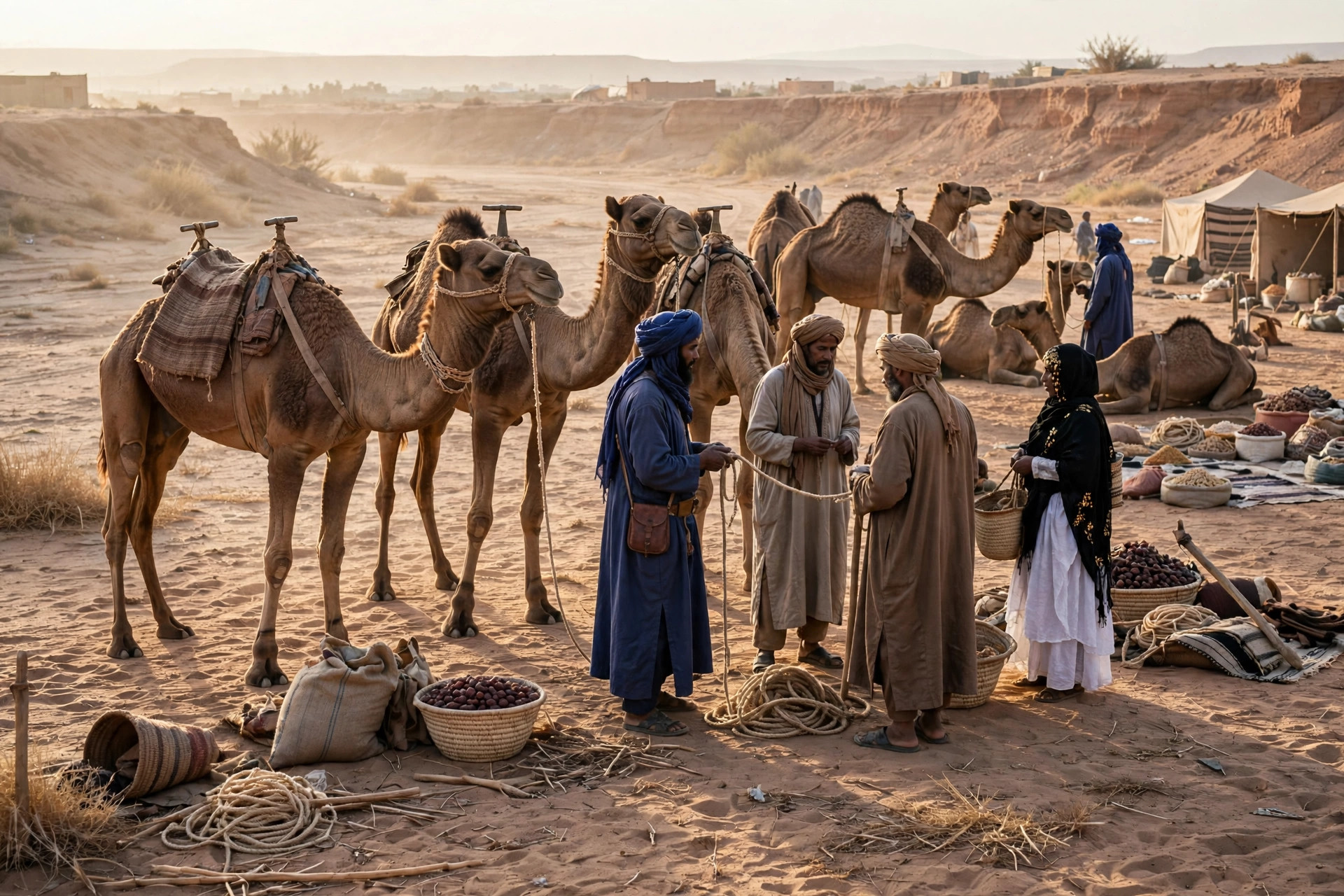
The weekly market is the most memorable experience in this Laayoune travel guide. Traders, herders and artisans come in from across the southern provinces to sell camels, goats and sheep alongside silver and amber jewellery, leather goods made from camel hide, handwoven textiles and embroidered melhfa wraps in blue, purple and yellow. Thursday and Friday mornings are the liveliest, when the camel trading is at its busiest and the haggling runs in Hassaniya Arabic.
The daily central market is calmer: dried dates, spices, fresh and dried fish, vegetables and household goods, sold at local prices with no tourist markup. Keep small notes and coins, carry cash, and move carefully through the camel section — the animals are large and unpredictable. Our tipping in Morocco guide covers what to pay the people who help you here.
Food and Drink in Laayoune
Eating is a highlight of any Laayoune travel guide: the food here is Saharan and Atlantic at once. The Atlantic supplies sea bass, red mullet, dorado and prawns, grilled the same day they are caught, while the desert supplies camel and goat tagines, dates and the three-glass Saharan tea ceremony — the last glass the sweetest. Harira soup, bread from the neighbourhood bakery and mint tea at 5–10 MAD ($0.50–$1) fill out the everyday table.
As planning ranges for November 2026, check on arrival: a tagine or grilled fish lunch 40–80 MAD ($4–$8), a seafood dinner 80–150 MAD ($8–$15), and a cafe breakfast of harira and bread under 20 MAD ($2). The best seafood is at the fishing port and at Foum el Oued, where small restaurants grill the morning catch. See our Moroccan food guide for the wider Moroccan table.
Foum el Oued: Where the Sahara Meets the Atlantic
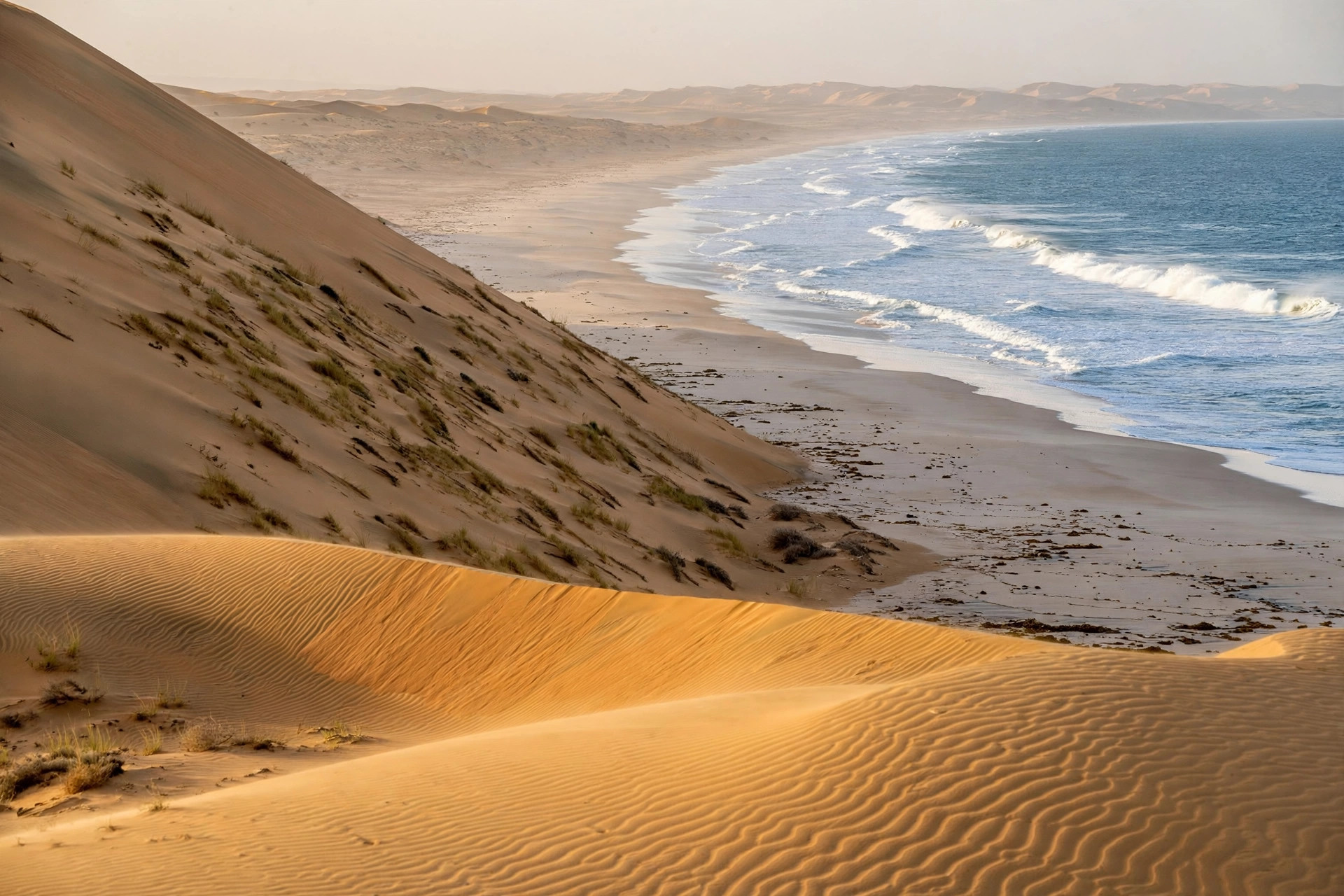
Foum el Oued, about 25 km west of Laayoune, is where this Laayoune travel guide earns its keep. Here the dunes descend directly into the Atlantic: a wide, wild and almost entirely undeveloped beach that stretches for kilometres in both directions, with powerful surf and light coloured by Saharan dust. It is one of the most striking meetings of desert and ocean in Africa.
The surf is serious — strong waves, not a gentle swimming beach — so treat the water with respect. Come for the walk, the photographs and the seafood at the small port restaurants, in the morning or late afternoon. The beach is free, and a taxi return from the city costs roughly 80–120 MAD ($8–$12). Laayoune-Plage, the fishing port closer to town, is the working alternative, with boats and a small fish market at low tide.
Bou Craa and the Desert Around Laayoune
South-east of the city lies Bou Craa, one of the largest phosphate mines in the world, and the reason a thin white line cuts across the desert on satellite images. The conveyor belt that carries phosphate rock from the mine to the port at El Marsa, near Laayoune, runs about 100 km and is the longest conveyor belt system in the world, moving about 2,000 tonnes of rock an hour — see the NASA Earth Observatory feature. The mine produces around 3 million tonnes a year, about a tenth of Morocco's total output.
No Laayoune travel guide can offer a mine tour: Bou Craa is a working industrial site, not a visitor attraction, and there are no public tours. But the desert around Laayoune is open to travellers on the paved roads. Dunes begin just beyond the last streets, and a short drive out of town gives you empty hammada and big skies. The Saguia el-Hamra riverbed, the "red river" along the edge of the city, carries water only after rare rains. For a desert night under canvas, see our Morocco Sahara camping guide.
Climate and the Best Time to Visit Laayoune
Laayoune's hot desert climate, softened by the Atlantic and the cool Canary Current, is the mildest this Laayoune travel guide covers in the Moroccan south. The average annual temperature is just over 21°C, with January averaging about 17°C and August about 25°C. Rain is rare — around 30 mm a year — and the wind and coastal fog shape the weather more than any rain.
| Season | Daytime | Nights | Best for |
|---|---|---|---|
| Winter (Dec–Feb) | 18–22°C | 8–12°C | Sightseeing, desert walks, clear skies |
| Spring (Mar–May) | 22–28°C | 10–17°C | Markets, road trips, the coast |
| Summer (Jun–Aug) | 28–35°C | 18–22°C | Beach mornings, early starts |
| Autumn (Sep–Nov) | 25–30°C | 15–20°C | The most comfortable all-round season |
The best months are October to May, when daytime temperatures sit in the high teens and twenties and the light is at its best. June to September is warmer and windier, best for early mornings and empty beaches. Whatever the season, pack sun protection, a windproof layer and water for any walk outside the city.
Laayoune Travel Guide Costs and Daily Budget
Laayoune is not expensive by Moroccan standards, and a mid-range day in this Laayoune travel guide costs 350–700 MAD ($35–$70). A bed in a mid-range hotel is the biggest cost, and food, taxis and sights are all cheap: the cathedral, the squares and the markets are free, and the beach costs only the taxi fare.
| Expense | Budget (MAD) | Mid-range (MAD) |
|---|---|---|
| Hotel, per night | 250–450 | 400–1,000 |
| Food and drink, per day | 80–150 | 150–300 |
| Taxis in town, per day | 20–50 | 50–120 |
| Foum el Oued taxi return | 80–120 | 80–120 |
| Flight from Casablanca, return | 800–1,500 | 800–1,500 |
| Daily total (without flights) | 350–550 | 550–900 |
Two nights is the right length for most visitors: one day for the city, the cathedral and the markets, and one for Foum el Oued and the desert edge. Our SIM cards and mobile data guide explains staying connected on the road south.
Practical Tips for Visiting Laayoune
A few honest notes make this Laayoune travel guide work in practice. French runs the administration, the hotels and the banks; Hassaniya Arabic and Darija run the markets and the street, and Spanish is still heard from the older generation.
Drink bottled water at first, and keep a bottle with you outside the city. Dress modestly — Laayoune is a conservative city — and ask before photographing people, especially women. Check your government's current travel advice before departure, and do not travel east of the berm or off the paved roads in the interior. Day trips are easy: Tarfaya (about 100 km north), Smara inland, and Boujdour (about 190 km south) on the road to Dakhla. Our about page explains how these guides are researched and priced.
Frequently Asked Questions
Is Laayoune safe for travellers?
Laayoune is generally visited as an ordinary Moroccan provincial city, with wide streets, a visible police presence and low street crime. Keep valuables out of sight, avoid walking alone late at night, and check your government's current travel advice before departure, because the territory's status is disputed. Do not travel east of the berm or off paved roads in the interior.
How do I get to Laayoune?
Fly to Hassan I Airport (EUN), about 2.5 km from the centre — the arrival this Laayoune travel guide recommends — with Royal Air Maroc from Casablanca, Agadir, Marrakech, Rabat and Dakhla, or Binter Canarias from Gran Canaria. By road, the N1 runs south from Agadir in about 7.5 to 8 hours and north from Dakhla in 6 to 8 hours, with CTM and Supratours coaches on the long routes.
When is the best time to visit Laayoune?
October to May is the best time, with daytime temperatures of about 18–28°C and clear skies. Summer is warmer and windier, with daytime highs of 28–35°C.
How many days do I need in Laayoune?
Two nights is right for most visitors: one day for the cathedral, the squares, the mosques and the markets, and one day for Foum el Oued beach and the desert edge.
What is the camel market, and when is it held?
The weekly market brings traders and herders from across the southern provinces to sell camels, goats and sheep, alongside Sahrawi crafts, jewellery and textiles. Thursday and Friday mornings are the liveliest. It is free to visit; dress modestly, ask before photographing people and move carefully among the animals.
Can I visit Bou Craa phosphate mine?
No — and no Laayoune travel guide can change that. Bou Craa is a working industrial mine, not a visitor attraction, and there are no public tours. You can still appreciate its scale from the road and from the satellite-visible conveyor belt, and the desert around Laayoune — the dunes, the hammada and the Saguia el-Hamra riverbed — is open to travellers on paved roads.
Conclusion
A Laayoune travel guide that is honest has to say this plainly: Laayoune is not a city of grand monuments, and it does not try to be. Its appeal is quieter — a Spanish cathedral in the desert light, a camel market at dawn, Saharan tea poured high in three glasses, and dunes running down into the Atlantic at Foum el Oued. It is the most human stop on the long Saharan road.
Come for the stopover and stay for the texture. Fly in, walk the old Spanish quarter, eat grilled fish at the port, and watch the sun drop over the dunes at Foum el Oued. If this Laayoune travel guide has done its job, you will arrive knowing what to expect and leave understanding why travellers keep coming back to the Saharan Atlantic.