
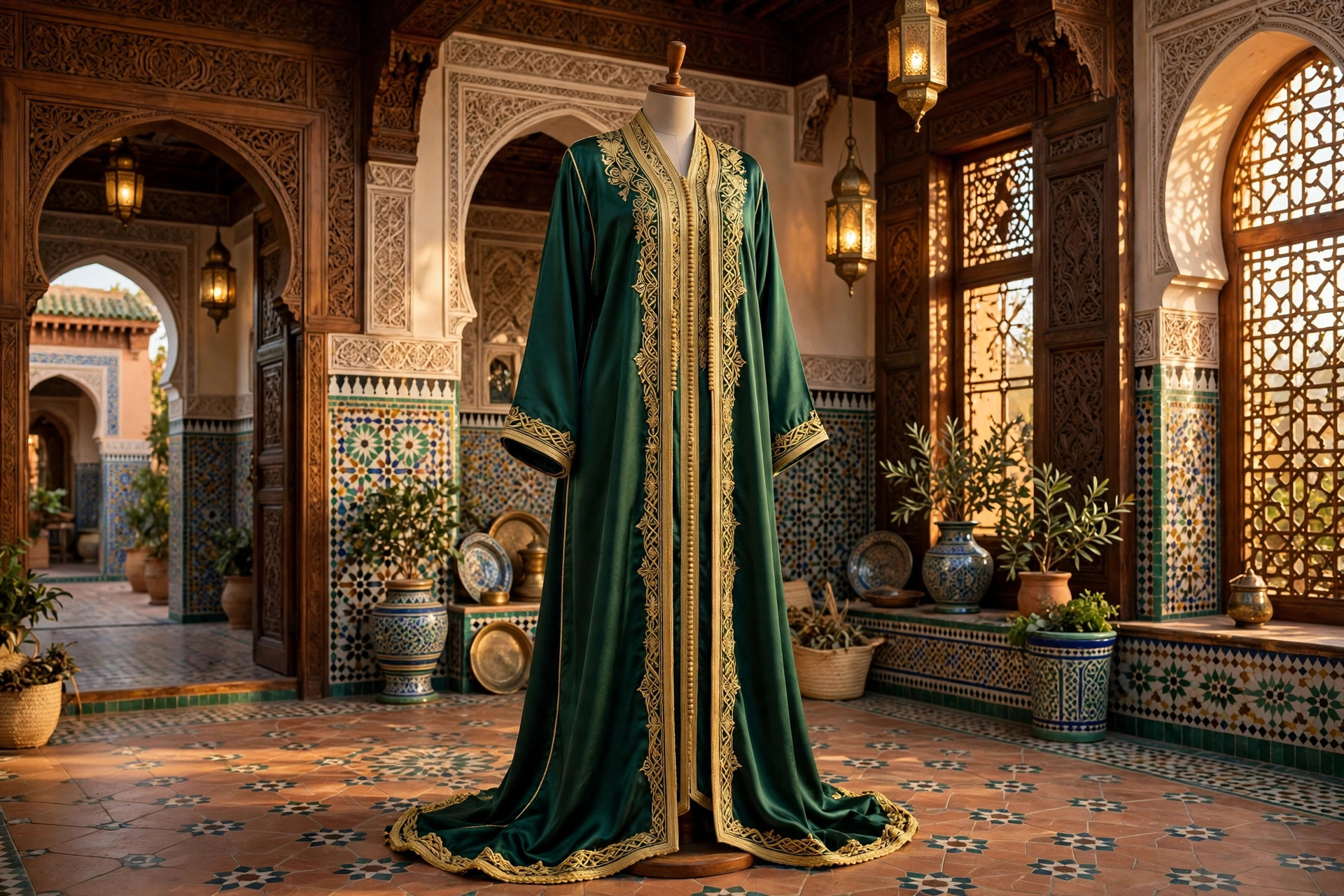
Stand at the edge of a Moroccan wedding dance floor as the bride makes her entrance, and the room seems to hold its breath. The history of Moroccan caftan begins in moments like this one, in silk and gold thread, in a garment that has dressed queens and brides for centuries. The caftan is a long, open-fronted robe, closed with knotted silk buttons and edged with braided trim, and it is the most recognisable symbol of Moroccan dress. Yet its story is not a simple one.
Some historians trace it to the courts of al-Andalus, others to Ottoman Istanbul, and still others to robes worn in Morocco centuries before either. The history of Moroccan caftan is therefore a story of arguments as much as of silk, and this guide tells it honestly, marking clearly where the evidence ends and the debate begins. It sits in our History & Heritage section, beside our history of Morocco, and our Moroccan food guide covers the feasts where the caftan is worn.
In this guide
- What Is a Moroccan Caftan?
- The History of Moroccan Caftan: From Court Robe to National Dress
- The Contested Origins: Andalusi, Ottoman or Older?
- Timeline: How the History of Moroccan Caftan Unfolded
- The Saadian Court and the Feminisation of the Caftan
- Fes, Tetouan and Rabat: Three Cities, Three Styles
- Caftan or Takchita? Reading the Two-Piece Dress
- Sfifa, Aakad and Tarz: The Craft in the Details
- The Maâlem’s Workshop: How a Caftan Is Made
- The History of Moroccan Caftan at Weddings
- From the Medina to the Runway: The History of Moroccan Caftan in Modern Fashion
- The UNESCO Story: Objection, Inscription and a Contested Heritage
- Buying a Caftan: Prices, Fabrics and Where to Shop
- Renting, Wearing and Caring for a Caftan
- The History of Moroccan Caftan Today
- Frequently Asked Questions
- Conclusion: A Thread That Has Not Broken
What Is a Moroccan Caftan?
A caftan is a long, loose robe, open down the front and fastened with a column of small knotted buttons. It falls to the ankles, has long sleeves, and is worn over an underdress or on its own, belted at the waist with a wide sash called a mdamma. The silhouette is simple, and that simplicity is the point: the cloth, the colour and the handwork do the talking.
What sets the Moroccan caftan apart is its finishing. A braided silk trim called sfifa edges the front opening, the neckline, the cuffs and the hem. The buttons, known as aakad, are knots of silk thread made by hand, each one a tiny sculpture. Embroidery, beads or sequins may cover the chest and sleeves, or the dress may stay plain.
The History of Moroccan Caftan: From Court Robe to National Dress
Long robes with front openings were worn across the Islamic world for centuries, and Morocco made the form its own. By the sixteenth century the caftan was the dress of sultans, viziers and their households, a visible marker of rank where cloth announced status before words. The history of Moroccan caftan in this period is a court story, told in silk brocade, gold thread and the workshops that supplied the palace.
Over the following centuries the robe travelled down the social scale, from merchants' wives to urban families to brides in every town. It survived the Protectorate years that followed the Treaty of Fes of 1912 and the earthquake that destroyed Agadir in 1960, and emerged as the ceremonial dress of independent Morocco.
The Contested Origins: Andalusi, Ottoman or Older?
Ask three historians where the caftan came from and you may get three answers, and none of them is settled. The strongest documented thread runs through al-Andalus: art historian Rachida Alaoui links the garment to Moorish heritage and dates its arrival in Morocco to the late fifteenth century, when refugees from Granada settled in Fes and Tetouan. The history of Moroccan caftan, on this account, begins with exiles carrying looms, dyes and embroidery patterns across the Strait of Gibraltar.
A second thread runs east. The Saadian sultan Abd al-Malik had lived in Algiers and Istanbul before taking the throne in 1576, and he dressed in the Ottoman manner; his brother Ahmad al-Mansur kept Turkish fashions at court after 1578. A third claim reaches further back, to robes of Moorish kings in antiquity and a miniature showing an Almohad caliph in an embroidered robe. The history of Moroccan caftan is best described as contested on origins: Andalusi, Ottoman and older influences all plausibly fed into it, and no single source explains the garment alone. The Wikipedia account of the caftan gives the wider family of robes across the region.
Timeline: How the History of Moroccan Caftan Unfolded
The dates below are the ones most sources agree on, with the early ones marked as disputed. The history of Moroccan caftan does not run in a straight line: it advances in bursts, at courts and in workshops.
| Date | What happened |
|---|---|
| 12th century (disputed) | A miniature is said to show an Almohad caliph in an embroidered robe; the dating and meaning are debated |
| Late 15th century | Refugees from Granada settle in Fes and Tetouan, bringing Andalusi weaving and embroidery skills |
| 1576–1578 | Saadian sultans Abd al-Malik and Ahmad al-Mansur bring Ottoman court fashions to Marrakech |
| Late 17th century | The caftan spreads from the palace to the urban middle classes |
| 19th century | Fes brocade workshops flourish; silk shot with gold and silver thread becomes the luxury cloth |
| 1990s–2000s | Caftan fashion shows in Marrakech present the garment as modern couture |
| December 2024 | Morocco objects to a caftan image in Algeria's UNESCO file; the committee orders it removed |
| 10 December 2025 | UNESCO inscribes the Moroccan caftan in New Delhi, at its twentieth session |
The Saadian Court and the Feminisation of the Caftan
The Saadian era, from the mid-sixteenth century, is where the caftan becomes unmistakably a court garment in Morocco. The sultans of Marrakech ruled an empire enriched by sugar and gold, and they dressed to show it. The two-piece caftan is still sometimes called the mansouria, after Ahmad al-Mansur, who reigned from 1578 — a name that ties the garment to his court, though the link is traditional rather than proven by a single document.
It was also under the Saadians that women took the caftan as their own. Until then the robe had largely been a male garment, worn by rulers and dignitaries. The history of Moroccan caftan turns here: as court women adopted it, the embroidery grew richer, the silks finer, and the dress began its long journey from a symbol of male power to the centrepiece of women's ceremonial dress. Visitors to Marrakech can still see the dynasty's Saadian Tombs, in the city where it happened.
Fes, Tetouan and Rabat: Three Cities, Three Styles
Every Moroccan city embroiders differently, and a trained eye can read the origin of a caftan from its stitching. Fes, the old weaving capital, is famous for tarz fassi, counted-thread embroidery in double running stitch, so precise that the back of the cloth shows the same pattern as the front. Traditionally it was worked in a single colour — blue, red, black or gold — in patterns passed down within families.
Tetouan kept the strongest Andalusi flavour, brought by the families who rebuilt the city after the fall of Granada, while Rabat and Salé developed their own bolder, floral schools. The history of Moroccan caftan is written city by city, and the table below gives the broad strokes. Travellers can see the workshops via our Fes travel guide and Marrakech travel guide.
| City | Style |
|---|---|
| Fes | Tarz fassi: counted-thread geometric embroidery, often one colour, reversible; brocade woven with gold and silver thread |
| Tetouan | Strong Andalusi flavour; fine, delicate embroidery from families who came from Granada |
| Rabat and Salé | Bolder floral designs with denser colour fill |
| Marrakech and the south | Rich colours, heavier decoration, gold thread favoured for celebrations |
| Sahara | Simpler, flowing cuts; embroidery in indigo and earth tones |
Caftan or Takchita? Reading the Two-Piece Dress
Visitors often use the two words as if they meant the same thing. They do not. A caftan, in everyday Moroccan speech, is a single dress, one layer, worn on its own. The takchita is two: a plain underdress, the tahtiya, and over it the dfina, open at the front or buttoned, which carries the embroidery, beading, sfifa and aakad.
The difference matters most at weddings, where a bride changes takchitas several times in one night, each change managed by the negafa, the woman who runs the ceremony behind the scenes. The history of Moroccan caftan includes both forms, but the takchita is the grander of the two: heavier, more decorated, and built for a single evening's entrances. For a guest, one well-chosen caftan is enough; for a bride, the takchita is the main event.
Sfifa, Aakad and Tarz: The Craft in the Details
Three details tell you whether a caftan is handmade, and how much work went into it. The sfifa is a braided trim of silk, rayon or metallic thread, plaited by hand into a flat band and stitched along the front opening, the neckline, the sleeves and the hem. The aakad are the knotted buttons that run down the front, dozens of them, each tied by hand and fastened into small loops; making them was historically a speciality of Sefrou, near Fes.
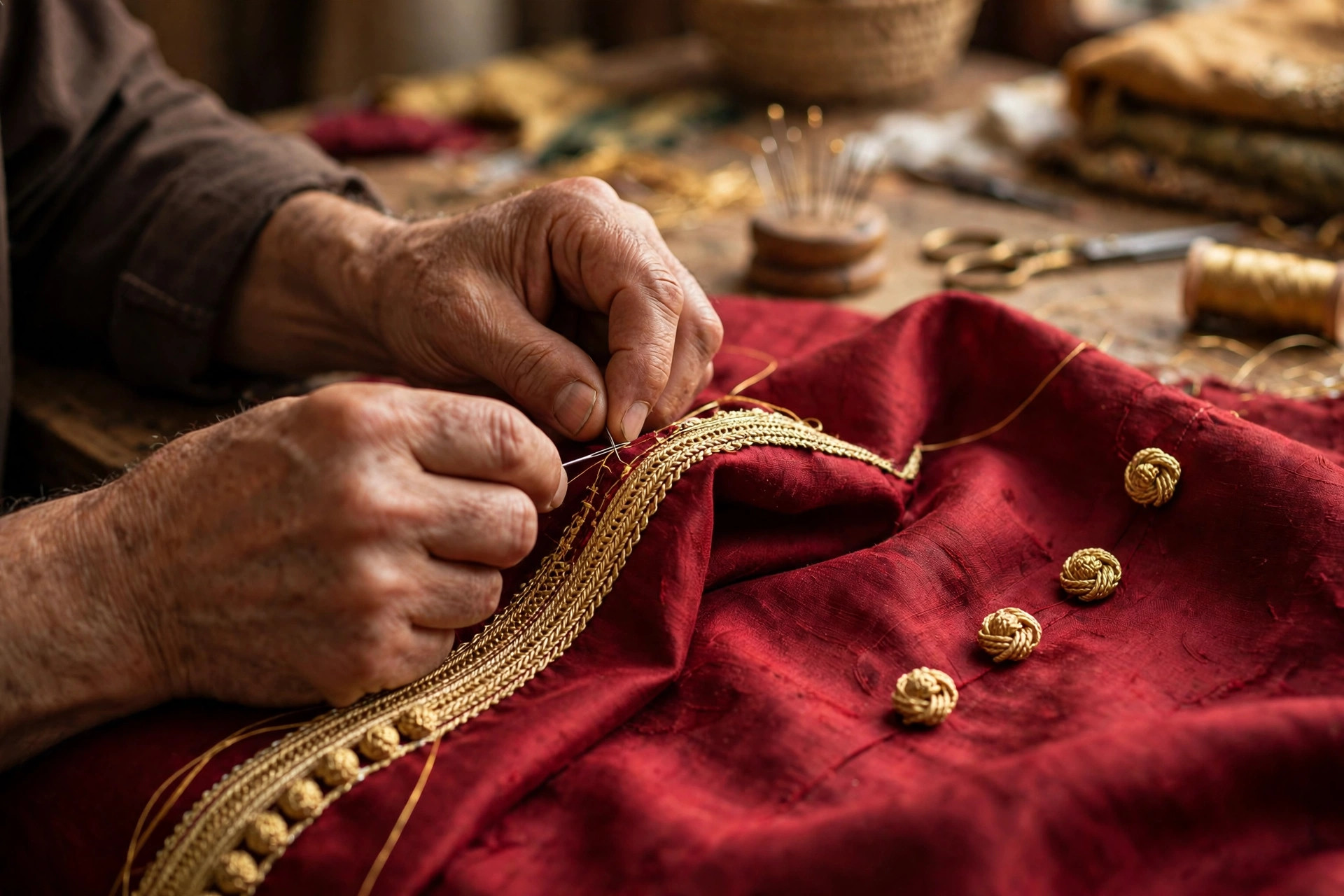
The third detail is the embroidery, tarz. Tarz fassi from Fes is counted-thread geometric work; tarz rbati from Rabat uses bolder floral designs. The history of Moroccan caftan lives in these three crafts, and in the maâlems who practise them: a plain-looking caftan with fine sfifa and neat aakad will always outlast a gaudy one with glued-on decoration. Look closely at the trim before you look at the price.
The Maâlem's Workshop: How a Caftan Is Made
A handmade caftan passes through many hands before a wedding. Weavers make the cloth, sometimes brocade shot with gold thread; tailors cut it; specialists make the buttons, braids and embroidery. The maâlem, the master craftsman, oversees the whole chain, and the knowledge passes from master to apprentice, often within the same family, over decades.
That is why a bespoke caftan takes weeks, not days. The history of Moroccan caftan is measured in hours of handwork: six weeks is a common production time for a made-to-order silk piece, and a heavily embroidered bridal takchita can occupy a workshop for months. When you buy handmade, you pay for that chain of skill, and for a garment that can be handed down.
The History of Moroccan Caftan at Weddings
No occasion shows the caftan at its best more than a Moroccan wedding. The bride enters in a takchita, changes outfits through the night, and each entrance is announced with music and ululation. Guests wear caftans too, and the room becomes a moving display of silk, velvet and gold thread.
The caftan is also worn for Eid, naming ceremonies and coming-of-age celebrations, and the history of Moroccan caftan is inseparable from these rites: the garment marks the moments when a family dresses up to be seen by its community. A guest needs only one good caftan to be correctly dressed for almost any Moroccan celebration. Our Moroccan food guide covers the feasts that follow the ceremony.
From the Medina to the Runway: The History of Moroccan Caftan in Modern Fashion
In the twentieth century, Moroccan designers took the caftan out of the wedding hall and onto the runway. Fashion shows in Marrakech, notably the long-running Caftan events, presented the garment as couture: new cuts, lighter fabrics, shorter sleeves, and embroidery restyled for evening wear. Designers in Paris and Casablanca carried it further, onto red carpets abroad.
The modern caftan keeps the long silhouette and the sfifa, but the rest is negotiable: capes, belts, jumpsuit cuts, chiffon and velvet. The history of Moroccan caftan on the runway is a story of adaptation, not abandonment — the craft stays, while the shape changes to fit the moment. Young Moroccan women now wear caftans reworked as evening dresses, and the garment has become a fashion export as well as a tradition.
The UNESCO Story: Objection, Inscription and a Contested Heritage
The most argued-over chapter in recent years concerns UNESCO. In December 2024 Algeria submitted a file on festive women's attire of eastern Algeria that included an image of a Moroccan-style caftan; Morocco filed a formal objection, and the UNESCO committee ordered the image removed — an unusual decision that the two sides describe very differently. The history of Moroccan caftan therefore includes a contested heritage dispute, and the competing claims remain politically charged.
Morocco then submitted its own nomination, "Art, tradition and savoir-faire of the Moroccan caftan," and on 10 December 2025, at its twentieth session in New Delhi, UNESCO's intergovernmental committee inscribed it on the Representative List of the Intangible Cultural Heritage of Humanity. The history of Moroccan caftan reached a new milestone that day, but inscription records a living practice, not a verdict on every claim: similar robes are worn across the region, and the origins debate continues.
Buying a Caftan: Prices, Fabrics and Where to Shop
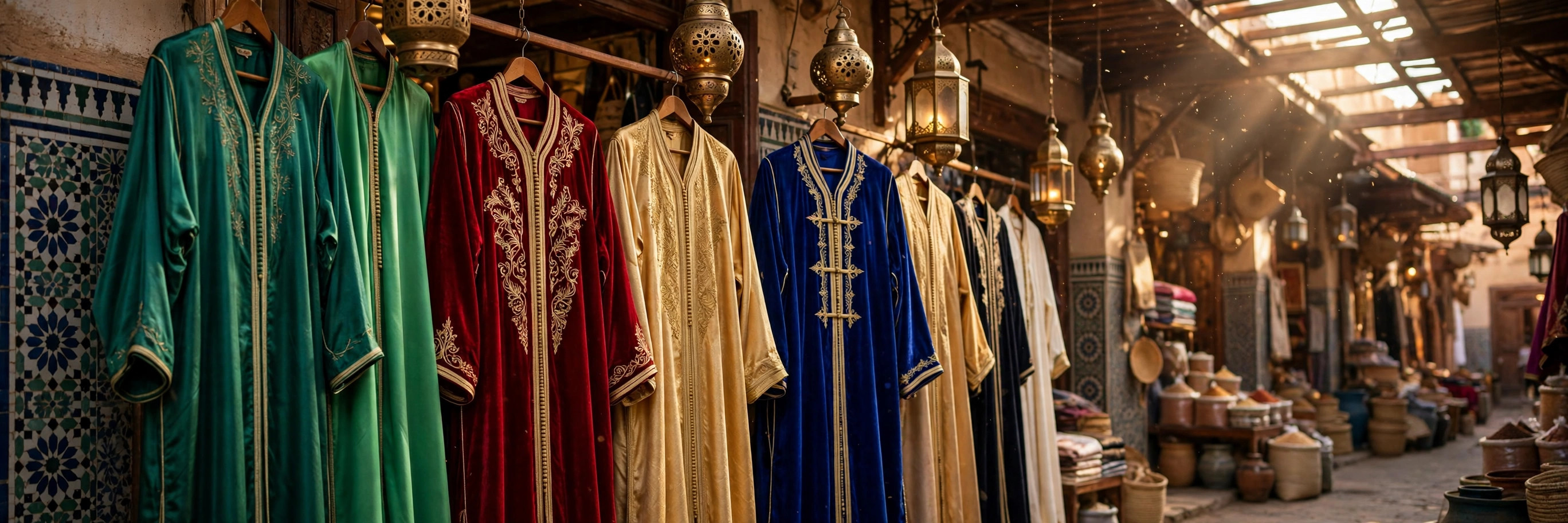
There is no single fair price for a caftan: fabric, lining, cut, decoration, labour and the designer's name all move the total. The history of Moroccan caftan is also a shopping story: the same word covers a simple cotton robe and a silk bridal takchita worth a small car. The table below gives typical ranges reported in 2026, with one US dollar at about 10 dirhams.
Start in the souks of Fes or the kissaria clothing shops of Marrakech, where you can compare styles and feel the cloth before you commit. Ask whether the embroidery is handmade, whether the silk is real, and how many fittings are included. On a longer trip, our Morocco in 19 days itinerary leaves room for a fitting and a return visit.
| Type of piece | Typical price, November 2026 |
|---|---|
| Simple ready-made caftan | 250–600 MAD (about $25–$60) |
| Boutique ready-made caftan, Marrakech | 1,700–1,800 MAD (about $170–$180) |
| Designer ready-made caftan | About 7,990 MAD (about $800) |
| Made-to-measure silk caftan, handmade | 8,000–25,000 MAD (about $800–$2,500) |
| Bridal takchita, heavily embroidered | 25,000–100,000 MAD (about $2,500–$10,000) |
| Rental, per outfit per evening | 300–1,500 MAD (about $30–$150) |
Renting, Wearing and Caring for a Caftan
Renting is more common than visitors expect, and it is the sensible choice for a one-off occasion. Dress-hire shops and the negafa rent caftans and takchitas by the evening, often as part of a bridal package that includes the jewellery; private listings also appear on classified sites; always see the piece first. Check what the fee covers — the belt, the underdress, and any alterations — before you pay.
To wear one well, keep the belt snug at the waist and let the robe fall straight; the caftan should move with you, not trail behind you. The history of Moroccan caftan continues in the care of the garment: store it hanging, out of sunlight, and have silk and velvet pieces cleaned by a specialist rather than washed at home. A well-kept caftan lasts for decades, and many families pass them from mother to daughter.
The History of Moroccan Caftan Today
Today the caftan is both a daily ceremonial dress and a national symbol. Young designers reinterpret it, grandmothers still commission it from the same tailors, and the diaspora wears it from Paris to Montreal. The history of Moroccan caftan is still being written, in ateliers and on runways, and the garment's future looks as busy as its past.
For a visitor, the best way to understand it is to see one being made, or to wear one to a celebration. The workshops of Fes, the souks of Marrakech and the salons of Casablanca tell the same story in different stitches: a robe that crossed centuries and still turns heads when it enters a room. Expats settling in Fes often buy their first caftan within weeks of arriving.
Frequently Asked Questions
What is the difference between a caftan and a takchita?
A caftan is a single dress, one layer, worn on its own. A takchita is two layers: a plain underdress called the tahtiya, and a decorated overdress called the dfina, which carries the embroidery, beading, sfifa and buttons.
When did the caftan arrive in Morocco?
The date is not settled. The best-known account places it in the late fifteenth century, with refugees from Granada settling in Fes and Tetouan; the first written record comes from the sixteenth century. Older claims, reaching back to the Almohads, are debated.
What are sfifa and aakad?
Sfifa is the braided trim, usually silk or metallic thread, stitched along the opening, neckline, sleeves and hem. Aakad are the small knotted silk buttons down the front, each made by hand and fastened into a loop.
How much does a Moroccan caftan cost?
A simple ready-made caftan costs about 250–600 dirhams (about $25–$60). Boutique pieces in Marrakech run about 1,700–1,800 dirhams, a designer piece about 7,990 dirhams, and a handmade made-to-measure silk caftan about 8,000–25,000 dirhams. A heavily embroidered bridal takchita can reach 100,000 dirhams.
Can visitors rent a caftan for a wedding?
Yes. Dress-hire shops and the negafa rent caftans and takchitas by the evening, often as part of a bridal package with jewellery. Typical rental is 300–1,500 dirhams per outfit; check whether the belt and underdress are included.
Is the caftan Moroccan?
UNESCO inscribed Morocco's nomination, "Art, tradition and savoir-faire of the Moroccan caftan," in December 2025. The garment as worn today is distinctly Moroccan, but similar robes are worn across the region and origins remain debated.
Conclusion: A Thread That Has Not Broken
Eight centuries, or five, or three — the exact age of the caftan is still argued. What is not in doubt is the craft: the weavers, the tailors, the embroiderers and the button-makers who have kept this garment alive, stitch by stitch, from the Saadian court to the runway. The history of Moroccan caftan ends, for now, where it began: in a room full of people, turning to look as the bride walks in.
So when you are invited to a Moroccan wedding, say yes, and wear a caftan if you can. Choose one that fits, in a colour you love, and let the sfifa do the talking. Some garments are clothes. This one is a history you can wear.
Last checked: November 2026. The origins of the caftan and the UNESCO dispute are contested, not settled; prices are typical ranges, with one US dollar at about 10 dirhams.
1 thought on “The History of the Moroccan Caftan: From the Saadians to the Runway”